
What Is the Difference Between Offshoring and Nearshoring?
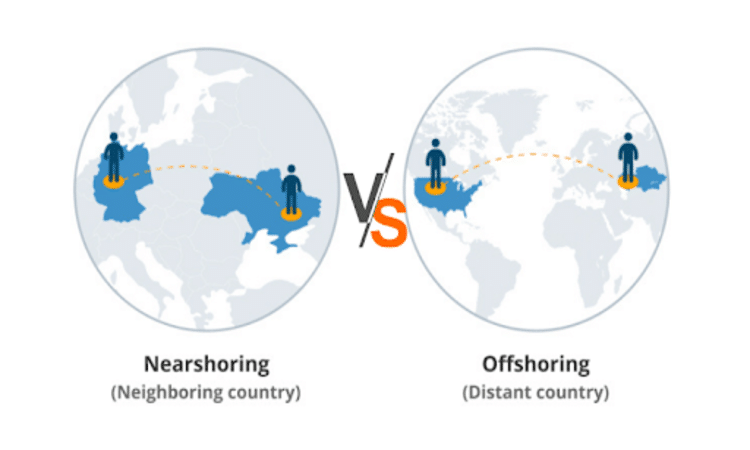
In today’s global business environment, companies often move operations beyond their home country to reduce costs, access talent, and improve efficiency. Two common strategies used for this purpose are offshoring and nearshoring. While both involve relocating business processes to another country, they differ significantly in terms of distance, cost, communication, and operational complexity.
Understanding the difference between offshoring and nearshoring is essential for businesses when deciding how to expand internationally or optimize operations.
This article explores the key differences, advantages, disadvantages, and use cases of offshoring and nearshoring.
Definitions
Offshoring
Offshoring refers to moving business operations to a distant country, often on another continent, typically to take advantage of lower labor costs.
Examples:
- A U.S. company outsourcing IT services to India
- A European company manufacturing goods in China
Nearshoring
Nearshoring involves relocating operations to a nearby country, usually within the same region or time zone.
Examples:
- A German company outsourcing services to Poland
- A U.S. company working with teams in Mexico
Key Difference
The main difference lies in geographic proximity, which affects communication, costs, and management.
1. Geographic Distance
Offshoring
- Long-distance locations
- Often different continents
Nearshoring
- Nearby countries
- Same or similar region
Impact
Distance affects travel, coordination, and cultural familiarity.
2. Time Zone Differences
Offshoring
- Large time zone gaps
- Limited overlapping work hours
Nearshoring
- Similar or identical time zones
- Easier real-time collaboration
Impact
Nearshoring improves communication speed and coordination.
3. Cost Differences
Offshoring
- Lower labor costs
- Greater cost savings
Nearshoring
- Slightly higher costs
- Still cheaper than onshore operations
Impact
Offshoring is often chosen for maximum cost reduction.
4. Communication and Collaboration
Offshoring
- Language barriers may be greater
- Communication delays more common
Nearshoring
- Easier communication
- Fewer language and cultural barriers
Impact
Nearshoring typically offers smoother collaboration.
5. Cultural Differences
Offshoring
- Larger cultural gaps
- Different work styles and practices
Nearshoring
- More similar cultures
- Shared business norms
Impact
Nearshoring reduces misunderstandings and conflict.
6. Travel and Accessibility
Offshoring
- Long travel times
- Higher travel costs
Nearshoring
- Shorter travel distances
- Easier site visits
Impact
Nearshoring allows more frequent in-person interaction.
7. Quality Control
Offshoring
- More challenging due to distance
- Requires strong management systems
Nearshoring
- Easier oversight
- Better alignment with company standards
Impact
Nearshoring often provides better control over quality.
8. Speed and Responsiveness
Offshoring
- Slower response times due to time differences
Nearshoring
- Faster communication and decision-making
Impact
Nearshoring improves agility and responsiveness.
9. Risk Levels
Offshoring
- Higher risks due to distance, legal differences, and communication gaps
Nearshoring
- Lower risks due to proximity and familiarity
Impact
Nearshoring is often considered less risky.
10. Talent Availability
Offshoring
- Access to large global talent pools
Nearshoring
- More limited talent pool compared to offshoring
Impact
Offshoring offers broader access to specialized skills.
11. Legal and Regulatory Differences
Offshoring
- Greater legal complexity
- Different regulatory environments
Nearshoring
- More similar legal systems (especially within regions)
Impact
Nearshoring simplifies compliance.
12. Supply Chain Efficiency
Offshoring
- Longer supply chains
- Higher transportation costs
Nearshoring
- Shorter supply chains
- Faster delivery times
Impact
Nearshoring improves logistics and reduces delays.
13. Flexibility and Scalability
Offshoring
- Highly scalable due to large labor markets
Nearshoring
- Moderate scalability
Impact
Offshoring is better for large-scale operations.
14. Impact on Customer Experience
Offshoring
- Potential delays in customer support
Nearshoring
- Faster response times
- Better customer interaction
Impact
Nearshoring enhances customer satisfaction.
15. Use Cases
When Companies Choose Offshoring
- Significant cost reduction is the priority
- Large-scale operations are needed
- Tasks are routine or standardized
When Companies Choose Nearshoring
- Real-time collaboration is important
- Quality and communication are priorities
- Faster turnaround is needed
16. Hybrid Approaches
Many companies use a combination of both.
Example
- Offshoring for cost efficiency
- Nearshoring for critical operations
Impact
Balanced approach optimizes benefits.
Advantages and Disadvantages Summary
Offshoring Advantages
- Lower costs
- Access to global talent
- Scalability
Offshoring Disadvantages
- Communication challenges
- Time zone issues
- Higher risk
Nearshoring Advantages
- Better communication
- Faster response times
- Lower risk
Nearshoring Disadvantages
- Higher costs than offshoring
- Smaller talent pool
Future Trends
Rise of Nearshoring
Companies are increasingly choosing closer locations.
Hybrid Models
Combining offshoring and nearshoring strategies.
Technology Integration
Improving communication and collaboration across distances.
Conclusion
Offshoring and nearshoring are both valuable strategies for global business operations, but they serve different purposes. Offshoring offers maximum cost savings and access to a large talent pool, while nearshoring provides better communication, lower risk, and faster collaboration.
The choice between the two depends on a company’s priorities, including cost, quality, speed, and operational complexity. In many cases, a hybrid approach offers the best balance, allowing companies to leverage the strengths of both strategies.
- Arts
- Business
- Computers
- Oyunlar
- Health
- Home
- Kids and Teens
- Money
- News
- Personal Development
- Recreation
- Regional
- Reference
- Science
- Shopping
- Society
- Sports
- Бизнес
- Деньги
- Дом
- Досуг
- Здоровье
- Игры
- Искусство
- Источники информации
- Компьютеры
- Личное развитие
- Наука
- Новости и СМИ
- Общество
- Покупки
- Спорт
- Страны и регионы
- World

 English
 Russian
 French
 Spanish
 Portuguese
 Deutsch
 Dutch
Dutch
 Italiano
 Arabic
 Romaian
 Portuguese (Brazil)
 Greek
Greek
