
How do I declutter my home?
How Do I Declutter My Home?
Decluttering your home is more than just tidying up—it is a systematic process of evaluating your environment, removing excess, and creating a space that supports your lifestyle. A well-executed decluttering strategy improves efficiency, reduces stress, and enhances overall quality of life. However, many people struggle because they approach decluttering without a clear framework.
This guide provides a comprehensive, structured methodology for decluttering your home effectively and sustainably. Rather than relying on motivation alone, it emphasizes repeatable systems, decision criteria, and behavioral adjustments.
Understanding Decluttering as a System
Before diving into action, it’s critical to understand that clutter is not just a physical issue—it’s a byproduct of habits, decision-making patterns, and consumption behavior.
Clutter typically accumulates due to:
-
Delayed decisions (“I’ll deal with it later”)
-
Emotional attachment to items
-
Over-purchasing or impulse buying
-
Lack of organizational systems
-
Undefined storage boundaries
Decluttering, therefore, is not a one-time purge. It is a continuous system of input control (what enters your home) and output management (what leaves it).
Step 1: Define Your Objective and Scope
Decluttering without a clear objective leads to inconsistent results. You need to establish what success looks like.
Ask yourself:
-
Why do I want to declutter?
-
What feeling do I want my home to evoke? (calm, efficient, spacious)
-
Which areas are causing the most friction?
Avoid vague goals like “I want a clean house.” Instead, define measurable outcomes:
-
“Clear all visible surfaces in the living room”
-
“Reduce wardrobe to items I actually wear weekly”
-
“Organize kitchen tools for fast access”
Start small. Attempting to declutter your entire home at once leads to burnout. Choose one defined area:
-
A drawer
-
A closet
-
A single room
This creates momentum and builds confidence.
Step 2: Use the “Category-Based” Approach
Decluttering by location can be inefficient because similar items are spread across multiple areas. Instead, group items by category.
Common categories include:
-
Clothing
-
Books
-
Papers
-
Kitchen items
-
Electronics
-
Sentimental items
By gathering all items in a category, you gain visibility into volume. This often triggers more rational decision-making.
For example, seeing all your clothes in one place makes it easier to identify redundancy and excess.
Step 3: Apply Clear Decision Criteria
One of the biggest barriers to decluttering is indecision. To eliminate this, use a consistent evaluation framework.
For each item, ask:
-
Utility – Do I use this regularly?
-
Value – Does this add meaningful value to my life?
-
Replaceability – If I needed this, could I easily replace it?
-
Frequency – Have I used this in the past 6–12 months?
If an item fails most of these criteria, it is a candidate for removal.
You can also use structured rules:
-
The 12-Month Rule: If unused for a year, consider removing it
-
The Duplicate Rule: Keep the best version, remove the rest
-
The Friction Rule: If it complicates your life, it doesn’t belong
Decisions should be decisive. Avoid “maybe” piles—they delay progress.
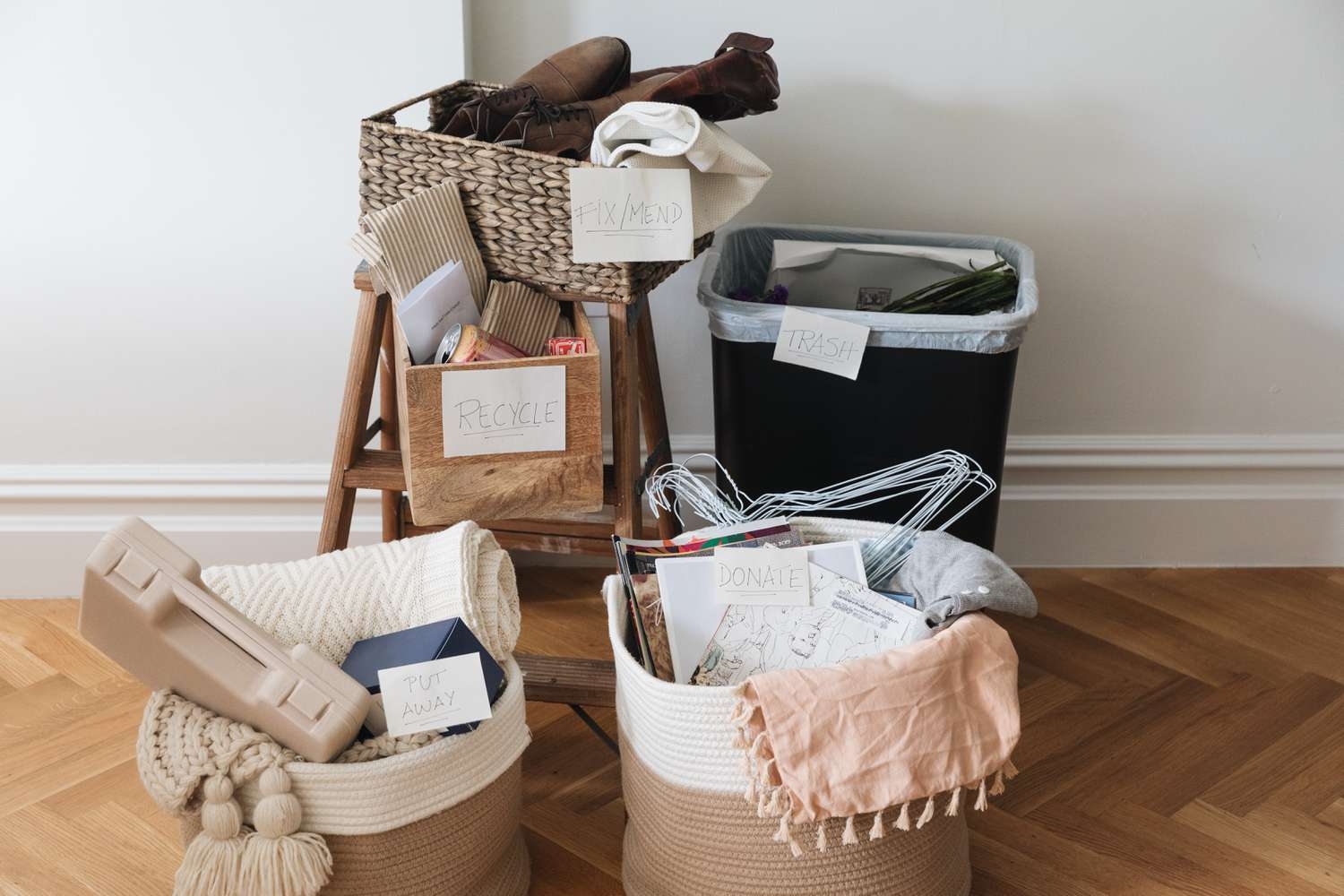
Step 4: Use the Four-Box Method
A practical execution strategy is the Four-Box Method. Label four containers:
-
Keep
-
Donate
-
Sell
-
Discard
Every item must go into one of these categories. This forces immediate decisions and prevents items from being shuffled around.
Guidelines:
-
Keep: Only items that meet your criteria
-
Donate: Functional items you no longer need
-
Sell: Items with resale value (but be realistic—don’t create backlog)
-
Discard: Broken, expired, or unusable items
Important: Remove “donate” and “discard” items from your home immediately after each session to prevent re-cluttering.
Step 5: Declutter Room by Room (Execution Strategy)
While categories are important, execution often happens spatially. Below is a systematic approach for each major area.
Living Room


Focus on visibility and function.
Steps:
-
Clear all surfaces (tables, shelves)
-
Remove unnecessary decor
-
Limit items to functional or meaningful pieces
-
Organize cables and electronics
Outcome: A space optimized for relaxation and social interaction.
Kitchen


Kitchens accumulate clutter quickly due to frequent use.
Steps:
-
Empty cabinets and drawers
-
Remove duplicate utensils and tools
-
Discard expired food
-
Group items by function (cooking, baking, storage)
Optimize for workflow:
-
Frequently used items should be easily accessible
-
Rarely used items should be stored away or removed
Bedroom


The bedroom should promote rest and recovery.
Steps:
-
Declutter surfaces (nightstands, dressers)
-
Reduce clothing to a functional wardrobe
-
Remove non-essential items
A clutter-free bedroom improves sleep quality and reduces mental load.
Bathroom


Bathrooms often contain expired and unused products.
Steps:
-
Dispose of expired items
-
Consolidate duplicates
-
Keep only daily-use products accessible
Simplify routines by reducing options.
Storage Areas (Closets, Garage, Attic)


These areas often hide the most clutter.
Steps:
-
Remove everything and reassess
-
Eliminate “just in case” items unless truly necessary
-
Use labeled storage systems
If you forgot you owned something, it likely isn’t essential.
Step 6: Address Sentimental Items Strategically
Sentimental items are the most difficult category.
Key principles:
-
Keep the most meaningful items, not everything
-
Digitize where possible (photos, documents)
-
Separate memory from object
Ask:
-
Does this item represent a unique memory?
-
Do I need the physical object to preserve that memory?
Limit sentimental storage to a defined space (e.g., one box). Constraints force prioritization.
Step 7: Optimize Storage Systems
Decluttering without proper storage leads to relapse.
Effective storage systems:
-
Assign a fixed place for every item
-
Use containers, dividers, and labels
-
Store items based on frequency of use
Rules:
-
If something doesn’t have a designated place, it becomes clutter
-
Storage should support retrieval, not just concealment
Avoid over-organizing with excessive containers—simplicity is key.
Step 8: Control Incoming Items
Decluttering fails if inflow is not managed.
Adopt these controls:
-
Delay purchases (24–48 hour rule)
-
Avoid impulse buying
-
Evaluate necessity before acquiring new items
You can also implement:
-
One-in, one-out rule: For every new item, remove one
This maintains equilibrium and prevents accumulation.
Step 9: Build Maintenance Habits
Decluttering is sustainable only with consistent habits.
Daily:
-
Reset surfaces (5–10 minutes)
-
Return items to their designated place
Weekly:
-
Review high-traffic areas
-
Remove accumulating clutter
Monthly:
-
Reassess problem areas
-
Adjust systems if needed
Consistency is more important than intensity.
Step 10: Overcome Psychological Barriers
Decluttering is often emotionally challenging.
Common barriers:
1. Fear of Waste
You may feel guilty discarding items. However, unused items are already wasted space and energy.
2. “I Might Need This”
This is a low-probability scenario. Prioritize present utility over hypothetical future use.
3. Sunk Cost Fallacy
Money already spent should not justify keeping an item.
4. Perfectionism
Waiting for the “perfect system” delays action. Progress matters more than perfection.
Recognizing these biases allows you to make more rational decisions.
Step 11: Use Time-Based Decluttering Techniques
If you feel overwhelmed, use time constraints:
-
10-Minute Rule: Declutter for 10 minutes daily
-
Timer Method: Set a 30-minute focused session
-
One-Area Rule: Complete one small space per session
These methods reduce resistance and build momentum.
Step 12: Track Progress and Reinforce Results
Tracking progress provides motivation and accountability.
You can:
-
Take before-and-after photos
-
Keep a log of items removed
-
Measure freed space
Visible progress reinforces behavior and encourages continuation.
Step 13: Align Decluttering with Lifestyle Design
Decluttering is not just about removing items—it’s about designing a functional lifestyle.
Ask:
-
Does my environment support my daily routines?
-
Are my spaces aligned with my priorities?
For example:
-
A remote worker needs a clean, distraction-free workspace
-
A fitness-focused individual may prioritize open space for exercise
Your home should be a tool that supports your goals.
Conclusion
Decluttering your home is a structured, multi-step process that combines decision-making frameworks, behavioral changes, and system design. It is not about achieving a perfect aesthetic, but about creating an environment that enhances your life.
To summarize the process:
-
Define clear goals and scope
-
Use category-based decluttering
-
Apply consistent decision criteria
-
Execute with structured methods like the Four-Box system
-
Address each room strategically
-
Manage emotional and psychological barriers
-
Build sustainable habits and systems
Ultimately, decluttering is about control—control over your space, your time, and your attention. When done effectively, it transforms your home into a place of clarity, efficiency, and intentional living.
The key is not to aim for perfection, but to start, iterate, and maintain.
- Arts
- Business
- Computers
- Jogos
- Health
- Início
- Kids and Teens
- Money
- News
- Personal Development
- Recreation
- Regional
- Reference
- Science
- Shopping
- Society
- Sports
- Бизнес
- Деньги
- Дом
- Досуг
- Здоровье
- Игры
- Искусство
- Источники информации
- Компьютеры
- Личное развитие
- Наука
- Новости и СМИ
- Общество
- Покупки
- Спорт
- Страны и регионы
- World

 English
 Russian
 French
 Spanish
 Deutsch
 Turkish
 Dutch
Dutch
 Italiano
 Arabic
 Romaian
 Portuguese (Brazil)
 Greek
Greek