
What is Adam Smith known for?
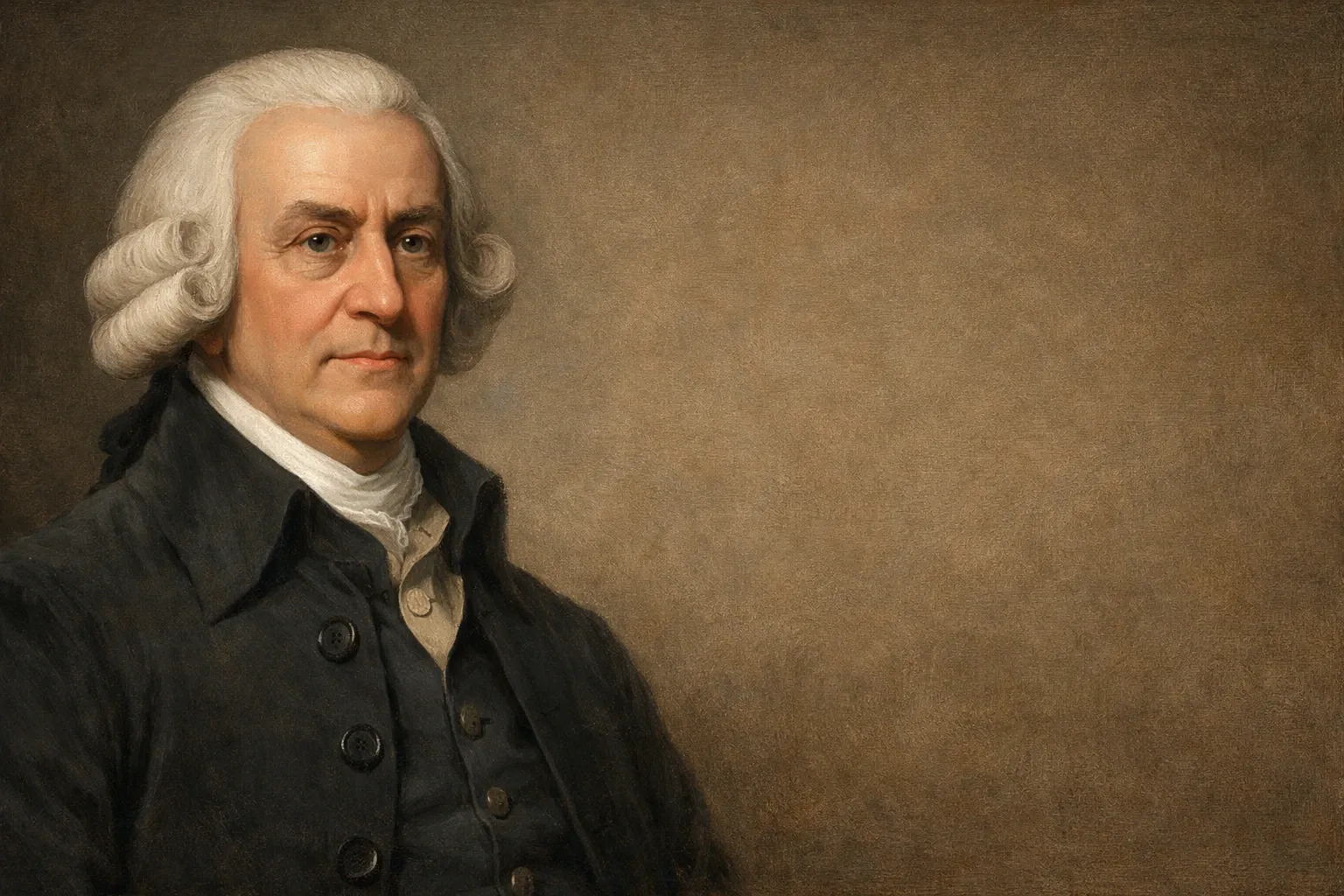
The Man Who Turned Self-Interest Into a System
It is tempting—too tempting—to reduce Adam Smith to a slogan. A single metaphor, polished by repetition: the “invisible hand.” Yet the real Smith resists compression. He was not merely an advocate of markets, nor a naïve celebrant of greed, nor even just the father of modern economics. He was something more unsettling and more enduring: a thinker who grasped that prosperity emerges from a dense web of institutions, norms, and incentives—and that these forces, once set in motion, can both liberate and corrode.
I remember the first time I read The Wealth of Nations in full. Not excerpts. Not textbook summaries. The whole thing—digressions, repetitions, moral reflections intact. What struck me was not its clarity, but its restlessness. Smith does not simply explain markets; he interrogates them. He asks not only how wealth is created, but who benefits, who loses, and under what conditions the system tilts toward justice or exploitation. That tension—between elegance and unease—is precisely what makes him indispensable.
Beyond the Invisible Hand
Smith is often introduced through shorthand: he “discovered” the invisible hand. But this phrase appears sparingly in his work and, when it does, it is embedded in a broader moral and institutional context. To isolate it is to misunderstand him.
In The Theory of Moral Sentiments, Smith constructs a theory of human behavior rooted not in cold calculation but in sympathy—the capacity to imagine ourselves in the position of others. Markets, in this view, are not detached mechanisms; they are extensions of social life. They function because individuals internalize norms, seek approval, and restrain impulses.
This is not a minor point. It reframes the entire project. Smith’s economics cannot be severed from his moral philosophy without distortion. The butcher, the brewer, and the baker do not supply our dinner out of benevolence—but neither are they unbounded maximizers. They operate within a system of expectations, reputations, and laws.
The Architecture of Wealth
If Smith is known for anything, it is his explanation of how nations grow rich. Yet even here, his insights are frequently flattened.
At the core of The Wealth of Nations lies a deceptively simple proposition: productivity depends on the division of labor. Smith’s famous pin factory example—where specialization multiplies output—has been repeated so often it risks losing its force. But its implications are profound. Specialization requires coordination. Coordination requires markets. Markets require trust, enforcement, and infrastructure.
In other words, economic growth is not spontaneous. It is scaffolded.
Smith recognized that institutions—secure property rights, impartial justice, predictable taxation—are not luxuries. They are prerequisites. Without them, specialization collapses into chaos. With them, it becomes a powerful engine of expansion.
A Comparative Snapshot of Smith’s Core Contributions
| Concept | Explanation | Modern Interpretation | Limitations Smith Acknowledged |
|---|---|---|---|
| Division of Labor | Breaking production into specialized tasks increases efficiency | Foundation of industrialization and global supply chains | Can dull workers’ minds and reduce autonomy |
| Invisible Hand | Self-interest can unintentionally benefit society | Market coordination without central planning | Works only under specific institutional conditions |
| Free Markets | Competition allocates resources efficiently | Basis of capitalist economies | Vulnerable to monopolies and collusion |
| Moral Sentiments | Human behavior shaped by empathy and social norms | Behavioral economics echoes this insight | Norms can erode or be manipulated |
| Role of Government | Provide public goods, enforce justice, regulate excesses | Mixed economies rely on this balance | Governments can be captured by elites |
The table, stripped of rhetoric, reveals a pattern: Smith’s arguments are conditional. He does not claim that markets always work. He claims they can work—if embedded in the right framework.
The Subtle Case for Government
It is here that Smith becomes most inconvenient for simplistic interpretations. He is often cast as an opponent of government. In reality, he assigns it a central role.
Smith identifies three essential duties of the state: defense, justice, and public works. The last category is especially revealing. Infrastructure—roads, bridges, education—may not be profitable for private actors but is indispensable for society. Left alone, markets will underprovide these goods.
Moreover, Smith is acutely aware of power imbalances. He warns that merchants and manufacturers, when left unchecked, conspire against the public. Monopolies, he argues, distort prices and stifle innovation. His critique of business elites is not incidental; it is woven into his analysis.
This is not the language of laissez-faire absolutism. It is the language of guarded optimism.
Smith and the Problem of Inequality
One of the more striking aspects of Smith’s work is his sensitivity to inequality. He does not treat disparities as irrelevant side effects. He sees them as potential threats to social stability and moral order.
Smith observes that extreme inequality breeds resentment and undermines cohesion. At the same time, he recognizes that some degree of inequality is inherent in a system driven by specialization and exchange. The challenge, then, is not elimination but containment.
Here, Smith anticipates debates that continue to animate modern economics. How much inequality is too much? When does concentration of wealth translate into concentration of power? And how does that power reshape the very institutions meant to regulate it?
These are not questions Smith resolves. They are questions he insists we confront.
A Personal Detour: Reading Smith in a Modern Crisis
A few years ago, during a period of economic upheaval, I returned to Smith—not out of academic obligation, but out of curiosity. Markets were faltering, institutions were strained, and the language of “self-correction” felt increasingly hollow.
What I found in Smith was not reassurance, but clarity. He does not promise stability. He does not guarantee fairness. Instead, he offers a framework for understanding why systems succeed or fail.
The lesson, if there is one, is disarmingly simple: markets are only as robust as the institutions that sustain them. When those institutions weaken—when trust erodes, when rules are bent, when power concentrates—the invisible hand falters.
It was a reminder that economics, at its core, is not about abstract models. It is about human arrangements.
The Misuse of Smith
If Smith is known for anything today, it is perhaps for being misunderstood. His ideas have been selectively invoked to justify policies he might have questioned—or even opposed.
The reduction of Smith to a caricature serves a purpose. It simplifies complex debates. It provides intellectual cover. But it comes at a cost: it obscures the conditions under which markets function effectively.
Consider the frequent invocation of “free markets” as a universal solution. Smith would likely ask: free for whom? Under what rules? With what safeguards? Without answers to these questions, the concept loses meaning.
Smith in Conversation With Modern Economics
Smith’s influence extends far beyond his own era. His ideas resonate in the work of later thinkers—from David Ricardo to John Maynard Keynes and, more recently, scholars like Daron Acemoglu.
What unites these figures is not agreement, but engagement. They grapple with Smith’s insights, refine them, challenge them, and, at times, overturn them. Yet the foundational questions remain unmistakably Smithian: How do institutions shape economic outcomes? What role should the state play? How do incentives interact with norms?
Modern economics, for all its mathematical sophistication, continues to orbit these questions.
The Enduring Paradox
Smith’s legacy is built on a paradox. He demonstrates that self-interest can generate collective prosperity—yet he also shows that unchecked self-interest can undermine it.
This duality is not a flaw. It is the essence of his argument.
Markets, in Smith’s view, are neither inherently virtuous nor inherently destructive. They are contingent systems. Their outcomes depend on the interplay of incentives, institutions, and human behavior.
To ignore this contingency is to misread him.
Why Smith Still Matters
So what is Adam Smith known for? The answer, if we resist simplification, is layered.
He is known for articulating the mechanisms of market economies. For identifying the power of specialization. For highlighting the role of self-interest in coordination. But he is also known for something less frequently acknowledged: his insistence that markets are embedded in moral and institutional frameworks.
This is what makes him enduring. Not the slogans, but the structure of his thinking.
A Conclusion That Refuses Closure
There is a tendency, in writing about foundational thinkers, to seek resolution—to extract a definitive lesson. Smith resists this impulse. His work does not culminate in a tidy doctrine. It opens a set of questions that remain unsettled.
Perhaps that is the point.
To read Smith carefully is to recognize that economic systems are fragile constructions. They require maintenance, vigilance, and, above all, humility. The invisible hand, if it exists, is not a force of nature. It is a product of human design.
And like all such designs, it can fail.
That, more than any single concept, is what Adam Smith is known for.
- Arts
- Business
- Computers
- Игры
- Health
- Главная
- Kids and Teens
- Деньги
- News
- Personal Development
- Recreation
- Regional
- Reference
- Science
- Shopping
- Society
- Sports
- Бизнес
- Деньги
- Дом
- Досуг
- Здоровье
- Игры
- Искусство
- Источники информации
- Компьютеры
- Личное развитие
- Наука
- Новости и СМИ
- Общество
- Покупки
- Спорт
- Страны и регионы
- World

 English
 French
 Spanish
 Portuguese
 Deutsch
 Turkish
 Dutch
Dutch
 Italiano
 Arabic
 Romaian
 Portuguese (Brazil)
 Greek
Greek