
How to organize desk supplies?
It wasn’t dramatic.
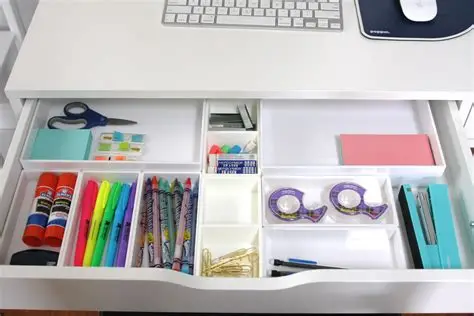
Just a slight resistance—paper clips caught on rubber bands, a pen wedged at the wrong angle, sticky notes curling into corners they didn’t belong to. The drawer didn’t jam. It hesitated.
That hesitation mattered more than it should have.
Because every time it happened, it interrupted something else. A task. A thought. A moment of momentum that didn’t quite return the same way afterward.
Desk supplies rarely announce disorder loudly. They signal it in small frictions.
And those frictions accumulate.
So the question isn’t simply how to organize desk supplies.
It’s how to remove the quiet resistance that keeps appearing where efficiency should live.
Organization Is Not Arrangement
The Visual Trap
Most attempts at organizing desk supplies begin with appearance:
- Aligning items
- Matching containers
- Creating symmetry
It looks controlled.
But appearance doesn’t guarantee usability.
The Functional Standard
True organization answers three questions:
- Can I find it immediately?
- Can I reach it without effort?
- Can I return it without thinking?
If any answer is no, the system isn’t working.
Step One: Start With Subtraction, Not Structure
The Hidden Excess
Desk supplies accumulate slowly:
- Extra pens
- Duplicate tools
- Items “just in case”
The First Move
Remove everything from your desk and drawers.
Then evaluate:
- What do I use daily?
- What do I use occasionally?
- What do I never use?
Why It Matters
Organization without reduction leads to:
- Overcrowding
- Confusion
- Inefficiency
Less creates clarity.
Step Two: Define Functional Categories
Group Before You Place
Desk supplies fall into natural categories:
- Writing tools
- Paper-related items
- Fasteners (clips, staples)
- Tech accessories
The Benefit
Grouping:
- Simplifies retrieval
- Reduces search time
- Creates logical structure
Avoid Over-Categorizing
Too many categories:
- Increase complexity
- Slow decisions
- Create unnecessary boundaries
Keep it simple.
Step Three: Assign Zones Based on Frequency
Not All Supplies Deserve Equal Access
Divide your desk into zones:
- Immediate zone (within arm’s reach)
- Secondary zone (slightly farther)
- Storage zone (drawers or shelves)
Placement Strategy
- Daily-use items: immediate zone
- Weekly-use items: secondary zone
- Rarely used items: storage zone
The Result
Movement decreases. Efficiency increases.
Step Four: Use Containers With Purpose
Not All Organizers Are Equal
Containers should:
- Fit the items they hold
- Prevent mixing of categories
- Allow easy visibility
Examples
- Pen holders for writing tools
- Small trays for clips and pins
- Drawer dividers for separation
The Mistake to Avoid
Using containers that:
- Look good but limit access
- Are too large or too small
- Encourage clutter inside them
Function comes first.
Step Five: Make Accessibility Effortless
Reach Matters More Than Placement
Even well-organized supplies fail if:
- They require multiple steps to access
- They are hidden behind other items
- They disrupt your posture
Practical Adjustments
- Keep frequently used items within a single motion
- Avoid stacking items unnecessarily
- Ensure visibility at a glance
The Outcome
Less interruption. More continuity.
A Lesson Learned: Organization Is About Behavior, Not Systems
There was a point when my desk looked organized.
Containers aligned. Categories defined. Everything had a place.
And yet, within days, disorder returned.
Not because the system failed—but because it didn’t match behavior.
I placed items where they should go, not where I naturally reached for them.
The adjustment was small:
- Moving frequently used items closer
- Reducing categories
- Simplifying placement
The system didn’t change dramatically.
But it started to hold.
The lesson was subtle: organization works only when it reflects how you actually use your space—not how you think you should.
Step Six: Control Drawer Organization
Drawers Are Hidden—but Critical
Disorganized drawers:
- Slow retrieval
- Create frustration
- Hide excess
Structure Them Clearly
Use:
- Dividers for separation
- Small containers for loose items
- Labels if necessary
Keep It Maintainable
Avoid overfilling.
A drawer should close without resistance—every time.
Step Seven: Limit Surface Items
The Desk Is Not Storage
A crowded surface:
- Reduces working space
- Increases distraction
- Slows task execution
Surface Rule
Keep only:
- Current task items
- Essential tools
- Minimal accessories
Everything Else
Belongs in drawers or designated storage.
Step Eight: Integrate Digital Tools Where Possible
Reduce Physical Dependence
Tools like:
- Google Docs
- Microsoft Excel
can replace:
- Paper notes
- Printed trackers
- Physical logs
The Benefit
Fewer physical supplies:
- Simplify organization
- Reduce clutter
- Improve accessibility
Step Nine: Maintain Through Small Actions
Organization Is Ongoing
Disorder returns through:
- Delayed decisions
- Temporary placements
- Accumulated items
Daily Habits
- Return items immediately after use
- Clear your desk at the end of the day
- Remove unnecessary items regularly
The Result
Maintenance becomes effortless.
A Comparative Breakdown: Disorganized vs. Organized Desk Supplies
| Element | Disorganized Setup | Organized Setup | Impact on Workflow |
|---|---|---|---|
| Item Placement | Random | Zone-based | Faster access |
| Categories | Undefined | Clear grouping | Reduced search time |
| Accessibility | Inconsistent | Immediate | Improved flow |
| Drawer Use | Overfilled | Structured | Less friction |
| Surface Space | Cluttered | Minimal | Better focus |
| Maintenance | Reactive | Habit-based | Sustained order |
Organization reduces effort—not just improves appearance.
Step Ten: Adjust Based on Real Usage
Your System Should Evolve
Over time:
- Usage patterns change
- Tools shift
- Priorities adjust
Observe and Refine
Notice:
- Which items you reach for most
- Which supplies remain unused
- Where friction occurs
Make Small Changes
Reposition. Remove. Simplify.
Iteration keeps the system effective.
The Subtle Skill: Reducing Micro-Decisions
Every Search Is a Decision
An unorganized desk forces you to ask:
- Where is this?
- Where should it go?
- Why isn’t it here?
Organization Eliminates Questions
A well-structured desk:
- Provides immediate answers
- Reduces hesitation
- Supports automatic action
The Impact
Fewer decisions mean more energy for meaningful work.
A Final Reflection: Organization Is Measured in Friction
It’s easy to evaluate a desk by how it looks.
Clean lines. Minimal clutter. Coordinated containers.
But appearance is not the metric that matters.
Friction is.
Which leads to a question worth asking:
When you reach for something on your desk, does the action feel immediate—or does it require adjustment, searching, or interruption?
Because the difference is small in the moment.
But repeated over hours, days, and weeks, it defines whether your workspace supports your work—or quietly slows it down, one small delay at a time.
- Arts
- Business
- Computers
- Spiele
- Health
- Startseite
- Kids and Teens
- Geld
- News
- Personal Development
- Recreation
- Regional
- Reference
- Science
- Shopping
- Society
- Sports
- Бизнес
- Деньги
- Дом
- Досуг
- Здоровье
- Игры
- Искусство
- Источники информации
- Компьютеры
- Личное развитие
- Наука
- Новости и СМИ
- Общество
- Покупки
- Спорт
- Страны и регионы
- World

 English
 Russian
 French
 Spanish
 Portuguese
 Turkish
 Dutch
Dutch
 Italiano
 Arabic
 Romaian
 Portuguese (Brazil)
 Greek
Greek