
What Is a Marketplace Business Model?
Every marketplace begins with the same awkward problem.
Nobody wants to arrive at an empty party.
Sellers refuse to join because there are no buyers. Buyers hesitate because there is nothing worth purchasing. Both sides wait for the other to move first while founders pace conference rooms pretending confidence they do not entirely feel.
This is the hidden tension underneath nearly every marketplace business ever built.
From ride-sharing platforms to freelance networks, vacation rentals to online resale ecosystems, marketplace businesses operate on a deceptively fragile premise: create enough value for two completely different groups simultaneously, then convince each side the platform would be incomplete without them.
Simple in theory.
Psychologically exhausting in practice.
I learned this firsthand years ago while advising the founder of a regional service marketplace connecting independent contractors with homeowners. The platform itself looked elegant. Investors praised the interface. Early press coverage glowed with optimism.
There was only one issue.
Homeowners visited the platform and found too few contractors.
Contractors joined and saw too few homeowners.
The founder spent months trying to solve what he called “the momentum problem.”
I told him it was not a momentum problem.
It was a liquidity problem.
Because marketplace businesses live or die based on one brutal truth:
Activity creates value. Empty platforms destroy it.
Understanding that principle explains almost everything about how marketplace business models function—and why some become extraordinarily powerful while others disappear quietly despite significant funding and impressive branding.
What Is a Marketplace Business Model?
A marketplace business model connects two or more groups—typically buyers and sellers—through a platform that facilitates transactions.
Instead of producing inventory directly, the marketplace acts as the intermediary.
The platform creates value by:
- Matching supply with demand
- Simplifying transactions
- Building trust between participants
- Managing payments or logistics
- Reducing friction
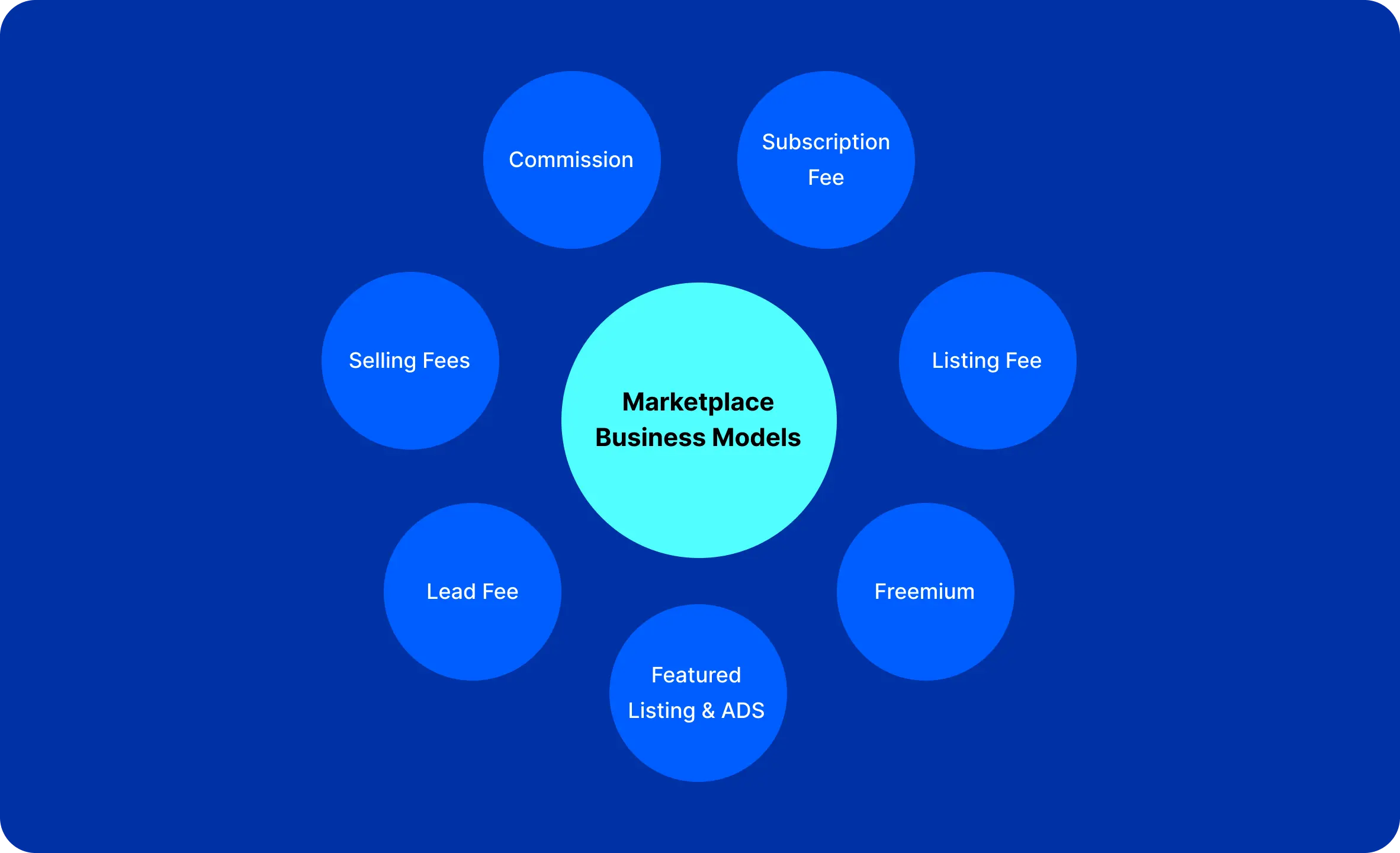
In exchange, the marketplace earns revenue through:
- Transaction fees
- Commissions
- Subscription charges
- Advertising
- Listing fees
- Premium services
The critical distinction is this:
A marketplace usually does not own the core products or services being sold.
It owns the infrastructure connecting participants.
That difference changes the economics dramatically.
Why Marketplace Models Became So Powerful
Traditional businesses often scale through inventory expansion, staffing growth, manufacturing increases, or physical infrastructure.
Marketplace businesses scale differently.
Once the platform infrastructure exists, users generate much of the value themselves.
Drivers create transportation supply.
Hosts create lodging inventory.
Freelancers create service availability.
Sellers create product catalogs.
The company facilitates rather than fully produces.
This creates operational leverage investors find deeply attractive.
Because if successful, marketplace businesses can expand rapidly without proportionally increasing operational costs.
That possibility explains why venture capital became so aggressively interested in marketplaces over the past two decades.
The Core Mechanism: Network Effects
Marketplace businesses depend heavily on network effects.
Network effects occur when the platform becomes more valuable as more users participate.
More sellers attract more buyers.
More buyers attract more sellers.
This creates a self-reinforcing loop.
Strong network effects are extraordinarily difficult for competitors to disrupt because the value of the platform compounds with scale.
A marketplace with abundant inventory and active demand becomes increasingly useful. A smaller competitor may technically offer similar functionality while lacking sufficient participant density to matter competitively.
This is why successful marketplaces often dominate categories aggressively once scale emerges.
The challenge, however, is reaching that point.
The Early-Stage Marketplace Problem Nobody Talks About Honestly
Most marketplaces initially feel empty.
Founders rarely discuss this publicly because it sounds unimpressive during fundraising meetings.
But the early stage is psychologically brutal.
A buyer arriving at a sparse marketplace loses confidence quickly.
A seller joining without customer activity becomes discouraged immediately.
The marketplace must solve both sides simultaneously while neither side wants to move first.
This problem is often called the “chicken-and-egg dilemma,” though that phrase almost understates the operational difficulty involved.
I once watched a startup spend enormous marketing budgets attracting consumers before realizing seller inventory remained too limited to satisfy demand effectively.
The result?
Customers arrived once and rarely returned.
The company had optimized traffic before optimizing liquidity.
That mistake proved expensive.
Types of Marketplace Business Models
Product Marketplaces
These platforms connect buyers and sellers of physical goods.
Examples include:
- E-commerce resale platforms
- Handmade goods marketplaces
- Wholesale exchanges
Strengths
Scalable inventory expansion without direct manufacturing ownership.
Risks
Counterfeit products, shipping complexity, quality inconsistency.
Service Marketplaces
These platforms connect customers with service providers.
Examples include:
- Freelance platforms
- Home repair services
- Ride-sharing platforms
Strengths
High flexibility and localized scaling potential.
Risks
Trust management becomes critical because service quality varies significantly.
Rental Marketplaces
These platforms facilitate temporary access rather than ownership.
Examples include:
- Vacation rentals
- Equipment rentals
- Vehicle-sharing services
Strengths
Efficient asset utilization.
Risks
Liability concerns and customer trust issues.
B2B Marketplaces
Businesses transact with other businesses through centralized platforms.
Examples include:
- Industrial supply exchanges
- Wholesale procurement systems
- SaaS integration ecosystems
Strengths
Large transaction values and recurring commercial relationships.
Risks
Long sales cycles and procurement complexity.
Comparison Table: Marketplace Models vs. Traditional Businesses
| Factor | Marketplace Model | Traditional Business Model |
|---|---|---|
| Inventory Ownership | Usually third-party owned | Company-owned |
| Scalability | Highly scalable | Operationally constrained |
| Revenue Source | Transaction fees, commissions | Direct product sales |
| Operational Complexity | Platform management | Production and logistics |
| Customer Dependency | Two-sided ecosystem | Single customer base |
| Growth Mechanism | Network effects | Sales expansion |
| Margin Potential | High after scale | Often operationally limited |
| Trust Requirement | Extremely high | Moderate |
| Early-Stage Difficulty | Very high | More predictable |
Trust Is the Real Currency of Marketplaces
Technology matters.
User experience matters.
Pricing matters.
But trust matters most.
Marketplace businesses ask strangers to transact with one another repeatedly. That introduces psychological friction immediately.
Can buyers trust sellers?
Can sellers trust buyers?
Can payments be processed safely?
Will disputes be resolved fairly?
This is why successful marketplaces invest heavily in:
- Reviews
- Ratings
- Verification systems
- Escrow mechanisms
- Refund protections
- Customer support
Without trust, liquidity collapses.
And once trust deteriorates publicly, recovery becomes remarkably difficult.
Why Marketplace Businesses Often Become Winner-Take-Most Markets
Network effects create concentration.
Once a marketplace achieves dominant participant density, competitors struggle to replicate the same level of utility.
For example:
- More buyers create better sales opportunities for sellers
- More sellers create greater selection for buyers
- Greater selection improves customer retention
- Higher retention attracts additional sellers
The cycle compounds.
This is why marketplace categories often produce a small number of dominant platforms rather than fragmented competition.
Liquidity itself becomes the moat.
The Hidden Complexity of Marketplace Incentives
Marketplace businesses must satisfy multiple audiences simultaneously.
This creates strategic tension constantly.
For example:
- Lower seller fees may improve supply growth
- Higher seller fees may improve platform profitability
- Aggressive buyer discounts may stimulate demand
- Excessive discounts may weaken long-term margins
Every decision affects both sides of the ecosystem.
I once worked with a marketplace company that reduced commission fees aggressively to attract sellers. Sellers loved it initially.
Revenue weakened sharply.
Then the company cut customer support staffing to compensate financially.
Buyers became frustrated.
Transaction volume declined.
The marketplace had optimized one side while destabilizing the other.
Successful marketplaces require equilibrium.
Not favoritism.
Why Many Marketplace Startups Fail
Because marketplaces are operationally deceptive.
At first glance, they appear elegantly scalable. Founders imagine building a platform where users generate activity organically while the company collects transaction revenue efficiently.
Reality is harsher.
Most marketplaces fail because:
- Liquidity never develops
- Trust mechanisms remain weak
- User acquisition costs become unsustainable
- Supply-demand balance deteriorates
- Retention weakens
- Margins shrink under competitive pressure
Building the platform itself is often the easiest part.
Building sustained participant behavior is far harder.
Marketplace Businesses Depend on Habit Formation
The strongest marketplaces become behavioral defaults.
Customers stop searching broadly because the marketplace becomes the assumed destination.
This behavioral dominance creates enormous strategic advantage.
People open the app instinctively.
Sellers list inventory automatically.
Service providers rely on the ecosystem financially.
At that point, the marketplace becomes infrastructure rather than merely a platform.
That transformation is extraordinarily valuable.
And extraordinarily difficult to achieve.
The Emotional Dynamics of Marketplace Businesses
Marketplace models are not purely transactional systems.
They are emotional ecosystems.
Participants experience:
- Trust
- Frustration
- Convenience
- Anxiety
- Competition
- Reputation pressure
A poorly managed review system can damage livelihoods. Weak dispute resolution can destroy buyer confidence. Excessive platform fees can create resentment among sellers.
The marketplace itself becomes a social environment as much as a commercial one.
That emotional layer is frequently underestimated by founders focused primarily on scale metrics.
The Most Important Lesson About Marketplace Models
Marketplace businesses are not inventory businesses.
They are coordination businesses.
Their true challenge is not simply attracting users.
It is creating enough repeated trust and utility that participants continue returning voluntarily.
That distinction changes everything.
Because a marketplace succeeds only when both sides of the ecosystem believe participation creates more value than leaving.
The moment either side begins feeling exploited, liquidity weakens.
And liquidity is survival.
Conclusion: Marketplace Businesses Sell Access, But They Thrive on Balance
Marketplace companies often describe themselves as technology platforms.
Technically accurate.
Strategically incomplete.
What they truly manage is balance.
Balance between buyers and sellers.
Growth and trust.
Scale and quality.
Fees and fairness.
Convenience and control.
The strongest marketplace businesses understand that their value does not come from owning products alone. It comes from orchestrating relationships efficiently enough that the ecosystem strengthens itself over time.
When that balance works, marketplaces become remarkably resilient.
When it fails, even well-funded platforms can unravel with surprising speed.
Because eventually every marketplace faces the same unforgiving question:
Does this ecosystem create enough value for everyone involved to keep participating?
The answer determines whether the platform becomes infrastructure—or just another forgotten app buried somewhere on a home screen people stopped opening months ago.
- Arts
- Business
- Computers
- Игры
- Health
- Главная
- Kids and Teens
- Деньги
- News
- Personal Development
- Recreation
- Regional
- Reference
- Science
- Shopping
- Society
- Sports
- Бизнес
- Деньги
- Дом
- Досуг
- Здоровье
- Игры
- Искусство
- Источники информации
- Компьютеры
- Личное развитие
- Наука
- Новости и СМИ
- Общество
- Покупки
- Спорт
- Страны и регионы
- World

 English
 French
 Spanish
 Portuguese
 Deutsch
 Turkish
 Dutch
Dutch
 Italiano
 Arabic
 Romaian
 Portuguese (Brazil)
 Greek
Greek