
What Is Outbound vs. Inbound Marketing? The Difference Isn’t What Most Companies Think
There’s a particular kind of silence that happens after a bad marketing meeting.
Not the productive silence. Not the “everyone is thinking deeply” silence. I mean the dead-air, eyes-on-laptops, nobody-wants-to-say-it silence that follows a sentence like:
“We just need more leads.”
A few years ago, I sat in a conference room with a SaaS company that had spent close to six figures on outbound campaigns in one quarter. Cold email sequences. Paid lists. SDR hires. LinkedIn automation. Sponsored webinars nobody attended willingly.
The pipeline looked inflated from a distance. Inside the CRM, though, it was mostly theater.
At the same time, their blog — which had been treated like a side project maintained by whichever intern could string together the phrase “top 10 trends” — was quietly generating qualified demo requests from buyers already halfway convinced.
That disconnect sits at the center of the inbound versus outbound debate.
Because despite the endless diagrams, funnels, and aggressively color-coded strategy decks, the distinction between outbound and inbound marketing is not simply push versus pull.
It’s interruption versus intention.
And companies that misunderstand that distinction usually end up overspending on attention they never really earned.
Outbound Marketing: Renting Attention at Scale
Outbound marketing is the older discipline. The louder one, too.
It operates on a simple premise: find people and place your message in front of them whether they asked for it or not.
Sometimes that works brilliantly.
Sometimes it resembles yelling through a megaphone in a parking garage.
Traditional outbound channels include:
- Cold emails
- TV and radio advertising
- Trade shows
- Direct mail
- Display ads
- Telemarketing
- Sponsored placements
- Paid social campaigns
- Sales outreach
The mechanics are straightforward. You identify an audience, build a message, and distribute it aggressively enough to generate awareness or action.
At its best, outbound marketing creates momentum quickly. Product launches often rely on it. So do new categories where demand doesn’t exist yet.
But outbound has an expiration problem.
The moment you stop paying, visibility disappears.
That’s why marketers often describe outbound as “renting attention.” You borrow exposure temporarily from platforms, publishers, or sales channels. Once the spend ends, so does the reach.
And consumers have become extraordinarily efficient at filtering it out.
Banner blindness is now measurable behavior. Email filters are smarter. Ad blockers are everywhere. Younger audiences skip, mute, swipe, or scroll with almost athletic precision.
The modern consumer’s relationship with interruption is increasingly hostile.
Which means outbound marketing now requires sharper targeting, better timing, and substantially more creativity than it did a decade ago.
Inbound Marketing: Earning Attention Before You Need It
Inbound marketing works differently.
Instead of chasing prospects, it positions a company where prospects are already searching.
The customer initiates contact — often through search engines, newsletters, podcasts, YouTube, communities, or educational content.
The philosophy sounds almost suspiciously soft until you see the economics.
A well-ranked article can generate leads for years. A useful webinar recording continues collecting views long after the live event dies. A genuinely insightful newsletter becomes a distribution channel companies own outright.
Inbound marketing includes:
- SEO
- Blogs and editorial content
- Podcasts
- Organic social media
- Video content
- Email newsletters
- Downloadable guides
- Webinars
- Community building
- Thought leadership
What makes inbound powerful isn’t merely discoverability.
It’s timing.
Outbound interrupts someone during their day.
Inbound meets someone during their research.
That difference changes everything about conversion behavior.
Someone searching “best CRM for small law firms” is already psychologically closer to a buying decision than someone passively seeing a display ad between weather updates and celebrity gossip.
Intent compresses the sales cycle.
That’s the real engine underneath inbound success.
The Biggest Misconception About Inbound Marketing
Many companies think inbound marketing means “posting content consistently.”
That’s not inbound marketing.
That’s publishing.
Inbound requires strategic alignment between audience pain points and discoverable expertise.
A shocking amount of branded content fails because it answers questions nobody important is asking.
I learned this the expensive way while helping a B2B startup overhaul its editorial strategy. Their content calendar was packed with leadership-approved topics — company updates, broad industry commentary, vague productivity advice.
Traffic remained flat for nearly eight months.
Then we stopped writing what executives found interesting and started writing what prospects typed into Google at 11:30 p.m. when their software stack broke.
Within four months:
- Organic traffic doubled
- Demo requests increased 41%
- Sales calls shortened noticeably
The content wasn’t prettier. It was simply useful.
Inbound marketing rewards usefulness with unusual consistency.
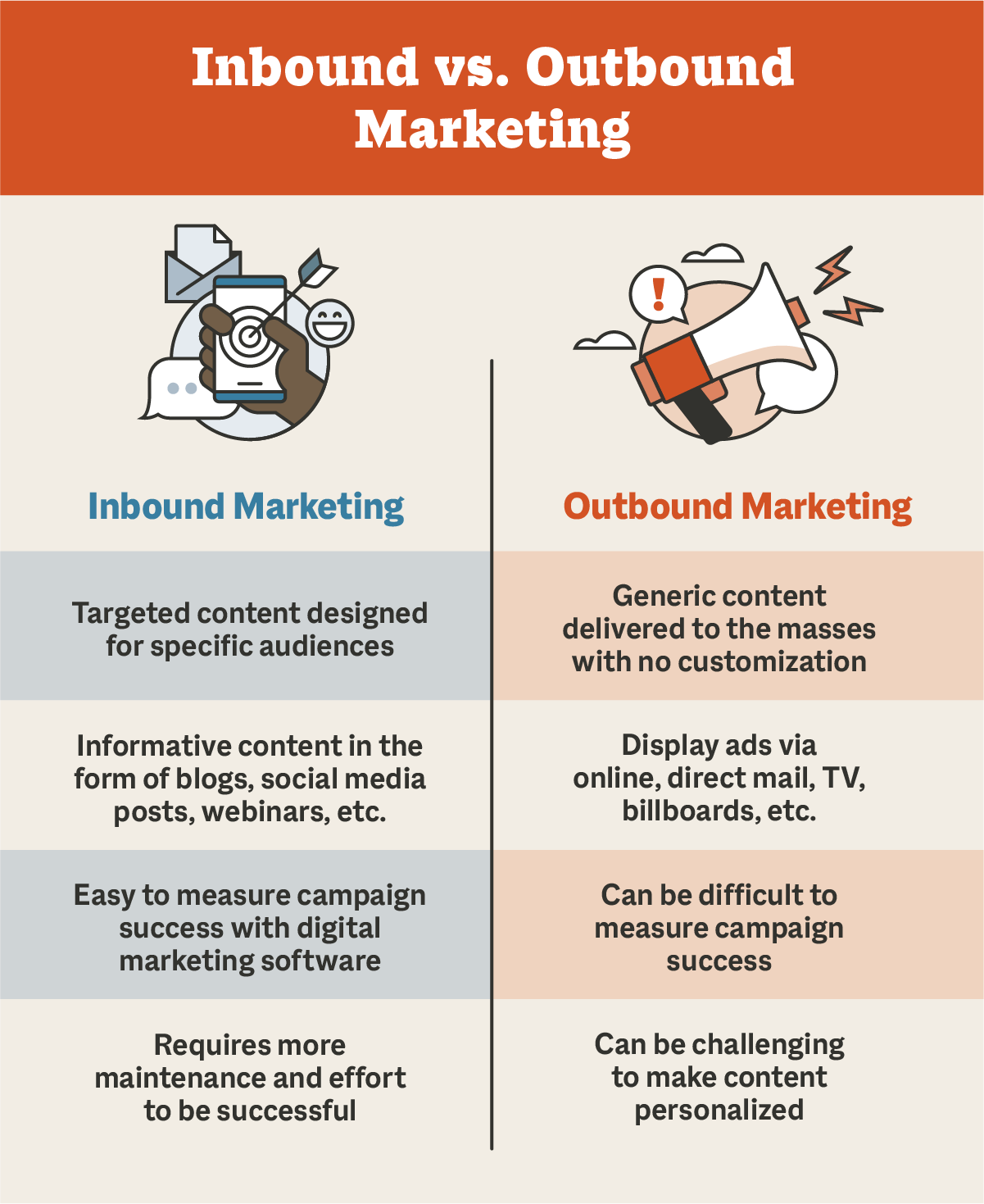
Outbound vs. Inbound Marketing: A Side-by-Side Breakdown
| Factor | Outbound Marketing | Inbound Marketing |
|---|---|---|
| Primary approach | Pushes messaging outward | Attracts audiences inward |
| Customer interaction | Interruptive | Intent-driven |
| Speed of results | Fast initial visibility | Slower build, longer payoff |
| Cost structure | Ongoing spend required | Compounding returns over time |
| Trust level | Often lower initially | Typically higher |
| Lead quality | Mixed depending on targeting | Usually more qualified |
| Scalability | Immediate but expensive | Gradual but durable |
| Core channels | Ads, cold outreach, sponsorships | SEO, content, newsletters |
| Measurement focus | Impressions, clicks, meetings booked | Engagement, conversions, retention |
| Lifespan of assets | Short-lived | Long-term value accumulation |
That table makes the divide look neat.
Real marketing departments are not neat.
Most successful companies use both.
The question is rarely which one should we choose?
The better question is: which one should carry more weight at this stage of growth?
Why Startups Lean Outbound — Even When It Hurts
Inbound marketing has a patience problem.
It takes time to build authority. Time to rank in search. Time to establish audience trust. Time to develop recognizable expertise.
Startups usually don’t have time.
So they default to outbound.
Cold outreach becomes the oxygen supply because founders need conversations immediately. Venture-backed companies, especially, optimize for acceleration over efficiency.
That creates a predictable cycle:
- Aggressive outbound spend
- Temporary pipeline growth
- Rising acquisition costs
- Audience fatigue
- Panic hiring in content marketing
Eventually leadership realizes they built a revenue engine dependent on constant fuel injections.
Inbound becomes attractive not because it’s trendy, but because it compounds.
One strong article can outperform a short-lived ad campaign over a three-year period. A trusted newsletter audience can lower acquisition costs dramatically.
The irony is that companies often discover inbound only after outbound becomes financially exhausting.
The Psychology Behind Why Inbound Converts Better
People like discovering things.
They dislike being cornered.
That sounds simplistic, but it explains much of the inbound advantage.
Inbound marketing aligns with self-directed decision-making. Consumers feel autonomous. They perceive themselves as researchers rather than targets.
Behavioral economists have studied versions of this dynamic for years. When individuals believe they arrived at a conclusion independently, resistance drops.
Outbound, by contrast, can trigger defensive filtering almost immediately:
- “Why are they contacting me?”
- “How did they get my information?”
- “What are they trying to sell?”
Inbound removes some of that friction because the relationship begins voluntarily.
That voluntary engagement creates stronger trust conditions from the outset.
And trust, more than impressions or clicks, remains the hidden variable behind most sustainable growth.
When Outbound Marketing Still Wins
Despite the cult-like devotion some marketers have toward inbound, there are situations where outbound is undeniably superior.
1. Launching Something New
If consumers don’t know a category exists, they won’t search for it.
Inbound cannot capture nonexistent demand.
Outbound creates awareness before search behavior develops.
2. Targeting Narrow Enterprise Buyers
Enterprise sales often involve highly specific stakeholders. Waiting for a CFO at a manufacturing company to discover your blog organically may not be realistic.
Direct outreach becomes necessary.
3. Speed Matters More Than Efficiency
Need leads this quarter?
Outbound can produce immediate visibility faster than organic content strategies.
It’s expensive velocity, but velocity nonetheless.
4. Retargeting Works Extremely Well
Interestingly, some of the highest-performing marketing systems blend inbound and outbound together.
A prospect discovers an article organically. Later, they see retargeted ads reinforcing the brand message.
The first interaction builds trust.
The second builds recall.
That combination can be remarkably effective.
The Best Marketing Strategies Don’t Pick Sides
The inbound-versus-outbound debate persists mostly because marketing culture enjoys binaries.
Brand versus performance.
Creative versus analytics.
Organic versus paid.
Reality is messier.
And usually more interesting.
Strong companies use outbound to accelerate attention and inbound to sustain it.
Outbound generates visibility spikes.
Inbound creates gravity.
One pulls people in quickly.
The other keeps them orbiting long enough to matter.
The strongest marketing ecosystems often look something like this:
- SEO content attracts researchers
- Newsletters nurture trust
- Paid ads amplify top-performing assets
- Sales outreach targets high-value accounts
- Webinars deepen authority
- Retargeting reinforces familiarity
No single channel carries the entire burden.
That diversification matters because audience behavior has fractured dramatically. Buyers move across platforms, devices, and formats unpredictably. The old linear funnel barely resembles actual consumer behavior anymore.
Someone might:
- Hear about a brand on a podcast
- Google the company three weeks later
- Read two comparison articles
- Ignore three emails
- Finally convert after seeing a retargeting ad
Attribution models struggle because human decision-making is chaotic.
Marketing strategies should reflect that chaos instead of pretending otherwise.
The Quiet Problem With “Performance Marketing”
There’s another wrinkle here that rarely gets discussed openly.
Many companies became addicted to measurable outbound tactics because dashboards made executives feel safe.
Clicks.
Open rates.
Cost per acquisition.
Attribution windows.
The numbers looked concrete.
Inbound, especially brand-oriented inbound, often develops more slowly and resists immediate measurement. Its influence spreads across trust, familiarity, authority, and reputation — metrics that executives claim to value but frequently underfund.
Then something strange happens.
A company pauses content investment for six months and suddenly:
- Search visibility drops
- Sales cycles lengthen
- Paid acquisition costs rise
- Brand recognition weakens
Inbound’s value becomes obvious only after it disappears.
Which is probably why mature companies increasingly treat content infrastructure as an asset rather than a campaign.
An article library is not merely “marketing material.”
It’s institutional memory with distribution attached.
Conclusion: Attention Is Expensive. Trust Is Priceless.
The conversation around outbound versus inbound marketing often collapses into tactical debates about channels, budgets, and conversion rates.
But beneath all of it sits a more uncomfortable truth:
Modern consumers are overwhelmed.
Every brand wants visibility.
Every platform wants engagement.
Every algorithm wants reaction.
Attention has become brutally expensive to acquire.
Trust, meanwhile, has become astonishingly rare.
Outbound marketing can buy visibility quickly.
Inbound marketing can earn credibility slowly.
The companies that endure understand the distinction.
Because eventually, every organization discovers the same thing: audiences can be targeted endlessly and still remain unconvinced.
But when people feel understood — when content answers the exact question they were already wrestling with — marketing stops feeling like marketing.
It starts feeling useful.
And usefulness has a longer shelf life than interruption ever will.
- Arts
- Business
- Computers
- الألعاب
- Health
- الرئيسية
- Kids and Teens
- مال
- News
- Personal Development
- Recreation
- Regional
- Reference
- Science
- Shopping
- Society
- Sports
- Бизнес
- Деньги
- Дом
- Досуг
- Здоровье
- Игры
- Искусство
- Источники информации
- Компьютеры
- Личное развитие
- Наука
- Новости и СМИ
- Общество
- Покупки
- Спорт
- Страны и регионы
- World

 English
 Russian
 French
 Spanish
 Portuguese
 Deutsch
 Turkish
 Dutch
Dutch
 Italiano
 Romaian
 Portuguese (Brazil)
 Greek
Greek
