
How to stop bad habits?
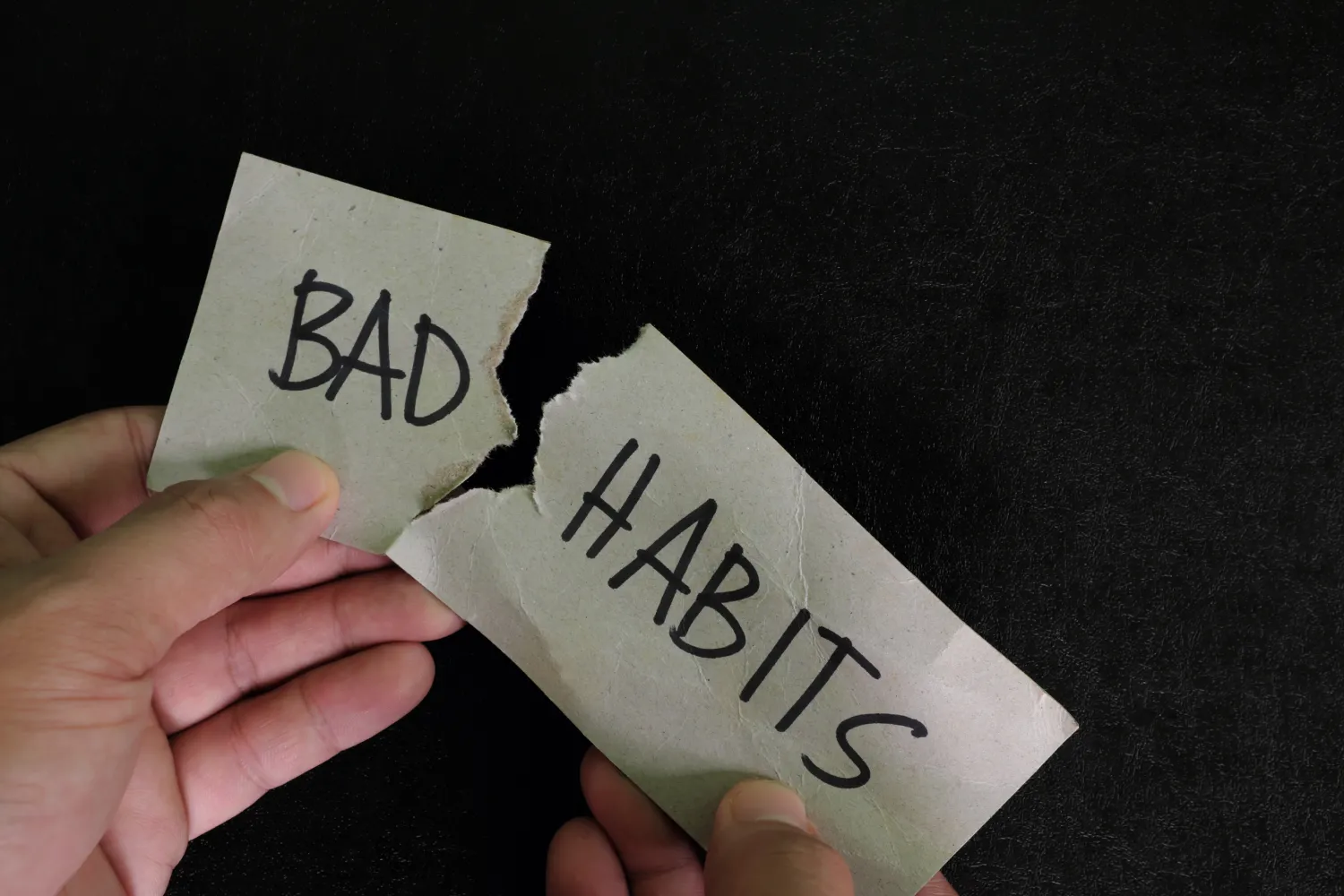
How to Stop Bad Habits?
Most people try to stop bad habits by applying pressure.
They rely on willpower, moral framing, or sudden bursts of discipline:
-
“I just need to stop doing this”
-
“I’ll force myself to quit”
-
“I’ll be more disciplined starting today”
And for a short time, it often works.
Until it doesn’t.
Because stopping a bad habit is not primarily about suppression. It is about dismantling the system that keeps reactivating it.
If a habit keeps returning, it is not because it is strong.
It is because the conditions that produce it are still intact.
The Core Principle: Habits Are Triggered Systems, Not Isolated Actions
A bad habit is not a single behavior.
It is a loop:
\text{Cue} \rightarrow \text{Craving} \rightarrow \text{Behavior} \rightarrow \text{Reward}
If you only attack the behavior, the loop remains intact.
And any intact loop will eventually restart under the right conditions.
So the real task is not “stop doing it.”
It is:
break the loop at its weakest point.
Step 1: Identify the True Trigger, Not the Story Around It
People often misidentify what causes the habit.
They say:
-
“I do it when I’m stressed”
-
“I do it when I’m bored”
-
“I just can’t resist it at night”
These are states, not triggers.
A trigger is more specific:
-
location
-
time window
-
preceding action
-
digital or physical cue
-
social context
\text{Cue} \rightarrow \text{Habit Activation}
If the cue is not clearly identified, you are trying to stop a behavior without knowing what starts it.
That is why most attempts fail.
Step 2: Increase Friction Until the Habit Becomes Inconvenient
Bad habits survive because they are easy.
They require:
-
no preparation
-
no planning
-
no delay
So one of the most reliable interventions is structural resistance.
Examples:
-
remove shortcuts
-
log out of accounts
-
store triggers out of reach
-
add steps before access
-
introduce intentional delay
\text{Higher Friction} \rightarrow \text{Lower Habit Activation Probability}
The goal is not to make the habit impossible.
It is to make it no longer automatic.
Because automaticity is what sustains it.
Step 3: Remove the Cue From the Environment
If you cannot consistently resist the habit, do not rely on resistance.
Remove the trigger.
Bad habits are often environmental:
-
visible snacks
-
phone notifications
-
apps on home screen
-
physical objects in reach
When the cue disappears, the loop weakens significantly.
This is one of the most effective but underused interventions because it feels too simple.
But simplicity is precisely why it works.
Step 4: Replace the Habit Instead of Only Removing It
If you only remove a habit, you create a behavioral vacuum.
And vacuums tend to refill.
So the system must include replacement behavior:
\text{Cue} \rightarrow \text{New Behavior} \rightarrow \text{Similar Reward}
Example:
-
stress → scrolling → relief
becomes -
stress → walk → relief
The key is not eliminating reward.
It is redirecting it.
If the reward is not replaced, the original habit will re-emerge under pressure.
Step 5: Interrupt the First Action in the Chain
Bad habits do not begin fully formed.
They begin with micro-actions:
-
opening an app
-
walking into a room
-
picking up a device
-
clicking a link
If you interrupt the first step, the entire chain collapses.
\text{Early Interruption} \rightarrow \text{Behavior Chain Collapse}
Most people try to stop the habit after it has already started.
That is the hardest moment to intervene.
Earlier is always easier.
Step 6: Add Delay Between Trigger and Action
One of the most powerful ways to weaken a habit is time separation.
Bad habits depend on immediacy:
-
impulse → action
-
cue → reaction
But if you insert delay:
-
urgency fades
-
craving weakens
-
rational control increases
Even small delays are effective.
Because impulsive behavior is time-sensitive.
If it is not immediate, it is not automatic.
Step 7: Change the Reward Structure
Every bad habit survives because it produces a reward:
-
relief
-
stimulation
-
distraction
-
comfort
If the reward remains unchanged, the behavior remains reinforced.
So stopping a habit requires one of two changes:
-
reduce reward intensity
-
replace reward source
Without this, the loop remains attractive.
And attraction eventually overrides intention.
Step 8: Design for Relapse Instead of Pretending It Won’t Happen
Most people assume stopping a habit is binary:
-
success or failure
-
quit or relapse
But behavior change is probabilistic.
There will be lapses.
So the system must include recovery:
-
immediate reset steps
-
no punishment loops
-
quick re-entry into structure
\text{Slip} \neq \text{Failure}
The difference between breaking a habit and sustaining change is not perfection.
It is recovery speed.
A Personal Observation on Stopping Habits
At one point, I tried to eliminate a habit purely through discipline.
The expectation was simple: if I resist long enough, it will disappear.
But what actually happened was cyclical:
-
suppression
-
relapse
-
frustration
-
renewed effort
Nothing stabilized.
What eventually worked was not stronger resistance, but system redesign:
-
removing cues
-
increasing friction
-
changing sequences
-
reducing exposure
Once the habit no longer appeared automatically, it stopped being a constant decision point.
It simply stopped recurring.
The Structural Model of Habit Suppression
At a systems level, stopping a habit depends on breaking at least one part of the loop:
-
cue removal
-
friction increase
-
delay insertion
-
reward replacement
-
behavioral interruption
-
environmental redesign
\text{Broken Cue or Behavior or Reward} \rightarrow \text{Habit Deactivation}
If all components remain intact, the habit persists.
If one is sufficiently disrupted, the loop weakens.
If multiple are disrupted, the habit collapses.
Conclusion: You Don’t Stop Habits by Fighting Them—You Stop Feeding Them
Bad habits are not powered by weakness.
They are powered by systems that continue to support them.
So stopping them is not about force.
It is about redesign.
The most reliable path is not:
-
trying harder
-
resisting longer
-
relying on discipline alone
But instead:
-
removing cues
-
increasing friction
-
delaying responses
-
replacing rewards
-
interrupting early actions
-
redesigning environments
Because once the loop no longer runs automatically, the habit stops being something you must constantly fight.
And eventually, it stops appearing at all.
Not because it was defeated.
But because it was no longer supported.
- Arts
- Business
- Computers
- Jogos
- Health
- Início
- Kids and Teens
- Money
- News
- Personal Development
- Recreation
- Regional
- Reference
- Science
- Shopping
- Society
- Sports
- Бизнес
- Деньги
- Дом
- Досуг
- Здоровье
- Игры
- Искусство
- Источники информации
- Компьютеры
- Личное развитие
- Наука
- Новости и СМИ
- Общество
- Покупки
- Спорт
- Страны и регионы
- World

 English
 Russian
 French
 Spanish
 Portuguese
 Deutsch
 Turkish
 Dutch
Dutch
 Italiano
 Arabic
 Romaian
 Greek
Greek
