
What is cap-and-trade?
What Is Cap-and-Trade?
There is a moment that arrives in certain industrial cities just before dawn when the air becomes visible. Not fog. Not weather. A chemistry of exhaust, sulfur, nitrates, carbon, and microscopic particulates suspended low enough to taste. I remember standing near the ship channel outside Houston years ago while a refinery exhaled steam against a bruised sky. A worker beside me pointed toward the flare stacks and said, almost casually, “That smoke has a price now.”
He meant cap-and-trade.
Not morality. Not environmental awakening. Price.
That distinction matters.
For decades, pollution occupied a peculiar category in economics: a cost without an invoice. Rivers absorbed waste freely. Atmospheres became open sewers with no landlord. Corporations extracted value while dispersing consequence. Economists politely labeled this an “externality,” as though asthma, drought, coral bleaching, and disappearing glaciers were clerical oversights.
Cap-and-trade emerged from a deceptively simple insight: if pollution carries economic value, then pollution reduction can become economically irresistible.
And therein lies the strange elegance of the system. It does not ask industries to become virtuous. It rearranges incentives so that reducing emissions becomes financially intelligent.
The distinction is the entire architecture.
The Core Idea: A Market for Pollution
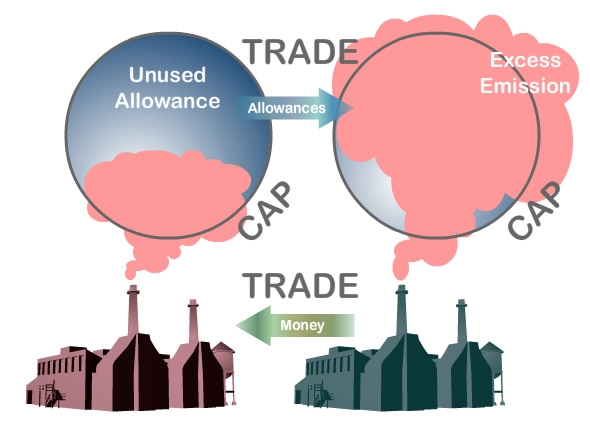
Cap-and-trade is a government-regulated system designed to reduce pollution by setting a strict limit — a cap — on total emissions while allowing companies to buy and sell pollution permits.
Imagine a city with ten factories.
The government determines those factories collectively may emit only 1 million tons of carbon dioxide annually. It then creates permits — often called allowances — representing the right to emit that pollution. Each permit equals a specific quantity, perhaps one ton of carbon.
Some factories pollute heavily. Others can reduce emissions cheaply through efficiency, cleaner machinery, or renewable energy.
Instead of forcing every company to cut emissions identically, cap-and-trade creates flexibility.
A factory that reduces pollution below its limit may sell unused permits. A factory unable to cut emissions quickly must buy permits from others.
The total pollution declines because the cap declines over time.
The market decides where reductions happen most efficiently.
At its mathematical heart, the mechanism looks like this:
\text{Total Emissions} \leq \text{Cap}
Simple enough to fit on a napkin. Complicated enough to reshape entire industries.
Why Governments Invented It
Environmental regulation once operated primarily through command-and-control rules.
Governments mandated technologies. Install this scrubber. Use this fuel. Reduce sulfur by this percentage. Compliance became bureaucratic choreography.
Cap-and-trade introduced something different: decentralization.
Instead of prescribing exactly how pollution must fall, regulators specify how much pollution is permissible overall. Businesses then determine the least expensive path toward compliance.
This matters because pollution reduction costs vary wildly.
One power plant may reduce carbon emissions for $15 per ton through efficiency upgrades. Another may require $200-per-ton retrofits. Under traditional regulation, both might face identical mandates. Under cap-and-trade, the cheaper reductions occur first because companies pursue economic advantage.
Markets, imperfect as they are, excel at discovering efficiencies faster than ministries and agencies.
The irony is difficult to miss: some of the most sophisticated environmental policies on Earth rely on capitalist competition to constrain capitalism’s excesses.
How Cap-and-Trade Actually Works
Step 1: Government Sets the Cap
The cap establishes the total permissible emissions across an economy or sector.
If climate scientists determine emissions must fall 40 percent by 2035, regulators gradually tighten the cap year after year.
Scarcity enters the system deliberately.
And scarcity creates value.
Step 2: Allowances Are Distributed
Governments either:
-
Give permits away freely
-
Auction them
-
Use a hybrid model
Auctions have become increasingly common because free allocations often resemble subsidies to polluters.
When companies pay for permits, public revenue emerges — money governments can invest in clean energy, infrastructure, or household rebates.
Step 3: Trading Begins
Companies that reduce pollution efficiently accumulate surplus permits.
Those permits become assets.
Other firms purchase them to remain compliant.
Thus, emissions allowances evolve into a commodity market not unlike wheat, copper, or oil futures.
Only here, the commodity being traded is the right to pollute.
That sentence still startles me whenever I write it.
Step 4: The Cap Shrinks
Over time, governments reduce the number of available permits.
As supply tightens, permit prices typically rise.
Higher prices encourage innovation:
-
electrification
-
renewable energy
-
carbon capture
-
industrial redesign
-
efficiency improvements
The economic signal intensifies.
Pollution becomes expensive.
The Acid Rain Experiment That Changed Everything
Long before carbon markets dominated climate conferences, the United States tested cap-and-trade against sulfur dioxide pollution during the 1990s.
Acid rain had devastated forests, lakes, and ecosystems across the northeastern United States and parts of Canada. Coal-burning power plants emitted sulfur compounds that transformed into acidic precipitation hundreds of miles away.
The solution arrived through the 1990 Clean Air Act Amendments under George H. W. Bush.
Critics predicted economic disaster.
Instead, emissions fell faster and cheaper than anticipated.
Utilities innovated aggressively. Fuel switching accelerated. Technological improvements multiplied. Compliance costs landed dramatically below forecasts.
For economists and policymakers, it was a revelation: environmental regulation could harness markets rather than fight them.
That success became the intellectual ancestor of modern carbon trading systems.
Carbon Markets Around the World
Today, cap-and-trade systems operate across multiple continents.
The largest is operated by European Union through the EU Emissions Trading System (EU ETS), launched in 2005.
Meanwhile:
-
China has developed the world’s largest carbon market by emissions volume.
-
California operates a linked system with parts of Canada.
-
Regional programs exist in the northeastern United States through RGGI, the Regional Greenhouse Gas Initiative.
Each system differs in complexity, enforcement, and ambition. Yet the underlying principle remains constant: constrain total pollution and allow economic flexibility underneath the ceiling.
Cap-and-Trade vs. Carbon Tax
The two policies are often confused because both place economic pressure on pollution. Yet they approach the problem from opposite directions.
| Feature | Cap-and-Trade | Carbon Tax |
|---|---|---|
| Primary Goal | Limit total emissions | Set pollution price |
| Certainty | Emissions quantity predictable | Price predictable |
| Market Trading | Yes | No |
| Permit System | Required | Not required |
| Government Revenue | Auction dependent | Direct tax revenue |
| Price Volatility | Often fluctuates | More stable |
| Political Framing | Market-based regulation | Explicit taxation |
A carbon tax says: pollution costs $50 per ton.
Cap-and-trade says: only this much pollution may exist.
One controls price. The other controls quantity.
Economists debate these distinctions endlessly. Atmospheres do not.
The Criticisms Are Real
Cap-and-trade is not a pristine instrument. It contains vulnerabilities large enough to drive tankers through.
Over-Allocation
Governments sometimes issue too many permits under political pressure from industry.
When permits flood the market, prices collapse. Polluting remains cheap. Emissions reductions stall.
This occurred during early phases of the EU carbon market.
Speculation
Carbon markets attract traders, hedge funds, and financial intermediaries.
Some critics argue pollution markets become detached from environmental outcomes and drift toward financial speculation.
Carbon, in that sense, risks becoming another abstract asset class.
Environmental Justice Concerns
One criticism unsettles me more than most.
Cap-and-trade can reduce total emissions while allowing pollution hotspots to persist locally.
A refinery may purchase permits instead of reducing emissions onsite. Overall carbon declines nationally, yet neighboring communities continue inhaling toxins.
Climate success does not automatically equal environmental justice.
That lesson deserves emphasis.
Atmospheric carbon is globally mixed. Human lungs are not.
Why Businesses Often Support It
This surprises people.
Many corporations prefer cap-and-trade to direct regulation because it offers flexibility and predictability.
Executives dislike uncertainty more than regulation itself.
If emissions carry a stable price trajectory, companies can plan investments years ahead:
-
electrify fleets
-
redesign supply chains
-
retrofit facilities
-
deploy renewables
Markets hate ambiguity. Carbon pricing reduces ambiguity.
Some of the loudest corporate resistance today is not toward climate policy generally, but toward fragmented and inconsistent policy.
Industries can adapt to difficult rules.
They struggle more with unstable ones.
The Psychology Beneath the Policy
Cap-and-trade reveals something profound about modern civilization.
We often imagine economies and ecosystems as separate domains. One governed by finance. The other by biology.
But they are inseparable systems.
A forest is not external to an economy. A stable climate is not adjacent to commerce. Pollinators, oceans, rainfall cycles, topsoil, and atmospheric chemistry form the invisible infrastructure beneath every market transaction humans perform.
Cap-and-trade attempts — imperfectly, awkwardly, bureaucratically — to translate ecological limits into economic language.
It says:
There is no such thing as infinite disposal.
That is the real revolution.
Not the permits.
Not the exchanges.
Not the derivatives.
The acknowledgment of limits.
A Lesson I Did Not Expect
Years ago, I visited a manufacturing facility that had dramatically reduced emissions under a regional trading program. I expected executives to describe environmental responsibility in polished public-relations language.
Instead, the plant manager walked me through spreadsheets.
Efficiency gains lowered fuel costs. Emissions reductions created tradable credits. Equipment upgrades reduced maintenance downtime. Investors responded favorably.
Then he paused beside a turbine and said something unexpectedly candid:
“We stopped thinking of waste as inevitable.”
That sentence stayed with me longer than the technical explanations.
Industrial civilization has long behaved as though waste simply disappears because it leaves our field of vision. Smoke rises. Water flows downstream. Plastic drifts offshore. Carbon disperses skyward.
Out of sight masquerades as out of existence.
Cap-and-trade, at its best, interrupts that illusion.
The Provocative Question at the Center
There is an uncomfortable philosophical question embedded within all carbon markets:
Should humanity commodify the atmosphere in order to save it?
Critics argue nature should never be reduced to tradable units.
Supporters counter that markets already commodified the atmosphere implicitly by allowing unlimited pollution at zero cost.
Cap-and-trade merely corrects the accounting.
Personally, I suspect both arguments contain truth.
Carbon markets are not moral instruments. They are transitional mechanisms — scaffolding erected around an economy attempting to evolve before ecological systems destabilize beyond repair.
No permit system will restore vanished glaciers.
No auction can negotiate with physics.
No emissions exchange bargains with melting permafrost.
Yet policy matters because incentives shape behavior, and behavior shapes infrastructure, and infrastructure shapes civilization itself.
The atmosphere responds not to speeches but to molecules.
Cap-and-trade exists because governments finally recognized something ancient cultures understood intuitively: every system has carrying capacity.
Rivers.
Forests.
Grasslands.
Oceans.
Air.
Exceed those limits long enough and the bill eventually arrives.
Not metaphorically.
Literally.
- Arts
- Business
- Computers
- Games
- Health
- Home
- Kids and Teens
- Money
- News
- Personal Development
- Recreation
- Regional
- Reference
- Science
- Shopping
- Society
- Sports
- Бизнес
- Деньги
- Дом
- Досуг
- Здоровье
- Игры
- Искусство
- Источники информации
- Компьютеры
- Личное развитие
- Наука
- Новости и СМИ
- Общество
- Покупки
- Спорт
- Страны и регионы
- World

 Russian
 French
 Spanish
 Portuguese
 Deutsch
 Turkish
 Dutch
Dutch
 Italiano
 Arabic
 Romaian
 Portuguese (Brazil)
 Greek
Greek