
How do I identify my strengths and weaknesses?
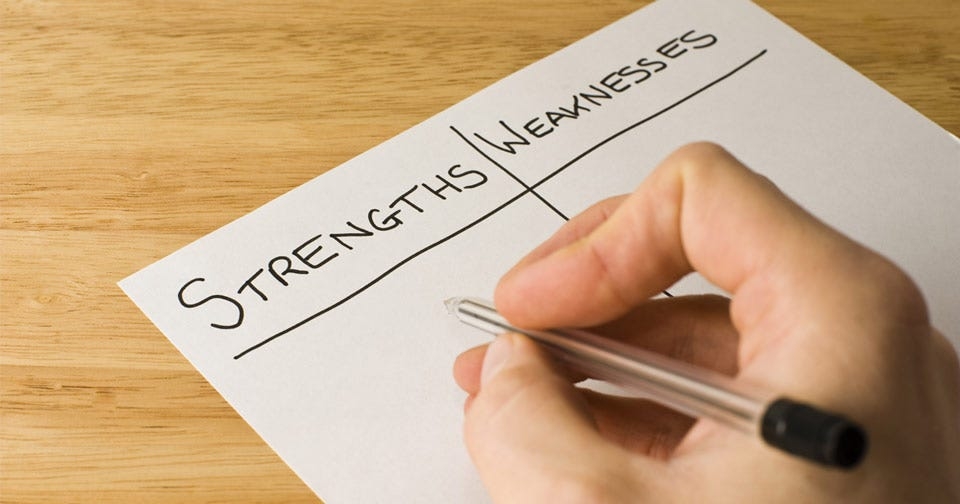
How Do I Identify My Strengths and Weaknesses?
Most people try to answer this question by thinking harder.
They sit still, reflect, maybe write a list, and hope insight appears.
But strengths and weaknesses are rarely revealed through introspection alone. They are exposed through behavior under constraint—when energy is low, stakes are real, and outcomes are visible.
In other words:
You don’t think your way into understanding yourself.
You observe your way into it.
The Core Mistake: Confusing Opinion With Evidence
When asked about strengths and weaknesses, people typically respond with internal narratives:
-
“I think I’m good at communication”
-
“I’m not very disciplined”
-
“I struggle with focus”
-
“I’m a fast learner”
These statements feel true because they are familiar.
But familiarity is not evidence.
\text{Self-Perception} \neq \text{Behavioral Evidence}
The gap between who you believe you are and how you actually behave is often where the most important insights live.
Strengths Show Up Where Effort Feels Easier Than Expected
A strength is not just something you are good at.
It is something that produces disproportionate output relative to effort.
You notice it when:
-
you progress faster than others in the same task
-
complexity feels manageable rather than overwhelming
-
you naturally sustain engagement longer
-
you recover quickly from mistakes in that domain
Strengths often feel less like effort and more like flow under structured challenge.
\text{High Output} / \text{Low Perceived Effort} = \text{Strength Signal}
This ratio matters more than isolated performance moments.
Weaknesses Show Up Where Friction Repeats Itself
Weaknesses are not simply absence of ability.
They are repeated friction points:
-
tasks you avoid
-
tasks you delay
-
tasks that drain disproportionate energy
-
tasks where you require constant external structure
Weakness is often less about failure and more about avoidance patterns.
If something consistently requires disproportionate willpower, it is revealing a weak system-to-task fit.
\text{Repeated Resistance} = \text{Weakness Indicator}
The key signal is not performance—it is energy cost over time.
Step 1: Track Behavior, Not Identity
Most people try to identify strengths by asking:
-
“What am I good at?”
A better question is:
-
“What do I consistently do well under normal conditions?”
And even better:
-
“What do I still do well when I’m tired, distracted, or under pressure?”
Because true strengths are stable across conditions.
Start by observing:
-
what you naturally return to
-
what you complete without external pressure
-
what others rely on you for repeatedly
Patterns reveal more than isolated moments.
Step 2: Look for Energy Signals
One of the most reliable indicators of strengths and weaknesses is energy response.
After certain tasks, you feel:
-
energized
-
neutral
-
depleted
Strengths tend to:
-
produce energy stability or mild energization
-
create engagement even under effort
Weaknesses tend to:
-
drain cognitive or emotional resources quickly
-
create avoidance behavior after exposure
\text{Energy Gain or Stability} = \text{Strength Indicator}
This is not about comfort. It is about sustainability.
Step 3: Study Your Friction Patterns
Friction is one of the most honest diagnostic tools available.
Ask:
-
Where do I hesitate before starting?
-
Where do I frequently procrastinate?
-
What requires excessive preparation before I act?
High friction domains often reveal weakness—not moral failure, but structural mismatch between task demands and current capability.
And importantly, friction is consistent. It repeats.
Which makes it observable.
Step 4: Identify Where You Improve Fastest
Some areas improve slowly despite effort.
Others improve quickly with minimal input.
That difference is critical.
\text{Practice Efficiency} = \text{Rate of Improvement per Unit Effort}
Fast improvement signals:
-
strong baseline alignment
-
natural pattern recognition
-
transferable underlying capability
Slow improvement signals:
-
mismatch between approach and task
-
missing foundational skill
-
or structural disinterest (which is also important data)
Step 5: Use External Feedback Carefully
Self-perception is incomplete. External feedback helps—but it must be interpreted correctly.
Useful feedback tends to be:
-
repeated across multiple sources
-
specific rather than general
-
behavior-based rather than personality-based
Examples:
-
“You explain things clearly under pressure”
-
“You tend to miss deadlines when tasks are ambiguous”
Less useful feedback:
-
vague praise or criticism
-
isolated opinions
-
emotionally charged judgments
The goal is pattern recognition, not validation.
Step 6: Separate Skill Gaps From Strength Gaps
Not every weakness is permanent.
Some are:
-
skill deficits
-
lack of exposure
-
insufficient practice
Others are:
-
low alignment
-
low interest
-
energy mismatch
Confusing these leads to unnecessary self-judgment.
\text{Skill Gap} \neq \text{Strength Limitation}
A skill gap can often be closed.
A strength mismatch may simply require repositioning.
Step 7: Watch What You Sustain Without External Pressure
One of the clearest signals of strength is voluntary continuation.
Ask:
-
What do I keep doing without deadlines?
-
What do I return to even when no one is watching?
-
What feels self-propelling rather than externally enforced?
Sustained behavior is more diagnostic than peak performance.
Because it reveals internal alignment rather than temporary motivation.
Step 8: Compare Contexts, Not Just Tasks
Strengths are often context-dependent.
Someone may:
-
struggle in structured environments but thrive in ambiguity
-
perform poorly under time pressure but excel with depth
-
be weak in execution but strong in analysis
So instead of asking:
-
“What am I good at?”
Ask:
-
“Under what conditions do I perform best?”
Context often reveals more than category.
A Personal Observation on Strengths and Weaknesses
At one point, I assumed strengths were obvious—you either had them or you didn’t.
So I focused on improving everything equally.
The result was predictable:
-
slow progress across many areas
-
unclear direction
-
constant comparison to others
What changed things was shifting from identity-based thinking to behavior-based observation.
I started noticing:
-
which tasks felt natural to begin
-
which problems I returned to repeatedly
-
which types of thinking felt sustainable over time
And slowly, patterns emerged that were not visible through reflection alone.
Strengths were not traits I discovered.
They were behaviors I could repeatedly observe under real conditions.
The Structural Formula for Identifying Strengths and Weaknesses
At a systems level, clarity comes from:
-
behavioral observation
-
energy tracking
-
friction analysis
-
improvement rate comparison
-
feedback synthesis
-
context evaluation
-
repetition patterns
\text{Repeated Behavior} + \text{Energy Signals} + \text{Friction Patterns} = \text{Strength and Weakness Identification}
This is not a one-time insight.
It is an ongoing diagnostic process.
Conclusion: You Don’t Discover Strengths—You Detect Patterns
Identifying strengths and weaknesses is less about introspection and more about evidence collection.
Your strengths are not what you wish you were good at.
They are what consistently produces:
-
better output with less resistance
-
sustained engagement
-
faster improvement
-
stable performance under pressure
Your weaknesses are not character flaws.
They are repeated friction points that signal misalignment between task demands and current capability.
Once you shift from self-judgment to pattern recognition, the question changes:
Not “Who am I good or bad at being?”
But:
“Where does performance consistently become easier—or harder—over time?”
And that shift is where real clarity begins.
- Arts
- Business
- Computers
- Giochi
- Health
- Home
- Kids and Teens
- Money
- News
- Personal Development
- Recreation
- Regional
- Reference
- Science
- Shopping
- Society
- Sports
- Бизнес
- Деньги
- Дом
- Досуг
- Здоровье
- Игры
- Искусство
- Источники информации
- Компьютеры
- Личное развитие
- Наука
- Новости и СМИ
- Общество
- Покупки
- Спорт
- Страны и регионы
- World

 English
 Russian
 French
 Spanish
 Portuguese
 Deutsch
 Turkish
 Dutch
Dutch
 Arabic
 Romaian
 Portuguese (Brazil)
 Greek
Greek
