
How to improve social skills?
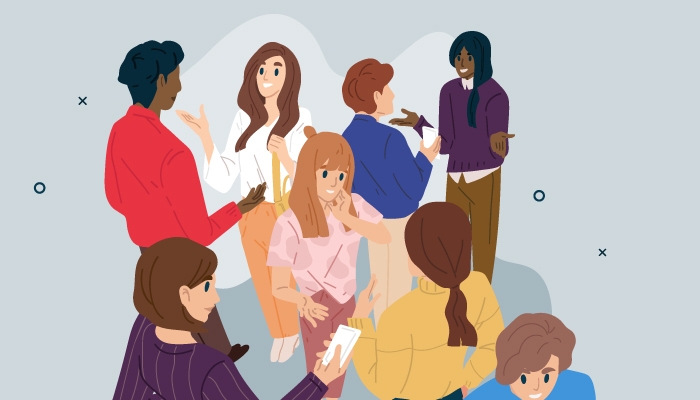
How to Improve Social Skills?
Social skills are often treated as something vague—“being outgoing,” “being likable,” or “having charisma.”
That framing is misleading.
Social skill is not a personality trait. It is a set of learnable behaviors that improve coordination between you and other people.
At its core, social skill is about one thing:
reducing friction in human interaction while increasing mutual understanding.
Once you define it that way, improvement becomes far more practical.
First Principle: Social Skill Is Feedback-Driven
You don’t become socially skilled by thinking about interaction.
You become socially skilled by repeatedly interacting and adjusting based on outcomes.
Every conversation gives feedback:
-
Did the other person engage or withdraw?
-
Did the flow feel natural or forced?
-
Did they ask questions back?
-
Did the interaction deepen or stall?
\text{Social Skill} = \text{Interaction} + \text{Feedback Loop Adjustments}
Without feedback loops, social skill does not develop—it stagnates.
Most Social Skill Problems Are Attention Problems
Many difficulties in social interaction come from where attention is placed:
Low-skill pattern:
-
self-monitoring (“Am I awkward?”)
-
performance anxiety
-
overthinking responses
Higher-skill pattern:
-
other-person focus
-
curiosity-driven listening
-
adaptive response based on cues
When attention shifts outward, behavior becomes more natural.
Listening Is the Core Social Skill
Most people think social skill is about talking well.
In reality, it is about listening well.
Effective listening includes:
-
tracking emotional tone
-
noticing what is emphasized
-
recognizing what is left unsaid
-
responding to meaning, not just words
When people feel understood, social friction drops immediately.
Ask Better Questions, Not More Questions
Questions are not just fillers in conversation. They are steering mechanisms.
Weak questions:
-
“How are you?”
-
“What do you do?”
Stronger questions:
-
“What’s been taking most of your attention lately?”
-
“What’s something you’ve been working through recently?”
-
“What part of that has been most interesting for you?”
Better questions:
-
extend depth
-
invite reflection
-
signal genuine interest
\text{Conversation Depth} \propto \text{Question Quality}
Quality drives connection more than quantity.
Reduce Self-Consciousness Through External Focus
Social discomfort often comes from internal monitoring:
-
how you sound
-
how you look
-
whether you're doing it right
This splits attention and reduces presence.
A better approach is to redirect attention to:
-
the other person’s responses
-
the content of the conversation
-
what they are trying to communicate
When focus is external, performance anxiety decreases naturally.
Learn Conversational Rhythm, Not Scripts
Social interaction is not scripted.
It follows rhythm:
-
initiation
-
response
-
expansion
-
reflection
-
transition
Most awkwardness comes from disrupting this rhythm:
-
over-talking
-
not responding enough
-
abrupt topic changes
Strong social skill is rhythmic awareness, not memorized lines.
Small Talk Is a Gateway, Not a Goal
Many people dismiss small talk.
But small talk serves a function:
-
establishing safety
-
testing responsiveness
-
creating conversational entry points
The goal is not to stay in small talk.
The goal is to use it as a bridge to deeper interaction.
\text{Connection Depth} = \text{Small Talk} \rightarrow \text{Shared Context} \rightarrow \text{Trust}
Depth is built, not jumped into.
Practice Social Exposure in Low-Stakes Environments
Social skill improves fastest when practiced frequently in low-pressure settings:
-
brief interactions with strangers
-
casual workplace conversations
-
small group discussions
-
asking simple questions in public contexts
These reduce fear while building familiarity.
Avoiding interaction preserves discomfort.
Exposure reduces it.
Learn to Notice Social Signals
Social interaction is rich with non-verbal feedback:
-
eye contact changes
-
posture shifts
-
response speed
-
tone variation
-
conversational energy
Strong social skill involves reading these signals and adjusting accordingly.
If engagement drops, adjust:
-
topic
-
pacing
-
question type
-
energy level
Don’t Try to Be Interesting—Try to Be Interested
A common mistake is focusing on being entertaining.
But people are more responsive to feeling understood than being impressed.
Shift the goal:
-
from “How do I sound?”
-
to “What can I understand about this person?”
Interest creates natural engagement.
Performance creates tension.
Learn to Handle Silence Without Panic
Silence is not failure.
It is processing time.
Many inexperienced conversationalists rush to fill silence, which often disrupts flow.
Comfort with silence allows:
-
better thought formation
-
more meaningful responses
-
less conversational pressure
\text{Conversational Comfort} \propto \text{Tolerance for Silence}
Silence is part of rhythm, not its breakdown.
A Personal Observation About Social Skill Development
A pattern emerges across learners:
Early-stage individuals focus on what to say.
Intermediate individuals focus on how to say it.
Advanced individuals focus on how the other person is experiencing the interaction.
This shift is critical.
Social skill moves from self-expression → to mutual regulation.
Common Social Skill Development Approaches Compared
| Approach | Short-Term Comfort | Long-Term Skill |
|---|---|---|
| Avoiding social situations | High | Low |
| Memorizing conversation scripts | Moderate | Low |
| Practicing occasional conversations | Moderate | Medium |
| Frequent low-stakes interaction | Moderate | High |
| Active listening + feedback adjustment | High | Very High |
| Focusing on self-performance | Low | Low |
| Focusing on other-person understanding | High | Very High |
\text{Social Skill Growth} = \text{Exposure} + \text{Attention Shift} + \text{Feedback Integration}
Growth is driven by interaction volume and quality of attention.
The Structural Formula for Social Skill
Social ability develops through:
-
repeated interaction
-
attention management
-
feedback interpretation
-
conversational rhythm awareness
-
curiosity-driven engagement
\text{Social Skill} = \text{Listening} + \text{Adaptation} + \text{Exposure}
Not charisma.
Not scripting.
Not performance.
Adaptation in real-time interaction.
Conclusion: Social Skill Is Coordination, Not Performance
Social skill is often misunderstood as the ability to impress others.
But in practice, it is the ability to coordinate understanding between people.
It is built through:
-
repeated interaction
-
improved listening
-
better questions
-
attention control
-
comfort with silence
-
responsiveness to feedback
And over time, something subtle happens:
Conversation stops feeling like a performance.
It becomes a process of discovery—where you are no longer trying to say the “right thing,” but instead trying to understand and respond to what is actually happening between you and another person in real time.
That shift is where social skill begins to feel natural.
- Arts
- Business
- Computers
- Spiele
- Health
- Startseite
- Kids and Teens
- Geld
- News
- Personal Development
- Recreation
- Regional
- Reference
- Science
- Shopping
- Society
- Sports
- Бизнес
- Деньги
- Дом
- Досуг
- Здоровье
- Игры
- Искусство
- Источники информации
- Компьютеры
- Личное развитие
- Наука
- Новости и СМИ
- Общество
- Покупки
- Спорт
- Страны и регионы
- World

 English
 Russian
 French
 Spanish
 Portuguese
 Turkish
 Dutch
Dutch
 Italiano
 Arabic
 Romaian
 Portuguese (Brazil)
 Greek
Greek
