
Why Is IaaS Important?
Infrastructure has a curious habit of becoming invisible when it works.
Nobody walks into an office and admires the electrical wiring. Nobody praises the plumbing after a productive meeting. Yet the moment either fails, attention snaps into focus. The same principle applies to modern IT infrastructure. For years, organizations invested heavily in servers, networking equipment, storage arrays, cooling systems, and the people required to maintain them. Most of that effort happened behind closed doors, far from customers and revenue-generating activities.
Then Infrastructure as a Service (IaaS) arrived and quietly altered the economics of computing.
What began as a practical alternative to purchasing hardware has evolved into something much larger: a strategic foundation that allows organizations to experiment faster, scale intelligently, and redirect resources toward innovation rather than maintenance.
The question is no longer whether infrastructure matters. It certainly does. The more revealing question is why IaaS has become such a critical component of modern business strategy.
Understanding IaaS Beyond the Definition
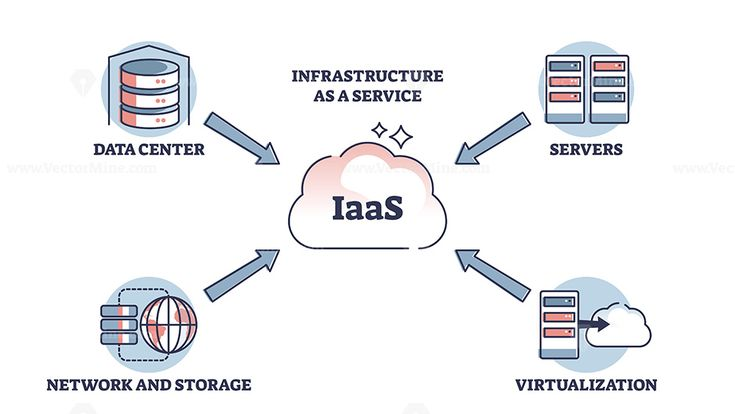
At its simplest, Infrastructure as a Service provides virtualized computing resources through the cloud. Instead of purchasing physical servers and housing them in a company-owned data center, businesses rent infrastructure from cloud providers and pay for what they use.
That definition, while technically correct, misses the point.
The real significance of IaaS lies in what it removes.
It removes lengthy procurement cycles. It removes the guesswork involved in capacity planning. It removes the uncomfortable conversation about spending six figures on hardware that may sit underutilized for years.
Organizations gain access to computing power, storage, networking, and security capabilities without becoming experts in managing physical infrastructure.
That shift sounds operational. In reality, it is strategic.
The Hidden Cost of Traditional Infrastructure
Before cloud infrastructure became mainstream, growth often carried a penalty.
A company expecting increased demand had to purchase equipment months in advance. IT teams estimated future requirements, negotiated with vendors, waited for delivery, configured systems, and hoped their forecasts were accurate.
Sometimes they were.
Frequently they were not.
I remember working with an organization that experienced a sudden surge in traffic after a successful product launch. Their internal servers had been sized for projected growth, but reality exceeded expectations. Within hours, performance deteriorated. Engineers scrambled to allocate resources while executives worried about customer experience.
The lesson was painfully simple: predicting demand is far more difficult than serving it.
That experience highlighted a fundamental weakness in traditional infrastructure models. Businesses were forced to invest based on assumptions rather than actual usage patterns.
IaaS changed that equation.
Instead of building for hypothetical demand, organizations can scale infrastructure according to real-world needs.
Agility Becomes a Competitive Advantage
Speed is often discussed as though it were a feature.
It is not.
It is a business outcome.
Companies that launch products faster, test ideas faster, and respond to market changes faster frequently outperform competitors that operate on slower timelines.
IaaS accelerates these processes by dramatically reducing infrastructure deployment times.
What once required weeks or months can often be accomplished in minutes.
A development team can provision servers for testing in the morning and decommission them before the workday ends. Data scientists can access high-performance computing resources without waiting for hardware purchases. Startups can launch globally without establishing physical data centers in multiple regions.
Infrastructure ceases to be a bottleneck.
And when bottlenecks disappear, innovation tends to follow.
Scalability Without the Financial Burden
One of the most compelling aspects of IaaS is its elasticity.
Traditional infrastructure requires organizations to prepare for peak demand. Unfortunately, peak demand may occur only a few days each year.
Imagine purchasing a fleet of vehicles large enough to accommodate holiday traffic and then leaving most of them parked for the remaining eleven months.
That is essentially how many legacy infrastructure environments operate.
IaaS introduces a different model.
Resources expand when demand increases and contract when demand falls. Businesses pay for consumption rather than maximum theoretical capacity.
This flexibility is particularly valuable for:
- E-commerce businesses during seasonal sales
- Streaming platforms during major events
- Educational institutions during enrollment periods
- Financial organizations during reporting cycles
- Startups experiencing unpredictable growth
The result is a closer alignment between operational expenses and actual business activity.
Cost Efficiency Is About More Than Saving Money
Cloud discussions often focus on cost reduction.
That emphasis is understandable but incomplete.
The most valuable benefit is not necessarily spending less. It is spending differently.
Capital expenditures become operational expenditures. Instead of committing large sums upfront, organizations distribute costs over time.
This shift improves financial flexibility and reduces risk.
A company experimenting with a new product does not need to invest heavily in infrastructure before validating market demand. If the initiative succeeds, resources scale accordingly. If it fails, infrastructure expenses decline immediately.
The financial consequences of experimentation become far less severe.
That changes decision-making behavior.
Organizations become more willing to explore new opportunities because the cost of failure decreases.
Reliability at Enterprise Scale
Reliability used to require substantial investment.
Redundant servers. Backup power systems. Disaster recovery facilities. Geographic failover capabilities.
Each layer added complexity and expense.
Major cloud providers distribute infrastructure across multiple regions and availability zones, enabling businesses to leverage resilience capabilities that would be prohibitively expensive to build independently.
This democratization of enterprise-grade reliability may be one of IaaS's most underappreciated advantages.
Small organizations gain access to infrastructure capabilities previously reserved for large enterprises.
A startup with ten employees can operate on infrastructure architectures resembling those used by multinational corporations.
That would have seemed improbable two decades ago.
Security Evolves Through Shared Responsibility
Security discussions around cloud infrastructure often become oversimplified.
Some assume cloud environments are inherently safer. Others assume they introduce greater risk.
Reality sits somewhere in between.
IaaS providers invest heavily in physical security, network protection, monitoring systems, compliance frameworks, and threat detection capabilities. At the same time, customers remain responsible for securing workloads, identities, configurations, and data.
This shared responsibility model creates opportunities for stronger security outcomes.
Organizations benefit from specialized expertise while retaining control over critical assets.
The key distinction is that businesses no longer shoulder every security burden alone.
Supporting Digital Transformation Initiatives
Digital transformation is frequently described in ambitious terms.
Yet many transformation projects stall because underlying infrastructure cannot support evolving requirements.
Modern applications demand flexibility.
Artificial intelligence workloads require significant computing resources. Analytics platforms process massive datasets. Customer-facing applications expect low latency and high availability.
IaaS provides the foundation upon which these initiatives operate.
Without scalable infrastructure, digital transformation remains largely aspirational.
With scalable infrastructure, it becomes executable.
The difference matters.
Strategy without execution is merely intent.
Comparing Traditional Infrastructure and IaaS
The contrast becomes clearer when viewed side by side.
| Factor | Traditional Infrastructure | Infrastructure as a Service (IaaS) |
|---|---|---|
| Initial Investment | High capital expenditure | Minimal upfront cost |
| Deployment Speed | Weeks or months | Minutes or hours |
| Scalability | Hardware-dependent | On-demand scaling |
| Maintenance | Internal responsibility | Provider-managed infrastructure |
| Resource Utilization | Often underused | Usage-based consumption |
| Disaster Recovery | Expensive to implement | Built-in options available |
| Geographic Reach | Limited by facilities | Global availability |
| Innovation Speed | Slower due to infrastructure constraints | Faster experimentation |
| Financial Flexibility | Fixed investments | Operational expense model |
| Business Agility | Limited adaptability | Rapid response capability |
The table reveals an important pattern.
Most IaaS advantages are not technical achievements. They are business advantages enabled by technical capabilities.
That distinction is crucial.
Why Startups and Enterprises Value IaaS Differently
Interestingly, startups and large enterprises often arrive at the same conclusion through entirely different paths.
Startups value IaaS because it eliminates barriers to entry.
They gain access to sophisticated infrastructure without major investments. Capital can be directed toward product development, marketing, and customer acquisition rather than server procurement.
Large enterprises face a different challenge.
Their concern is rarely access to infrastructure. Instead, it is complexity.
Thousands of applications, global operations, fluctuating workloads, and evolving customer expectations create pressure to modernize. IaaS offers flexibility that legacy environments often struggle to provide.
Both groups benefit.
They simply start from different problems.
The Innovation Multiplier Effect
Perhaps the most significant impact of IaaS is difficult to measure directly.
When infrastructure becomes easier to access, innovation accelerates.
Developers test more ideas. Teams launch more pilots. Organizations gather more data. Experiments occur more frequently.
Not every experiment succeeds.
That is precisely the point.
Innovation depends on the ability to fail efficiently.
IaaS lowers the cost, complexity, and risk associated with trying something new.
The cumulative effect can be profound.
Companies spend less time preparing infrastructure and more time building products, serving customers, and exploring opportunities.
The Real Reason IaaS Matters
The conversation about IaaS often centers on servers, storage, networking, and cloud architecture.
Those elements matter, but they are not the central story.
The deeper story concerns freedom.
Freedom from hardware procurement cycles. Freedom from capacity constraints. Freedom from infrastructure decisions that lock organizations into years of fixed commitments.
IaaS transforms infrastructure from a fixed asset into a flexible resource.
And that shift changes how businesses think, plan, and compete.
The organizations gaining the greatest value from IaaS are not necessarily those with the largest cloud budgets. They are the ones that recognize a fundamental truth: infrastructure should enable ambition, not limit it.
When infrastructure becomes adaptable, businesses become adaptable.
And in a marketplace defined by uncertainty, adaptability may be the most valuable asset of all.
- Arts
- Business
- Computers
- Spellen
- Health
- Home
- Kids and Teens
- Money
- News
- Personal Development
- Recreation
- Regional
- Reference
- Science
- Shopping
- Society
- Sports
- Бизнес
- Деньги
- Дом
- Досуг
- Здоровье
- Игры
- Искусство
- Источники информации
- Компьютеры
- Личное развитие
- Наука
- Новости и СМИ
- Общество
- Покупки
- Спорт
- Страны и регионы
- World

 English
 Russian
 French
 Spanish
 Portuguese
 Deutsch
 Turkish
 Italiano
 Arabic
 Romaian
 Portuguese (Brazil)
 Greek
Greek
