
How do emotions affect economic choices?
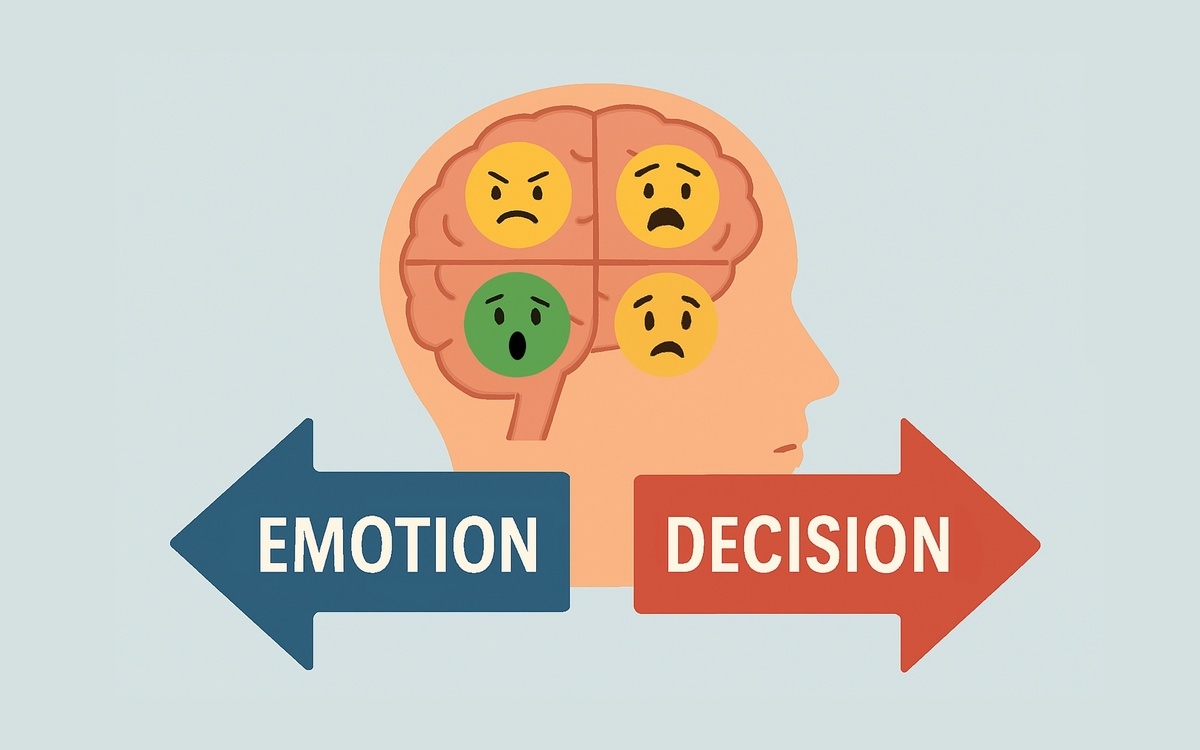
How Do Emotions Affect Economic Choices?
The Assumption That Never Quite Survived Reality
A person opens their investment app.
The portfolio is down 4%.
No urgent information has changed. No company fundamentals have shifted. No structural risk has emerged.
And yet, the finger hovers over the “sell” button.
Something else is happening—something that does not appear in spreadsheets or economic models.
A tightening in the chest. A flicker of unease. A desire to regain control.
The decision that follows is not purely analytical.
It is emotional.
For much of economic theory, emotion was treated as noise—an interference in an otherwise rational system of choice.
Behavioral economics overturned that assumption.
Not by denying reason, but by showing that emotion is not separate from economic choice.
It is embedded within it.
Emotion Is Not the Opposite of Rationality
A common misunderstanding is that rationality and emotion sit on opposite ends of a spectrum.
One is logic. The other is disturbance.
But real decision-making does not operate in that binary structure.
Emotion is not an external force disrupting calculation. It is part of the calculation itself.
When individuals evaluate economic choices, they do not process abstract numbers alone. They process meaning:
-
What will I lose?
-
What will I gain?
-
How will I feel afterward?
-
What does this decision say about me?
These are not secondary considerations.
They are central inputs.
Loss Aversion: When Pain Outweighs Gain
One of the most robust emotional findings in behavioral economics is loss aversion.
Losses feel more intense than equivalent gains.
Losing $100 is not psychologically equivalent to gaining $100.
The loss produces a stronger emotional reaction.
This asymmetry shapes behavior across domains:
-
Investors hold losing stocks too long
-
Consumers avoid selling possessions below purchase price
-
Individuals over-insure against unlikely risks
The underlying mechanism is emotional, not computational.
Loss triggers avoidance behavior.
Gain triggers satisfaction, but not to the same degree.
The result is systematically skewed decision-making.
Fear as a Financial Force
Fear is one of the most powerful drivers of economic behavior.
It accelerates decisions that would otherwise be delayed.
During market downturns, fear leads to:
-
Panic selling
-
Withdrawal from risk
-
Preference for liquidity over return
Fear does not require accurate information.
It requires perceived threat.
This is why financial crises often involve behavior that worsens the crisis itself. Emotional contagion spreads faster than rational assessment.
Fear compresses time horizons.
Future gains become irrelevant compared to immediate safety.
Greed and the Expansion of Risk
If fear contracts decision-making, greed expands it.
When individuals experience optimism or excitement, risk perception changes.
Potential gains become more salient than potential losses.
This leads to:
-
Overinvestment in rising markets
-
Speculative bubbles
-
Underestimation of downside risk
Greed is not simply desire for more money.
It is a shift in emotional weighting where anticipated reward dominates caution.
Behavioral economics shows that risk perception is not stable. It fluctuates with emotional state.
Anxiety and the Search for Control
Economic decisions often occur under uncertainty.
Uncertainty produces anxiety.
And anxiety produces behavior aimed at restoring control—even if that control is illusory.
Examples include:
-
Frequent checking of investments during volatility
-
Over-diversification beyond optimal levels
-
Avoidance of necessary but uncertain decisions
In such cases, the decision is not guided by expected value.
It is guided by emotional regulation.
People choose actions that reduce uncertainty feelings, even when those actions reduce financial outcomes.
Regret: The Emotion That Shapes Future Choices
Regret is a forward-looking emotion.
It does not only evaluate outcomes. It anticipates them.
People imagine how they will feel after making a decision—and adjust behavior to avoid future self-blame.
This leads to systematic patterns:
-
Avoiding risky but potentially beneficial investments
-
Holding onto losing positions to avoid “locking in” regret
-
Choosing familiar options over uncertain ones
Regret aversion is particularly powerful because it blends cognition and emotion.
It is not just fear of loss.
It is fear of emotional responsibility for the loss.
Emotion as a Shortcut in Complex Environments
When information is incomplete or overwhelming, emotion becomes a substitute for analysis.
This is not a failure of reasoning. It is a mechanism for managing cognitive limits.
For example:
-
A feeling of “comfort” substitutes for detailed risk analysis
-
A sense of “unease” signals potential danger without clear evidence
-
Trust replaces calculation in repeated transactions
Emotional responses compress complexity into usable signals.
Behavioral economics frames this as bounded rationality: people use simplified strategies under constraints.
Emotion is one of those strategies.
Framing Effects and Emotional Activation
The way information is presented can trigger different emotional responses—even when the underlying data is identical.
Consider:
-
“You will lose $1,000”
-
“You will keep $9,000”
Both describe the same outcome.
But the first activates loss-related emotion. The second activates gain-related emotion.
The resulting decisions differ.
Emotion mediates perception before analysis begins.
This is why framing effects are so persistent: they operate at the emotional level, not just the cognitive level.
Anticipated Emotion vs Experienced Emotion
Behavioral economics distinguishes between how people think they will feel and how they actually feel.
These often diverge.
People:
-
Overestimate future regret
-
Overestimate the emotional impact of losses
-
Misjudge satisfaction from gains
This leads to conservative decision-making.
Anticipated emotion becomes a governing force—even when it is inaccurate.
The irony is that decisions are often guided not by real emotional outcomes, but by imagined ones.
A Personal Observation on Emotional Economics
At one point, I noticed a recurring pattern in my own financial decisions.
When evaluating options abstractly, choices seemed clear.
But when real stakes were introduced, emotional signals became dominant.
A slight market drop felt disproportionately significant.
A potential gain felt less compelling than the discomfort of possible loss.
What changed was not the data.
It was the emotional proximity of the decision.
The closer the outcome felt, the more emotion shaped interpretation.
This suggests that emotional influence is not constant—it intensifies with perceived immediacy.
Why Emotional Influence Is Systematic, Not Random
A common misconception is that emotional decision-making is chaotic.
In reality, it is structured.
Behavioral economics identifies consistent patterns:
-
Losses weigh more than gains
-
Fear leads to risk avoidance
-
Greed increases risk tolerance
-
Anxiety increases control-seeking behavior
-
Regret shapes future avoidance patterns
These are not anomalies.
They are stable regularities in human behavior.
Emotion does not distort economic choice randomly.
It distorts it predictably.
Emotion as Part of Rational Systems
Modern behavioral economics does not treat emotion as an enemy of rationality.
Instead, it treats it as part of the system through which decisions are made.
Without emotion:
-
Risk cannot be evaluated meaningfully
-
Trade-offs lack significance
-
Preferences lose motivational force
Emotion assigns value to outcomes.
It makes numbers matter.
The problem arises not from emotion itself, but from mismatches between emotional response and statistical reality.
Conclusion: Economic Choices Are Felt Before They Are Calculated
Economic models often assume that decisions begin with computation.
Behavioral evidence suggests otherwise.
Decisions begin with feeling.
Then justification follows.
Emotion shapes what feels acceptable, what feels risky, and what feels urgent.
It does not replace reasoning.
It frames it.
Behavioral economics reveals that understanding economic behavior requires more than understanding incentives and information.
It requires understanding how people experience outcomes internally—before any calculation is made.
In that sense, emotion is not an interruption of economic choice.
It is one of its foundations.
- Arts
- Business
- Computers
- Jocuri
- Health
- Home
- Kids and Teens
- Money
- News
- Personal Development
- Recreation
- Regional
- Reference
- Science
- Shopping
- Society
- Sports
- Бизнес
- Деньги
- Дом
- Досуг
- Здоровье
- Игры
- Искусство
- Источники информации
- Компьютеры
- Личное развитие
- Наука
- Новости и СМИ
- Общество
- Покупки
- Спорт
- Страны и регионы
- World

 English
 Russian
 French
 Spanish
 Portuguese
 Deutsch
 Turkish
 Dutch
Dutch
 Italiano
 Arabic
 Portuguese (Brazil)
 Greek
Greek