
What is hindsight bias?
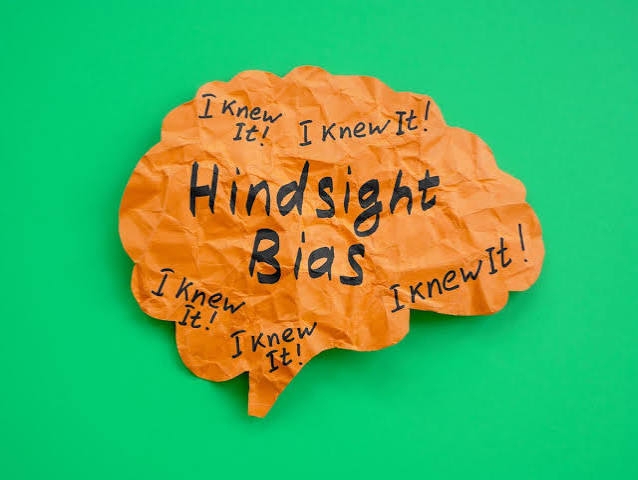
What Is Hindsight Bias?
The Illusion That the Past Was Predictable
After an election result is announced, people say they “saw it coming.”
After a stock market crash, they insist the signs were obvious.
After a relationship ends, they feel they always knew it would not last.
The event, once it occurs, seems almost inevitable.
Yet before it happened, uncertainty was real.
This is hindsight bias.
Hindsight bias is the tendency to believe, after an outcome is known, that it was predictable all along.
It is not simply memory distortion.
It is a reconstruction of the past to fit the present.
The Mind Rewrites the Story After the Outcome
Human memory is not a static record.
It is reconstructive.
When new information arrives—especially an outcome—the mind updates the narrative of what “must have been true.”
Once the result is known, earlier uncertainty fades.
Competing possibilities become harder to imagine.
The outcome feels like the only reasonable endpoint.
What was once uncertain becomes retrospectively obvious.
Why Outcomes Change Our View of the Past
Before an outcome occurs, multiple futures feel possible.
After it occurs, only one future remains in memory.
The mind then reorganizes past information around that single result.
This creates a subtle distortion:
-
Evidence that supports the outcome becomes more salient
-
Ambiguous signals are reinterpreted as warnings
-
Contradictory signals are minimized or forgotten
The past is not erased.
It is reshaped.
The “I Knew It All Along” Effect
One of the most recognizable expressions of hindsight bias is the feeling of inevitability.
After an outcome, people often say:
-
“It was obvious.”
-
“There were clear signs.”
-
“I knew this would happen.”
This feeling is powerful but misleading.
It arises because the mind substitutes current knowledge for past uncertainty.
Knowing the answer changes how the question feels.
Hindsight Bias and Prediction
Hindsight bias is especially relevant in environments involving prediction:
-
Financial markets
-
Political forecasting
-
Medical outcomes
-
Strategic planning
When predictions are evaluated after the fact, they often appear worse than they actually were.
This creates a distorted impression of foresight.
People may believe outcomes were more predictable than they truly were at the time.
The Memory Reconstruction Process
Hindsight bias involves three key cognitive steps:
1. Outcome assimilation
The known result becomes integrated into memory.
2. Selective retrieval
Supporting evidence is easier to recall than conflicting possibilities.
3. Narrative simplification
Complex uncertainty is compressed into a single coherent story.
Together, these processes transform uncertain pasts into seemingly inevitable sequences.
Why the Mind Prefers Certainty in Retrospect
Uncertainty is cognitively uncomfortable.
It requires holding multiple possibilities at once.
Once an outcome is known, the mind can simplify.
It replaces branching possibilities with a single path.
This reduces cognitive load.
But it also distorts understanding of how decisions were actually made.
A Personal Observation on Retrospective Clarity
At one point, while reviewing past decisions and their outcomes, I noticed a pattern.
Events that had felt uncertain at the time appeared far more predictable in retrospect.
I found myself identifying “signs” I had not consciously weighted before the outcome was known.
The interpretation of earlier evidence seemed to shift after the result became fixed.
What felt like insight was often reconstruction.
The Role of Narratives in Hindsight Bias
Humans are natural storytellers.
When an outcome is known, the mind seeks coherence.
It constructs a narrative that explains how the outcome came about.
In doing so, it reduces ambiguity.
But it also reduces accuracy about what was actually knowable in advance.
Narratives tend to favor simplicity over uncertainty.
How Hindsight Bias Distorts Learning
Hindsight bias can interfere with learning from experience.
If outcomes are seen as obvious after the fact, people may:
-
Overestimate their predictive ability
-
Underestimate the role of chance
-
Misjudge the quality of prior decisions
This can lead to:
-
Overconfidence in future predictions
-
Failure to recognize genuine uncertainty
-
Misinterpretation of past performance
Learning becomes distorted by the illusion of predictability.
The Difference Between Explanation and Prediction
One of the central insights behind hindsight bias is the distinction between:
-
Explaining an outcome after it occurs
-
Predicting an outcome before it occurs
Explanation is easier.
It relies on a fixed result.
Prediction must account for uncertainty.
Hindsight bias collapses this distinction.
It makes explanation feel like prediction.
Why Experts Are Not Immune
Expertise improves prediction in many domains.
But it does not eliminate hindsight bias.
Experts, like non-experts, reconstruct the past once outcomes are known.
In some cases, expertise may even strengthen the effect, because experts are better at constructing coherent explanations after the fact.
Coherence, however, is not the same as foresight.
Conclusion: The Past That Changes After It Happens
Hindsight bias reveals a subtle feature of human cognition.
The mind does not store the past as fixed and unchanging.
It updates it.
Once outcomes are known, uncertainty is reduced in memory, alternative possibilities fade, and the narrative becomes streamlined.
What remains is a version of the past that feels clearer, simpler, and more inevitable than it ever was.
The central lesson is not that people misremember details.
It is that knowing the outcome changes the structure of remembered uncertainty itself.
- Arts
- Business
- Computers
- الألعاب
- Health
- الرئيسية
- Kids and Teens
- مال
- News
- Personal Development
- Recreation
- Regional
- Reference
- Science
- Shopping
- Society
- Sports
- Бизнес
- Деньги
- Дом
- Досуг
- Здоровье
- Игры
- Искусство
- Источники информации
- Компьютеры
- Личное развитие
- Наука
- Новости и СМИ
- Общество
- Покупки
- Спорт
- Страны и регионы
- World

 English
 Russian
 French
 Spanish
 Portuguese
 Deutsch
 Turkish
 Dutch
Dutch
 Italiano
 Romaian
 Portuguese (Brazil)
 Greek
Greek