
What is anchoring bias?
What Is the Anchoring Bias?
The First Number That Quietly Organizes Thought
A person is asked whether the height of a mountain is more or less than 2,000 meters.
Then they are asked to estimate its actual height.
Even if the initial number is arbitrary, their estimate tends to cluster around it.
If the number had been 10,000 instead, their estimate would shift upward.
Nothing about the mountain has changed.
Only the starting point has.
This is anchoring bias.
Anchoring bias is the tendency for people to rely too heavily on the first piece of information they encounter when making judgments or decisions.
That initial piece of information becomes a reference point—an anchor—that shapes everything that follows.
The Mind Rarely Begins From Zero
A common assumption about thinking is that it begins from a neutral baseline.
Information arrives.
It is evaluated.
A conclusion is formed.
But in practice, the mind rarely operates this way.
It begins with whatever is presented first.
That first input becomes a cognitive anchor.
Subsequent judgments are made relative to it.
Even when the anchor is irrelevant, it still influences interpretation.
Why Anchors Are So Influential
Anchors are powerful because they arrive early in the cognitive process.
Before careful reasoning begins, the mind has already formed a reference structure.
Once that structure exists, it becomes difficult to ignore.
The mind does not discard the anchor.
It adjusts away from it.
But that adjustment is often incomplete.
As a result, final judgments remain biased toward the initial value.
Anchoring in Everyday Judgment
Anchoring bias appears across many domains of life.
Pricing Decisions
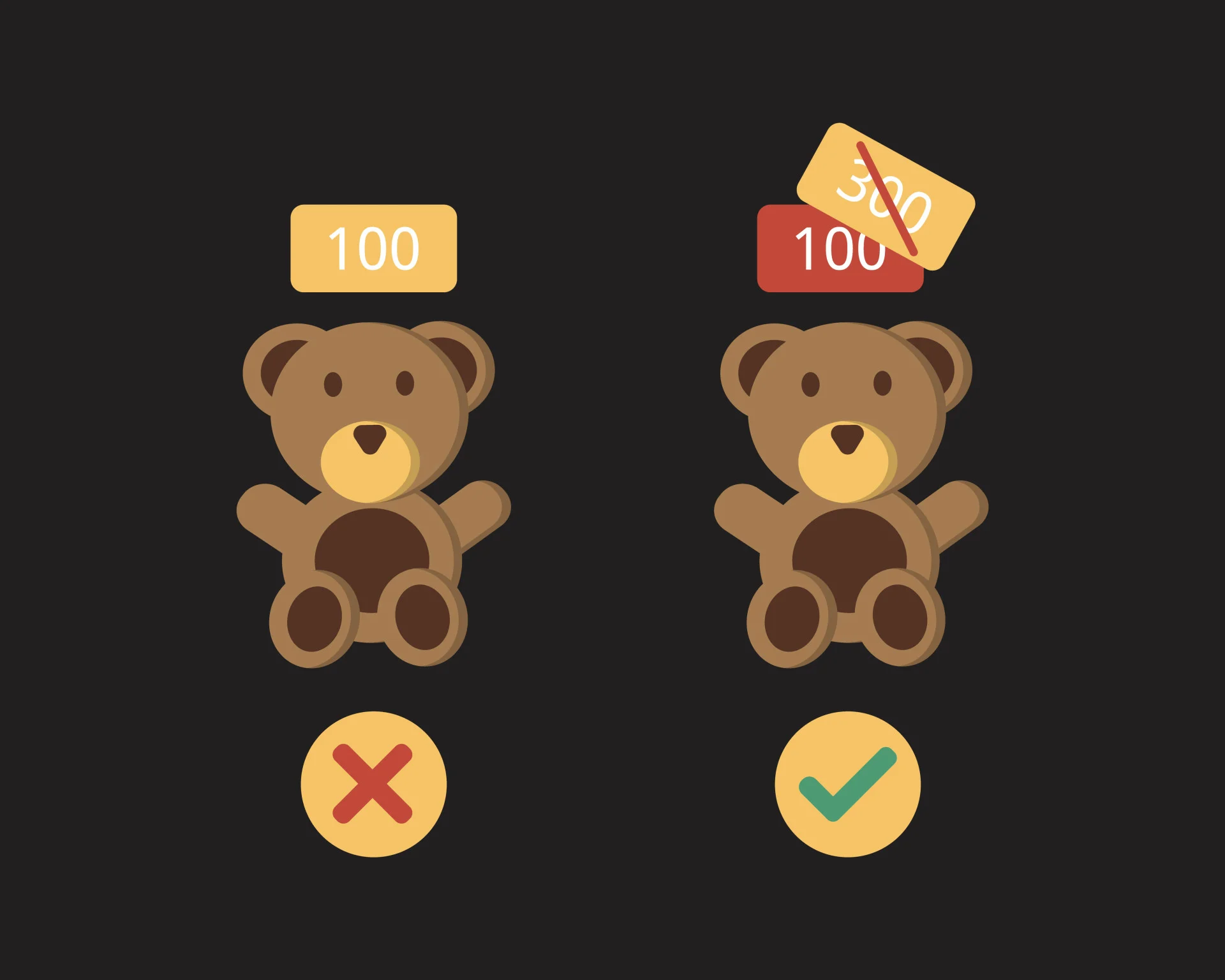
A product labeled “was $300, now $150” feels like a better deal than a product simply priced at $150.
The original price acts as an anchor.
Negotiations
The first offer in a negotiation often sets the range of acceptable outcomes.
Later counteroffers tend to remain close to that starting point.
Salary Expectations
The first salary figure mentioned in a discussion can strongly influence the entire negotiation process.
Even if adjusted, final numbers often remain anchored.
Estimation Tasks
When people are asked to estimate quantities, distances, or probabilities, initial numbers bias their responses—even when those numbers are arbitrary.
The Mechanism: Adjustment From a Starting Point
Anchoring bias is often explained through adjustment.
People start from an initial value and adjust upward or downward.
However, this adjustment is typically insufficient.
The mind stops adjusting before reaching a fully independent estimate.
There is no clear signal indicating when adjustment should end.
So the process stabilizes prematurely.
Why Even Arbitrary Numbers Work
One of the most striking findings about anchoring bias is that even irrelevant numbers can influence judgment.
A random number generated by chance can shift estimates.
This occurs because the mind automatically incorporates available information into its reference frame.
Once present, the number becomes part of the mental landscape.
It does not need to be meaningful to be influential.
A Personal Observation on Reference Points
At one point, while comparing unfamiliar pricing structures, I noticed a subtle shift in judgment.
The first price I encountered established a sense of what seemed reasonable.
Subsequent prices were evaluated relative to that initial exposure.
Even when I consciously tried to ignore it, the first number remained in the background of comparison.
What felt like independent evaluation was, in fact, structured comparison.
The starting point had already shaped the range of plausible outcomes.
Anchoring and Uncertainty
Anchoring effects become stronger when people are uncertain.
In unfamiliar domains, there is no internal benchmark for comparison.
The mind therefore relies heavily on external cues.
The first available number becomes especially influential in these situations.
It does not simply guide judgment.
It defines the scale on which judgment occurs.
Why Adjustment Fails
Adjustment requires:
-
Awareness of bias
-
Effortful recalibration
-
A stopping rule for correction
In many situations, none of these are clearly defined.
As a result, adjustment is partial.
The mind settles on a value that feels reasonable rather than one that is fully independent.
This creates systematic deviation from objective estimation.
Anchoring Beyond Numbers
Although often demonstrated with numerical estimates, anchoring also affects:
-
First impressions of people
-
Initial interpretations of events
-
Early narratives in decision contexts
Once a starting frame is established, later information is interpreted relative to it.
The first impression often becomes the reference point for everything that follows.
Why Awareness Does Not Eliminate It
Even when people understand anchoring bias, it remains influential.
This is because:
-
It operates automatically
-
It influences perception before conscious reasoning
-
Adjustment mechanisms are still constrained
Awareness may reduce its magnitude slightly.
But it does not remove the underlying process.
Conclusion: The Power of the First Reference Point
Anchoring bias reveals a fundamental property of human judgment.
Thinking does not begin from a blank slate.
It begins from a starting point.
That starting point shapes interpretation, adjustment, and final judgment.
Even when irrelevant, it remains influential.
Understanding anchoring bias is not about eliminating its effects.
It is about recognizing that every judgment is, in part, a comparison against an initial frame that may have been arbitrary from the beginning.
- Arts
- Business
- Computers
- Spiele
- Health
- Startseite
- Kids and Teens
- Geld
- News
- Personal Development
- Recreation
- Regional
- Reference
- Science
- Shopping
- Society
- Sports
- Бизнес
- Деньги
- Дом
- Досуг
- Здоровье
- Игры
- Искусство
- Источники информации
- Компьютеры
- Личное развитие
- Наука
- Новости и СМИ
- Общество
- Покупки
- Спорт
- Страны и регионы
- World

 English
 Russian
 French
 Spanish
 Portuguese
 Turkish
 Dutch
Dutch
 Italiano
 Arabic
 Romaian
 Portuguese (Brazil)
 Greek
Greek