
Why do investors make emotional decisions?
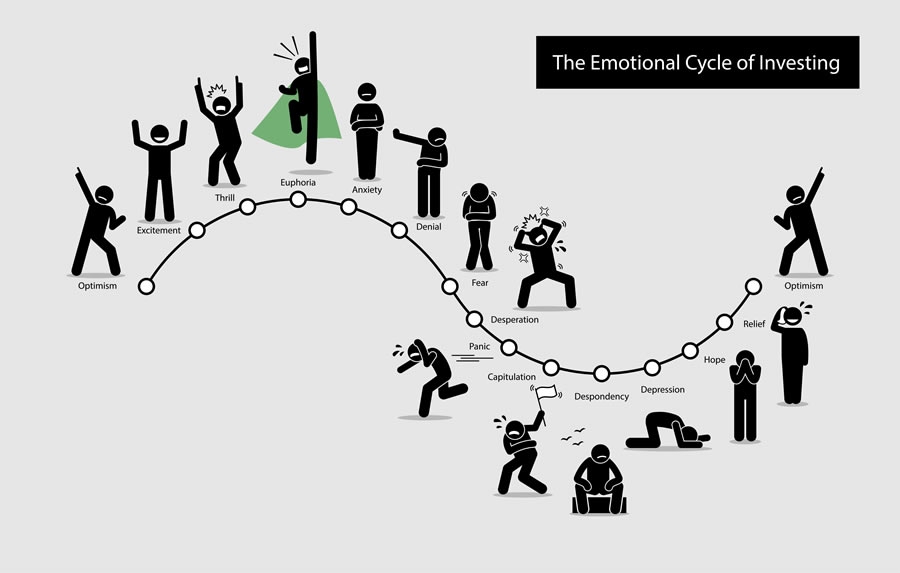
Why Do Investors Make Emotional Decisions?
The Myth of the Purely Rational Investor
An investor opens a trading app.
A portfolio flashes green and red.
Prices move in real time.
Decisions that look like calculations are made in seconds.
But beneath the numbers, something less mechanical is often guiding action.
A sudden drop triggers panic.
A rapid gain creates excitement.
A long period of stagnation produces frustration.
Even in highly analytical environments, emotion is rarely absent.
It is embedded in the way financial information is experienced.
Markets Are Experienced, Not Just Analyzed
In theory, investing is about probabilities, valuations, and expected returns.
In practice, investors do not interact with abstract models.
They interact with:
-
Changing prices
-
Visual graphs
-
Headlines
-
Social commentary
-
Personal gains and losses
These inputs are not emotionally neutral.
They are experienced in real time.
And experience naturally produces emotional reactions.
Losses Feel More Intense Than Gains
One of the strongest emotional forces in investing is loss aversion.
A financial loss is felt more strongly than an equivalent gain.
This creates asymmetry in behavior:
-
A small loss can trigger panic selling
-
A similar gain may not produce equal satisfaction
As a result, decisions are often driven by the desire to avoid pain rather than maximize return.
The Emotional Weight of Money Is Personal
Money is not just a numerical unit.
It is tied to:
-
Security
-
Identity
-
Future expectations
-
Past effort
Because of this, financial outcomes are interpreted emotionally.
A gain can feel like validation.
A loss can feel like failure.
Even when rationally small, changes in value can feel psychologically significant.
Market Volatility Amplifies Emotional Reactions
Investing environments are dynamic.
Prices fluctuate constantly.
This creates repeated emotional stimuli.
Each movement can trigger:
-
Anxiety during declines
-
Excitement during rallies
-
Uncertainty during volatility
Frequent feedback amplifies emotional engagement, making detachment difficult.
The more immediate the feedback, the stronger the emotional response tends to be.
Availability Bias and Recent Events
Recent market events heavily influence perception.
A recent crash makes risk feel more immediate.
A recent rally makes optimism feel justified.
Because recent events are easier to recall, they disproportionately shape decision-making.
This leads investors to extrapolate short-term patterns into long-term expectations.
Overconfidence During Gains
Success in investing often increases confidence.
When decisions lead to gains, investors may overestimate their skill.
This can result in:
-
Increased risk-taking
-
Reduced caution
-
Overtrading
The emotional reward of success reinforces the behavior that produced it, even when outcomes are partly due to chance.
Fear of Missing Out (FOMO)
Social and market narratives play a major role in emotional investing.
When others appear to be profiting, investors may feel pressure to act quickly.
This creates FOMO-driven behavior:
-
Entering positions late in cycles
-
Ignoring risk evaluation
-
Prioritizing participation over analysis
The emotional driver is not valuation.
It is comparison.
Anchoring to Purchase Price
Investors often anchor their expectations to entry points.
A purchased price becomes a psychological reference.
This leads to:
-
Holding losing positions too long to “get back to even”
-
Selling winners too early to lock in gains
The anchor replaces objective evaluation with emotional reference points.
A Personal Observation on Decision Tension
At one point, while observing financial decision patterns, a recurring tension became visible.
Even when individuals had access to analytical tools and rational frameworks, final decisions often shifted when prices moved rapidly.
A planned strategy could be overridden by a sudden emotional response to market movement.
The decision environment and the emotional environment were not separate.
They were continuously interacting.
Short-Term Feedback Dominates Long-Term Planning
Investing requires long time horizons.
But emotional feedback is often immediate.
This mismatch creates instability in decision-making.
Short-term outcomes feel more real than long-term projections.
As a result:
-
Long-term strategies are frequently interrupted
-
Emotional reactions override planned discipline
-
Consistency becomes difficult to maintain
The immediacy of emotion competes with the abstraction of planning.
Uncertainty Intensifies Emotional Dependence
The future is inherently uncertain in markets.
When uncertainty is high, the mind relies more on emotion and intuition.
In the absence of clear signals, emotional reactions provide a sense of direction.
Even though they are not always accurate, they are immediate and compelling.
This makes emotional decision-making more likely precisely when certainty is lowest.
Conclusion: Emotion as Part of Financial Cognition
Investors do not make emotional decisions because they lack intelligence or information.
They make emotional decisions because financial environments are inherently emotional experiences.
Cognitive biases, uncertainty, and real-time feedback combine to shape perception.
Emotion is not an interruption of investing.
It is part of the system through which investing is experienced.
Understanding this does not remove emotion from decision-making.
But it clarifies why even rational investors consistently feel its influence.
- Arts
- Business
- Computers
- Jeux
- Health
- Domicile
- Kids and Teens
- Argent
- News
- Personal Development
- Recreation
- Regional
- Reference
- Science
- Shopping
- Society
- Sports
- Бизнес
- Деньги
- Дом
- Досуг
- Здоровье
- Игры
- Искусство
- Источники информации
- Компьютеры
- Личное развитие
- Наука
- Новости и СМИ
- Общество
- Покупки
- Спорт
- Страны и регионы
- World

 English
 Russian
 Spanish
 Portuguese
 Deutsch
 Turkish
 Dutch
Dutch
 Italiano
 Arabic
 Romaian
 Portuguese (Brazil)
 Greek
Greek