
Why do countries depend on each other economically?
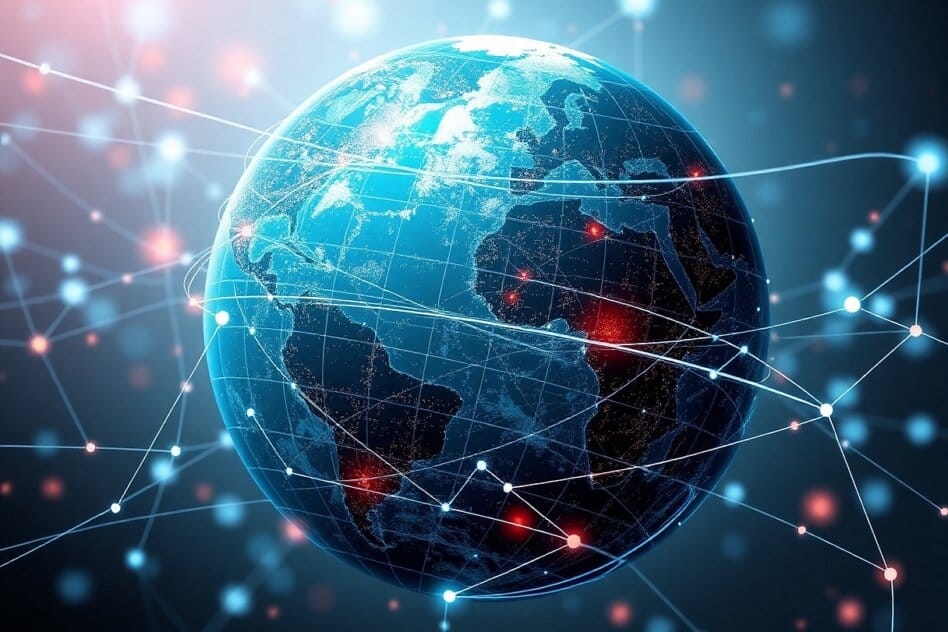
Why Do Countries Depend on Each Other Economically?
The Myth of Self-Sufficiency
Walk into your kitchen tomorrow morning and take inventory.
The coffee may have come from Brazil. The smartphone on the counter likely contains minerals mined in Africa, chips manufactured in Taiwan, and software developed in the United States. The natural gas heating your home might have crossed multiple borders before reaching your neighborhood. Even the shirt on your back probably represents a production journey spanning three or four continents.
Now imagine a government announcing that it intends to produce every one of those things entirely within its own borders.
Sounds appealing at first. Independent. Strong. Self-reliant.
Then reality enters the room.
The modern economy is built on a simple truth: no country possesses everything it needs, everything it wants, or everything it can produce efficiently. Economic interdependence is not an accident. It is the result of nations pursuing prosperity, specialization, and growth.
For decades, politicians have periodically promised greater economic independence. Yet the global marketplace keeps delivering the same lesson. Countries that engage with one another tend to create more wealth than countries that isolate themselves.
That isn't ideology. It's arithmetic.
The Fundamental Reason: Nobody Has Everything
The starting point is surprisingly straightforward.
Every nation has strengths and weaknesses.
Some possess abundant oil reserves. Others have fertile farmland. Some excel at manufacturing. Others lead in technology, finance, or logistics.
Nature itself distributes resources unevenly.
Consider a few examples:
-
Saudi Arabia has enormous energy resources.
-
Japan has limited natural resources but extraordinary industrial expertise.
-
Brazil possesses vast agricultural capacity.
-
Switzerland has built a reputation around finance, pharmaceuticals, and precision manufacturing.
If each country attempted to satisfy every economic need internally, productivity would collapse.
Why?
Because resources would constantly be diverted toward activities where they perform poorly instead of activities where they excel.
Economic cooperation allows countries to focus on their strengths and trade for the rest.
That principle sounds simple because it is.
Simple principles often drive the biggest outcomes.
Comparative Advantage: The Engine Behind Global Trade
Economists call this concept comparative advantage.
The phrase sounds academic. The idea is remarkably practical.
Imagine two neighbors.
One is an excellent carpenter and a decent gardener.
The other is an excellent gardener and a decent carpenter.
Even if the carpenter can garden reasonably well, both benefit when each focuses on the task they perform relatively better and then exchanges services.
Countries operate under the same logic.
Why Specialization Creates Wealth
When nations specialize:
-
Productivity rises.
-
Costs decline.
-
Innovation accelerates.
-
Consumers gain access to more products.
-
Businesses expand into larger markets.
The result is a larger economic pie.
This doesn't mean every worker benefits equally from every trade relationship. They don't. Economic transitions create winners and losers.
But on a national level, specialization generally increases overall output.
That's why trade has remained a central feature of economic development for centuries.
A Quick Look at Economic Interdependence
| Economic Need | Country Strength Example | Trade Outcome |
|---|---|---|
| Energy | Saudi Arabia, Norway | Export fuel to importing nations |
| Technology | United States, South Korea | Export software, chips, innovation |
| Agriculture | Brazil, Argentina | Export food products globally |
| Manufacturing | China, Vietnam | Produce goods at scale |
| Finance | United Kingdom, Switzerland | Facilitate global capital flows |
| Rare Minerals | Democratic Republic of Congo, Australia | Supply critical industrial inputs |
The table highlights something important.
Economic relationships are not one-directional.
Even powerful economies rely heavily on partners.
The United States imports billions of dollars' worth of goods annually while exporting aircraft, software, medical technology, agricultural products, and financial services.
China exports manufactured goods but imports energy, food, advanced equipment, and raw materials.
Dependence works both ways.
Supply Chains Changed Everything
A generation ago, many products were largely built in one country.
Today, production resembles an international relay race.
Take a modern automobile.
Its components may originate from dozens of countries.
Steel from one nation.
Semiconductors from another.
Software developed somewhere else.
Final assembly completed elsewhere.
This fragmentation occurred because businesses discovered something powerful: efficiency increases when each stage of production takes place where it can be performed most effectively.
The result is the global supply chain.
It has lowered costs dramatically.
It has also made economies more interconnected than ever before.
A factory shutdown in one country can influence production schedules thousands of miles away.
The pandemic exposed this reality in vivid fashion.
Many executives discovered that products they assumed were readily available actually depended on highly specialized suppliers scattered across multiple continents.
The lesson wasn't that globalization had failed.
The lesson was that interdependence had become deeper than many people realized.
Capital Doesn't Respect Borders
Goods are only part of the story.
Money moves globally as well.
Investors constantly search for opportunities beyond their home countries.
Pension funds in America may invest in European companies.
Japanese institutions may purchase U.S. Treasury bonds.
Middle Eastern sovereign wealth funds may finance infrastructure projects around the world.
This movement of capital creates another layer of economic dependence.
Countries often rely on foreign investment to:
-
Build infrastructure.
-
Expand businesses.
-
Create jobs.
-
Finance innovation.
-
Stabilize financial markets.
Capital flows create opportunities, but they also create vulnerabilities.
When investor confidence weakens, money can leave quickly.
Economic relationships therefore become deeply intertwined with financial stability.
The Lesson I Learned From Business
Years ago, during conversations with executives involved in retail, manufacturing, and distribution, I noticed something interesting.
The strongest companies rarely tried to do everything themselves.
They built networks.
One firm handled logistics.
Another specialized in production.
A third focused on technology.
A fourth managed distribution.
The companies that insisted on controlling every single function often became slower, more expensive, and less competitive.
Nations face a similar challenge.
The instinct toward complete self-sufficiency can sound appealing, particularly during periods of uncertainty. Yet the pursuit of total independence frequently sacrifices efficiency, innovation, and growth.
The lesson was simple:
Strength does not always come from doing everything yourself.
Sometimes it comes from building reliable partnerships.
That principle applies to businesses and countries alike.
Innovation Thrives Through Economic Connections
Another overlooked reason countries depend on one another is innovation.
Ideas travel.
Researchers collaborate across borders.
Universities share knowledge.
Businesses form international partnerships.
Technology rarely develops in isolation.
Consider the smartphone.
Its existence reflects contributions from countless countries:
-
Advanced semiconductor design.
-
Global telecommunications standards.
-
International manufacturing networks.
-
Worldwide software development.
Innovation has become increasingly collaborative.
Countries that cut themselves off from global knowledge networks often discover that technological progress slows.
Competition and cooperation frequently occur simultaneously.
That may sound contradictory.
It isn't.
The most successful economies often compete fiercely while remaining deeply connected.
Why Smaller Countries Depend Even More on Trade
Economic dependence becomes especially important for smaller nations.
A country with ten million consumers cannot always support large-scale industries internally.
International markets solve that problem.
Exports allow businesses to reach hundreds of millions—or billions—of potential customers.
This expansion creates:
-
Higher revenues.
-
Greater investment.
-
More jobs.
-
Faster economic growth.
Without access to external markets, many industries would remain too small to achieve meaningful scale.
That reality explains why many smaller countries aggressively pursue trade agreements and foreign investment.
For them, global access is often not optional.
It is essential.
The Risks of Economic Dependence
Interdependence creates benefits.
It also creates risks.
Ignoring those risks would be irresponsible.
Economic relationships can generate vulnerabilities such as:
Supply Disruptions
Natural disasters, geopolitical conflicts, or transportation disruptions can interrupt critical supplies.
Strategic Dependence
Countries may become overly reliant on foreign suppliers for essential goods.
Financial Contagion
Economic crises can spread rapidly across borders.
Political Leverage
Nations sometimes use economic relationships as tools of influence.
These concerns have become increasingly prominent in recent years.
Governments worldwide are reevaluating supply chains, strategic industries, and national security considerations.
The debate is no longer about whether interdependence exists.
The debate concerns how much dependence is appropriate and where resilience should be strengthened.
Why Complete Economic Independence Remains Unlikely
Despite growing discussions about reshoring and national self-sufficiency, complete economic independence remains extraordinarily difficult.
The numbers simply don't cooperate.
Producing everything domestically would often require:
-
Higher costs.
-
Lower efficiency.
-
Reduced consumer choice.
-
Slower innovation.
-
Significant resource duplication.
Even large economies face these constraints.
Smaller economies face them even more acutely.
That is why, despite political rhetoric, international trade continues to represent a substantial share of global economic activity.
The incentives remain powerful.
Countries trade because trade creates value.
The Bigger Picture
At its core, economic dependence reflects a broader reality about human progress.
Civilization advances through cooperation.
Farmers depend on manufacturers.
Manufacturers depend on engineers.
Engineers depend on educators.
Countries operate according to the same principle.
Economic relationships allow societies to leverage specialized skills, resources, technologies, and ideas that would be impossible to replicate efficiently everywhere at once.
The world economy functions less like a collection of isolated islands and more like a complex network.
Every connection carries opportunity.
Every connection carries risk.
The challenge is managing both.
Conclusion: Dependence Is Not Weakness
The word "dependence" often makes people uncomfortable.
It sounds fragile.
It sounds subordinate.
It sounds risky.
But economic dependence, when managed intelligently, is often a sign of sophistication rather than weakness.
The richest economies on earth are not isolated fortresses. They are deeply connected participants in vast networks of trade, investment, innovation, and production.
That reality may frustrate advocates of complete self-sufficiency.
Yet history keeps pointing in the same direction.
Prosperity tends to emerge where specialization, exchange, and cooperation flourish.
The objective for nations is not to eliminate economic dependence altogether. That goal is largely unattainable. The objective is to build resilient relationships, diversify risks, and ensure that interdependence serves national interests rather than undermines them.
Countries depend on each other economically because modern prosperity demands it.
The question is no longer whether nations are connected.
The real question is how wisely they manage those connections in a world where no economy—regardless of size, power, or ambition—stands entirely alone.
- Arts
- Business
- Computers
- Oyunlar
- Health
- Home
- Kids and Teens
- Money
- News
- Personal Development
- Recreation
- Regional
- Reference
- Science
- Shopping
- Society
- Sports
- Бизнес
- Деньги
- Дом
- Досуг
- Здоровье
- Игры
- Искусство
- Источники информации
- Компьютеры
- Личное развитие
- Наука
- Новости и СМИ
- Общество
- Покупки
- Спорт
- Страны и регионы
- World

 English
 Russian
 French
 Spanish
 Portuguese
 Deutsch
 Dutch
Dutch
 Italiano
 Arabic
 Romaian
 Portuguese (Brazil)
 Greek
Greek