
What is the framing effect in marketing?
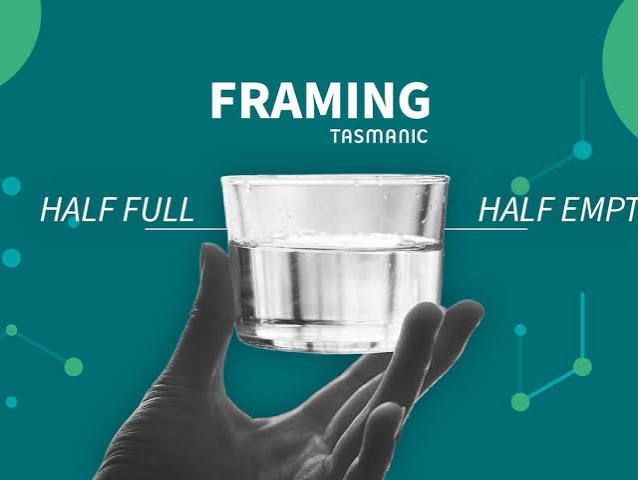
What Is the Framing Effect in Marketing?
A shopper stands in front of two nearly identical packages.
One says: “95% fat-free.”
The other says: “Contains 5% fat.”
Same product.
Same nutrition.
Same underlying reality.
Yet one feels healthier.
More appealing.
Less risky.
The shopper reaches for it almost automatically, without noticing the mental step that made the choice feel obvious.
Nothing was hidden.
Nothing was false.
And yet something decisive happened before conscious reasoning could fully intervene.
This is the framing effect.
Not a trick in the narrow sense.
Not deception in the legal sense.
But a systematic feature of human judgment: the way information is presented often matters as much as the information itself.
Marketing does not merely communicate value.
It constructs the lens through which value is perceived.
And once the frame is set, the conclusion often follows with surprising ease.
Why Framing Works: The Mind Does Not Process Raw Facts
A common intuition about decision-making is that people evaluate facts directly.
We imagine a consumer comparing attributes, weighing pros and cons, and then arriving at a reasoned judgment.
But psychological evidence suggests a different sequence.
Information is not received as neutral data.
It is interpreted immediately.
Sometimes automatically.
Before deliberation begins.
A “90% success rate” does not arrive in the mind as a statistical statement first.
It arrives as reassurance.
A “10% failure rate” does not arrive as the same fact in reverse.
It arrives as risk.
The content is identical.
The experience is not.
This gap between objective information and subjective interpretation is where framing operates.
It does not change what is true.
It changes what is salient.
And what is salient often determines what is chosen.
The Two Systems Behind Framing Effects
Framing effects are closely linked to the interaction between fast and slow thinking.
System 1 produces immediate impressions.
System 2 engages in deliberate analysis.
But in many marketing contexts, System 1 speaks first—and loudly.
A headline is read.
An image is seen.
A percentage is encountered.
An emotional reaction forms instantly.
Only afterward does reflective thinking attempt to interpret or correct that reaction.
The challenge is timing.
By the time System 2 intervenes, the initial frame has already shaped the direction of thought.
The mind is not blank at the start of reasoning.
It is already leaning.
The Core Mechanism: Reference Points and Psychological Context
Framing effects depend on reference points.
A price is not evaluated in isolation.
It is evaluated relative to expectations.
A medical treatment is not judged solely on effectiveness.
It is judged relative to perceived risk.
A product is not assessed only by features.
It is assessed relative to alternatives.
This means that meaning is not contained in the message itself.
Meaning arises from comparison.
Marketing leverages this by controlling what comparisons are most accessible.
The frame determines the reference point.
And the reference point determines the judgment.
Gain Frames vs. Loss Frames: The Asymmetry That Shapes Decisions
Consider two ways of describing the same outcome:
-
“This treatment saves 90 out of 100 patients.”
-
“This treatment fails to save 10 out of 100 patients.”
Logically equivalent.
Psychologically distinct.
The first emphasizes gains.
The second emphasizes losses.
Research consistently shows that people respond more favorably to gain-framed messages in some contexts and more strongly to loss-framed messages in others.
Losses tend to feel more intense than equivalent gains.
This asymmetry is known as loss aversion.
Marketing often uses it without explicit acknowledgment.
Messages such as:
-
“Don’t miss out”
-
“Avoid costly mistakes”
-
“Stop losing money on inefficient solutions”
These are not informational statements.
They are emotionally structured frames.
The Subtle Power of Attribute Framing
Framing does not only apply to outcomes.
It also applies to descriptions of attributes.
A product labeled “95% organic” feels different from one labeled “5% non-organic.”
A service described as “90% satisfaction rate” feels stronger than one described as “10% dissatisfaction.”
The numerical reality is unchanged.
But attention is guided toward either positive or negative aspects.
This subtle shift can alter preferences even when people fully understand the equivalence.
Understanding does not always neutralize framing.
Comparative Framing: How Context Changes Value
One of the most powerful applications of framing occurs in comparison sets.
A product rarely exists alone.
It is presented alongside alternatives.
And those alternatives define perception.
A $1,200 product may feel expensive in isolation.
But placed next to a $3,000 option, it becomes reasonable.
Not because its value changed.
But because its position in the comparison structure changed.
Marketing often uses tiered pricing structures for precisely this reason.
Premium options elevate mid-tier offerings.
Budget options make premium offerings appear more justified.
The frame is not the product.
It is the environment in which the product is judged.
Comparison Table: Framing Techniques in Marketing and Their Psychological Effects
| Framing Technique | Description | Marketing Application | Psychological Effect |
|---|---|---|---|
| Gain framing | Emphasizing positive outcomes | “Saves you time,” “boosts productivity” | Encourages approach behavior |
| Loss framing | Emphasizing avoided losses | “Don’t miss out,” “avoid costly errors” | Increases urgency and risk sensitivity |
| Attribute framing | Positive vs negative description of same fact | “95% fat-free” vs “5% fat” | Alters perception of quality |
| Context framing | Evaluation depends on comparison set | Tiered pricing models | Shifts perceived value |
| Temporal framing | Timing of outcomes is emphasized | “Immediate results” vs “long-term gains” | Influences impatience vs patience |
| Risk framing | Same probability framed differently | Survival vs mortality rates | Changes emotional response |
| Default framing | Status quo is implied option | Preselected subscriptions | Increases passive adoption |
| Social framing | Others’ behavior is highlighted | “Most popular choice” | Reduces perceived uncertainty |
Temporal Framing: The Psychology of “Now” vs “Later”
Time is not psychologically neutral.
“Immediate benefit” and “delayed benefit” are not evaluated symmetrically.
Marketing often exploits this asymmetry.
Immediate rewards feel more tangible.
Future benefits feel abstract.
A product promising “instant relief” tends to outperform one promising “long-term improvement,” even when long-term benefits are greater.
The frame compresses time.
Or expands it.
Depending on what is advantageous for perception.
Risk Framing: When Survival and Mortality Are the Same Data
One of the most striking demonstrations of framing effects involves risk communication.
Consider two statements:
-
“This surgery has a 90% survival rate.”
-
“This surgery has a 10% mortality rate.”
Medical professionals understand they are identical.
Patients do not respond identically.
The survival frame feels reassuring.
The mortality frame feels threatening.
The emotional system reacts before statistical reasoning can normalize the information.
Marketing in health, insurance, and finance frequently relies on this mechanism.
Not to mislead.
But to influence emotional interpretation of risk.
Why Framing Persists Even When People Know About It
A natural assumption is that awareness should reduce susceptibility.
If people understand framing, they should be able to correct for it.
The evidence suggests otherwise.
Knowledge helps.
But does not eliminate the effect.
Why?
Because framing operates before conscious correction begins.
The initial emotional interpretation is not easily erased.
Even when people intellectually recognize equivalence, the emotional response often remains asymmetrical.
This creates a gap between understanding and experience.
Marketing operates largely in that gap.
My Lesson About Framing and Choice
I once encountered two subscription options for a service I was considering:
-
Plan A: “$10 per month, billed annually at $120.”
-
Plan B: “$120 per year, saving $24 compared to monthly billing.”
I analyzed both.
I compared features.
I checked assumptions.
And yet I found myself leaning toward Plan B.
Only later did I realize what had influenced me.
The phrase “saving $24” had created a frame of gain rather than cost.
The decision was not driven purely by price or utility.
It was shaped by how the same financial outcome was described.
Nothing had been added.
Nothing removed.
Only the frame had changed.
That realization was not dramatic.
It was quiet.
But persistent.
It altered how I read marketing language thereafter.
Not with distrust.
But with attention to structure.
Framing as Architecture of Attention
Framing is not simply about wording.
It is about attention allocation.
What is highlighted becomes central.
What is omitted becomes peripheral.
Marketing professionals often do not ask:
“What is the product?”
They ask:
“What aspect of the product should be most visible at the moment of decision?”
This question is more psychological than informational.
Because visibility shapes interpretation.
And interpretation shapes choice.
The Ethical Boundary: Influence vs Manipulation
Framing is unavoidable.
Language requires selection.
Selection implies emphasis.
Emphasis implies framing.
The ethical question is not whether framing exists.
It is how it is used.
Transparent framing helps consumers understand options.
Opaque framing can distort perception.
The boundary is not always clear.
A “limited-time offer” may reflect real constraints.
Or it may create artificial urgency.
A “most popular choice” may reflect genuine data.
Or selective presentation.
The mechanism is neutral.
Its application is not.
Why Framing Works: A Summary of the Mechanism
Framing effects persist because several cognitive features converge:
-
People respond to meaning, not structure
-
Emotional reactions precede analysis
-
Reference points define value
-
Losses feel more intense than gains
-
Context determines interpretation
-
Cognitive effort is limited and selective
Marketing does not need to override rationality.
It only needs to guide initial interpretation.
Once interpretation is established, reasoning often follows its lead.
Conclusion: The Frame Is Often the Decision
When people describe their choices, they often emphasize reasoning.
Comparison.
Analysis.
Preference.
But framing research suggests something more subtle.
The structure of information presentation frequently shapes the direction of thought before reasoning begins.
This does not imply that consumers are irrational.
It implies something more precise:
Rationality operates within boundaries defined by perception.
Marketing understands this.
Not always explicitly.
But consistently in practice.
It does not change what is offered.
It changes how what is offered is seen.
And in many cases, what is seen determines what is chosen.
The unsettling implication is not that people are easily manipulated.
It is that the mind relies on interpretive shortcuts that make such influence possible.
Not because judgment is weak.
But because attention is selective.
And meaning is constructed, not merely received.
The framing effect, in its simplest form, reveals a quiet truth about decision-making:
We do not respond to the world as it is.
We respond to the world as it is presented.
And those two worlds are never identical.
- Arts
- Business
- Computers
- Spiele
- Health
- Startseite
- Kids and Teens
- Geld
- News
- Personal Development
- Recreation
- Regional
- Reference
- Science
- Shopping
- Society
- Sports
- Бизнес
- Деньги
- Дом
- Досуг
- Здоровье
- Игры
- Искусство
- Источники информации
- Компьютеры
- Личное развитие
- Наука
- Новости и СМИ
- Общество
- Покупки
- Спорт
- Страны и регионы
- World

 English
 Russian
 French
 Spanish
 Portuguese
 Turkish
 Dutch
Dutch
 Italiano
 Arabic
 Romaian
 Portuguese (Brazil)
 Greek
Greek