
What exercises improve creative thinking?
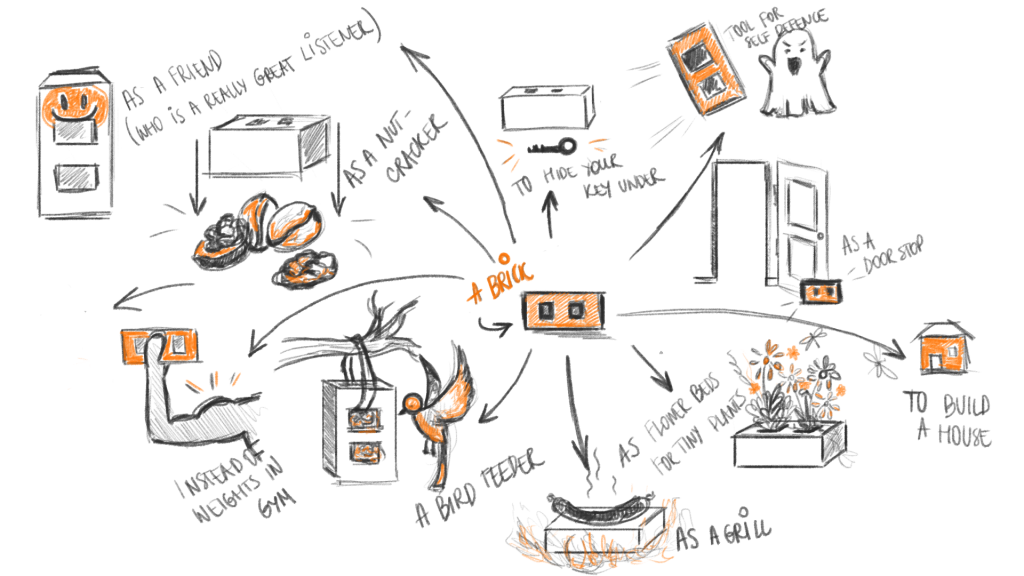
What Exercises Improve Creative Thinking?
The Real Question Beneath the Question
When people ask what exercises improve creative thinking, there is usually an assumption underneath it.
That creativity is something fragile.
Something distant.
Something that requires special conditions to appear.
So the instinct is to search for exercises.
Methods.
Techniques.
But the deeper question is not what exercises work.
It is:
What conditions allow perception to loosen enough for new connections to form?
Because creative thinking is not generated in isolation.
It is revealed through practice.
Through repeated shifts in attention.
Through small interruptions in habit.
Creativity Is a Muscle, But Not in the Way People Think
It is tempting to compare creativity to physical training.
Repetition.
Strength building.
Progressive overload.
But creative “muscle” is not about force.
It is about sensitivity.
Not how hard the mind pushes.
But how finely it notices.
Exercises that improve creative thinking do not primarily increase output.
They increase:
-
perception range
-
tolerance for ambiguity
-
flexibility of interpretation
-
delay between perception and judgment
The goal is not more ideas.
It is different ideas.
A Table: Common Thinking vs Trained Creative Thinking
| Dimension | Untrained Thinking | Trained Creative Thinking |
|---|---|---|
| Response speed | Immediate | Flexible timing |
| Idea evaluation | Instant judgment | Delayed observation |
| Attention style | Narrow focus | Expansive scanning |
| Handling uncertainty | Avoidance | Engagement |
| Pattern recognition | Familiar patterns only | Subtle variation detection |
| Problem framing | Fixed | Reframed repeatedly |
| Output | Predictable | Divergent |
Exercises work when they shift behavior along these dimensions.
Not when they simply produce more thinking.
Exercise 1: The 10-Interpretations Method
Take a simple object.
A chair.
A door.
A cup.
And generate 10 different interpretations of what it could be.
Not uses.
Interpretations.
A chair is:
-
a pause point
-
a structure of rest
-
a frame for absence
-
a measurement of time spent sitting
-
a boundary between movement and stillness
The first few are easy.
Then it gets uncomfortable.
That discomfort is the exercise working.
Because the mind prefers early closure.
This exercise delays closure.
And in that delay, perception expands.
Exercise 2: The Constraint Reduction Drill
Start with an idea.
Then remove something from it:
-
remove color
-
remove time
-
remove purpose
-
remove scale
-
remove function
Each removal forces reinterpretation.
What remains after subtraction is often more revealing than what was initially added.
Constraints are not restrictions here.
They are revealing forces.
They expose structure beneath assumption.
Exercise 3: The “Wrong Answer First” Practice
Instead of trying to find the right answer immediately, deliberately generate a wrong one.
Not absurdly wrong.
But slightly misaligned.
Then observe:
-
why it feels wrong
-
what assumption it violates
-
what structure it disrupts
This practice does something subtle.
It teaches the mind to map boundaries.
And once boundaries are visible, creative movement becomes easier inside them.
A Personal Observation About Rushing Toward Correctness
There was a time when I avoided wrong answers at all cost.
If an idea appeared, I would immediately try to refine it into correctness.
This felt efficient.
But it quietly reduced variation.
Ideas began to converge too quickly toward familiar structures.
When I later began intentionally allowing “incorrect” ideas to exist longer, something changed.
Some of those ideas contained unexpected directions.
Not because they were right.
But because they revealed assumptions I had not questioned.
Exercise 4: The Slow Observation Walk
Walk without a goal.
No destination.
No task.
Only attention.
The instruction is simple:
Notice what is usually ignored.
Not what is new.
What is already there but not typically seen.
Examples:
-
textures on surfaces
-
patterns in repetition
-
small asymmetries
-
unnoticed transitions between spaces
This exercise is not about movement.
It is about perception under reduced pressure.
Exercise 5: The Idea Extension Chain
Take one idea.
Then extend it five times.
Not in the same direction.
In different directions.
Example:
Idea: “A notebook”
-
a storage of thought
-
a time capsule of attention
-
a map of forgotten decisions
-
a mirror of mental patterns
-
a record of what was once uncertain
Each extension shifts the original idea slightly.
Over time, the idea stops being fixed.
It becomes a field of possibilities.
Exercise 6: The 3-Minute Constraint Build
Set a timer for three minutes.
Define a problem.
Then build a solution using only what you already know.
No research.
No external input.
This forces:
-
reliance on existing perception
-
recombination of known elements
-
rapid association without overthinking
Often, the output is not perfect.
But it reveals something important:
how the mind organizes known material under pressure.
Exercise 7: The Silence Layer Practice
Take an idea.
Then remove explanation from it.
Strip it down to only what is essential.
No justification.
No framing.
Just the core perception.
This exercise exposes how much thinking is often layered on top of thinking.
And how often that layering hides the original clarity.
Why These Exercises Work
These exercises are not about generating creativity directly.
They work indirectly by altering:
-
attention structure
-
judgment timing
-
tolerance for ambiguity
-
relationship to uncertainty
Creative thinking improves when:
-
automatic responses slow down
-
perception becomes more granular
-
interpretation is delayed
-
familiarity is interrupted
Each exercise introduces a small disruption in habitual cognition.
A Table: Surface Practice vs Deep Creative Practice
| Practice Type | Surface Exercise | Deep Creative Exercise |
|---|---|---|
| Goal | Produce output | Shift perception |
| Time frame | Immediate | Gradual |
| Focus | Ideas | Awareness |
| Evaluation | Frequent | Deferred |
| Effect | Volume increase | Pattern change |
| Difficulty | Low to moderate | Subtle discomfort |
The difference is not intensity.
It is depth of attention.
Exercise 8: The Perspective Swap
Take a situation.
Then reframe it from multiple viewpoints:
-
object
-
user
-
outsider
-
system
-
environment
Each shift reveals hidden assumptions.
What seemed fixed becomes relative.
What seemed obvious becomes constructed.
This exercise is especially powerful because it destabilizes certainty gently.
Not by rejecting it.
But by multiplying it.
Exercise 9: The “What Is Missing?” Scan
Instead of asking what is present, ask what is absent.
In:
-
a system
-
a design
-
an idea
-
a conversation
What is not being considered?
What is assumed but not spoken?
What is missing that would change interpretation?
This exercise trains negative space perception.
And creative thinking often lives in negative space.
Why Most Creativity Fails Without Practice
Creativity is often treated as spontaneous.
But spontaneity without structure defaults to repetition.
Without exercises that reshape attention:
-
the same ideas reappear
-
familiar patterns dominate
-
novelty becomes rare
Practice does not guarantee creativity.
But it increases the likelihood that perception will break habitual loops.
A Table: Without Practice vs With Practice
| Aspect | Without Practice | With Creative Exercises |
|---|---|---|
| Idea diversity | Low | High |
| Pattern awareness | Limited | Expanded |
| Judgment speed | Immediate | Modulated |
| Flexibility | Low | High |
| Comfort with ambiguity | Low | Increased |
| Originality | Occasional | More consistent |
The shift is gradual.
Not dramatic.
But cumulative.
Why Simplicity Matters in Exercises
Complex exercises often overwhelm attention.
Simple ones penetrate deeper.
Because simplicity allows repetition.
And repetition allows observation.
Creative improvement is rarely about complexity.
It is about sustained engagement with simple shifts in attention.
A Final Observation About Practice Itself
There is a misunderstanding that practice should feel productive.
But in creative thinking, practice often feels uneventful.
Subtle.
Almost invisible.
Nothing dramatic appears at first.
But over time, something changes in how the mind responds to the same inputs.
That change is the real outcome.
Not the exercise itself.
But the shift in perception it leaves behind.
Conclusion: Creativity Is Trained in Small Interruptions of Habit
What exercises improve creative thinking?
Not ones that force ideas.
But ones that interrupt certainty.
That slow judgment.
That expand interpretation.
That expose assumptions.
That allow perception to loosen from habit.
Creative thinking improves when attention is trained to:
-
see more than the obvious
-
delay closure
-
tolerate ambiguity
-
shift perspective repeatedly
-
and notice what was previously ignored
These exercises do not create creativity directly.
They remove what blocks it.
And what remains is not new thinking imposed from outside.
But thinking that was already present—waiting for space to appear.
- Arts
- Business
- Computers
- Games
- Health
- Home
- Kids and Teens
- Money
- News
- Personal Development
- Recreation
- Regional
- Reference
- Science
- Shopping
- Society
- Sports
- Бизнес
- Деньги
- Дом
- Досуг
- Здоровье
- Игры
- Искусство
- Источники информации
- Компьютеры
- Личное развитие
- Наука
- Новости и СМИ
- Общество
- Покупки
- Спорт
- Страны и регионы
- World

 Russian
 French
 Spanish
 Portuguese
 Deutsch
 Turkish
 Dutch
Dutch
 Italiano
 Arabic
 Romaian
 Portuguese (Brazil)
 Greek
Greek