
How can I train my brain to be more creative?
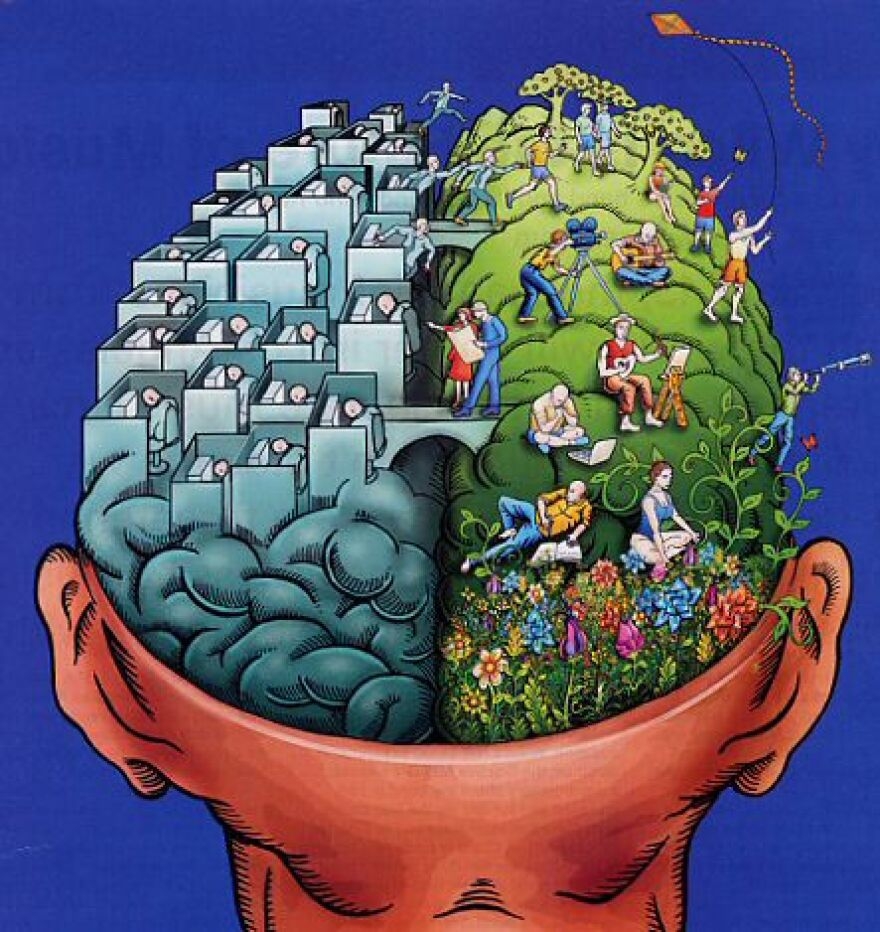
How Can I Train My Brain to Be More Creative?
The Question That Already Contains a Quiet Assumption
When people ask how to train the brain to be more creative, there is often an unspoken belief underneath it.
That creativity is a trait.
Something fixed.
Something unevenly distributed.
Something you either have or do not have.
But that framing does not hold up under closer observation.
Because creativity, in practice, behaves less like a possession.
And more like a condition.
A way the mind operates when certain constraints are loosened.
The question is not really how to add creativity.
It is how to remove what interferes with it.
Creativity Is Not Stored in the Brain. It Is a Mode of Attention.
Neuroscience often describes creativity as network interaction:
-
divergent thinking
-
associative activation
-
flexible switching between patterns
But in lived experience, it does not feel like networks.
It feels like attention shifting shape.
When the mind becomes more creative, what changes is not the amount of thinking.
It is how thinking relates to itself.
Ideas stop behaving like fixed objects.
They start behaving like moving relationships.
A Table: Fixed Thinking vs Trained Creative Thinking
| Dimension | Fixed Thinking | Trained Creative Thinking |
|---|---|---|
| Attention | Narrow and goal-bound | Wide and exploratory |
| Response to uncertainty | Immediate resolution | Sustained observation |
| Idea formation | Repetition of known patterns | Recombination of elements |
| Judgment timing | Early and automatic | Delayed and flexible |
| Emotional tone | Pressure to be correct | Curiosity about emergence |
| Perception | Categorized quickly | Held longer before labeling |
Training creativity is not about adding complexity.
It is about adjusting timing.
The First Training Principle: Delay Judgment
Most thinking collapses too early.
An idea appears.
It is labeled:
-
good
-
bad
-
useful
-
irrelevant
And in that labeling, the idea is frozen.
Training the brain for creativity begins by delaying that moment of closure.
Not eliminating judgment.
Just postponing it.
Because in that space between perception and evaluation, something else begins to form.
Something less familiar.
More fluid.
Why the Brain Defaults to Familiar Patterns
The brain is efficient.
It prefers:
-
speed over depth
-
recognition over exploration
-
certainty over ambiguity
These preferences are not flaws.
They are adaptations.
But they come at a cost.
Efficiency reduces variation.
And variation is the raw material of creativity.
Training creativity means gently interrupting that efficiency loop.
A Personal Observation About Mental Shortcuts
There was a period when I noticed how quickly I would settle on interpretations.
Something would appear—a thought, an idea, a possibility—and within seconds it would be categorized.
Not consciously.
Automatically.
It felt like clarity.
But over time, something became visible.
The quick interpretations were not deeper understanding.
They were shortcuts.
When I began resisting that immediate labeling, even slightly, something changed.
Ideas began to stretch.
Not because I forced them.
But because I stopped cutting them short.
The Second Training Principle: Expand Attention Before You Decide
Before deciding what something is, extend attention toward it.
Not intellectually.
Perceptually.
Look again.
Stay a little longer.
Notice what is usually filtered out:
-
edges instead of centers
-
tensions instead of conclusions
-
relationships instead of objects
This shift does not require effort.
It requires restraint.
A refusal to rush toward meaning.
Why Environment Shapes Creativity More Than Effort
Training the brain is often framed as internal work.
But environment plays a silent role.
Consider:
-
visual complexity
-
noise patterns
-
interruption frequency
-
social pressure
-
digital overload
Each of these conditions shapes attention before thought begins.
A cluttered environment compresses perception.
A quiet environment expands it.
So brain training is not only internal.
It is ecological.
The Third Training Principle: Repetition Without Expectation
Repetition is often misunderstood.
It is not about doing the same thing for mastery alone.
It is about noticing differences in the same thing.
Return to:
-
the same idea
-
the same problem
-
the same question
Each return reveals something previously unseen.
Not because the object changed.
But because attention did.
Training creativity requires this slow accumulation of perspective shifts.
A Table: Passive Exposure vs Creative Repetition
| Aspect | Passive Exposure | Creative Repetition |
|---|---|---|
| Attention level | Low | High |
| Perception change | Minimal | Incremental |
| Engagement | Surface | Deep |
| Outcome | Familiarity | Insight |
| Pattern recognition | Static | Evolving |
| Cognitive impact | Weak | Strong over time |
Repetition becomes training only when attention is active.
The Fourth Training Principle: Introduce Constraints
Without structure, the mind disperses.
With too much freedom, everything becomes possible—and therefore indistinct.
Constraints sharpen perception:
-
limited time
-
limited tools
-
limited format
-
limited perspective
They do not restrict creativity.
They force selection.
And selection is where creativity begins to take shape.
Why Mistakes Are Part of Training
Mistakes are not interruptions in creative development.
They are signals.
Each mistake reveals:
-
an assumption
-
a pattern
-
a limitation
Training creativity means changing the role of mistakes from failure indicators to informational feedback.
Not to be avoided.
But examined.
The Fifth Training Principle: Separate Generation from Judgment
Most people mix two processes:
-
producing ideas
-
evaluating ideas
This overlap reduces variation.
Because judgment enters too early.
Training creativity requires separation:
-
generate freely
-
evaluate later
This separation allows fragile ideas to survive long enough to evolve.
Why Slowing Down Improves Neural Flexibility
Speed compresses perception.
When thinking is fast:
-
assumptions are not examined
-
patterns are reused
-
alternatives are skipped
Slowing down creates space between stimulus and response.
That space is where new connections form.
Not because slowing down creates ideas.
But because it reveals what speed hides.
The Sixth Training Principle: Learn to Notice Subtle Differences
Creativity often depends on sensitivity to small distinctions:
-
slight variations
-
unexpected contrasts
-
minor inconsistencies
Training the brain means refining this sensitivity.
This can be practiced by asking:
What is slightly different here that I normally ignore?
That question shifts attention from category to detail.
A Table: Habitual Perception vs Trained Perception
| Dimension | Habitual Perception | Trained Perception |
|---|---|---|
| Detail awareness | Low | High |
| Pattern detection | Broad | Fine-grained |
| Assumption strength | Strong | Flexible |
| Interpretation speed | Immediate | Delayed |
| Cognitive openness | Limited | Expanded |
| Idea formation | Predictable | Emergent |
Training creativity is training perception itself.
Why Rest Is Part of Training
The brain does not only develop during activity.
It reorganizes during rest.
When pressure is removed:
-
connections consolidate
-
associations reorganize
-
unresolved patterns continue processing
Rest is not absence of training.
It is part of the training cycle.
The Seventh Training Principle: Change Perspective Frequently
One of the most powerful ways to train creative thinking is shifting viewpoint:
-
from user to system
-
from object to environment
-
from problem to context
-
from part to whole
Each shift reveals structures that were previously invisible.
A Personal Observation About Mental Noise
At one point, I noticed how much thinking was reactive.
Not intentional.
Just response after response.
Ideas triggering other ideas without pause.
It felt like productivity.
But underneath, it was noise.
When I began introducing pauses between thoughts—even small ones—something changed.
Thinking became less automatic.
More deliberate.
And strangely, more fluid.
The Eighth Training Principle: Protect Empty Space
Empty space in thinking is often uncomfortable.
It feels like nothing is happening.
But empty space is where new structure begins to form.
If every moment is filled:
-
no new pattern can emerge
-
no contrast can develop
-
no signal can rise above noise
Training creativity means protecting moments of nothingness.
Not filling them immediately.
Conclusion: Training Creativity Is Not Addition. It Is Removal.
How can I train my brain to be more creative?
Not by adding techniques.
Not by forcing output.
Not by increasing mental effort.
But by reshaping how attention behaves.
By:
-
delaying judgment
-
expanding observation
-
reducing environmental noise
-
separating generation from evaluation
-
embracing repetition
-
introducing constraints
-
allowing rest
-
shifting perspective
-
noticing subtle differences
Creativity is not installed into the brain.
It emerges when interference is reduced enough for perception to reorganize itself.
Training, then, is not about building something new inside the mind.
It is about clearing space so the mind can see differently.
And when perception changes, ideas follow naturally.
Not because they were forced into existence.
But because they were finally allowed to appear.
- Arts
- Business
- Computers
- Игры
- Health
- Главная
- Kids and Teens
- Деньги
- News
- Personal Development
- Recreation
- Regional
- Reference
- Science
- Shopping
- Society
- Sports
- Бизнес
- Деньги
- Дом
- Досуг
- Здоровье
- Игры
- Искусство
- Источники информации
- Компьютеры
- Личное развитие
- Наука
- Новости и СМИ
- Общество
- Покупки
- Спорт
- Страны и регионы
- World

 English
 French
 Spanish
 Portuguese
 Deutsch
 Turkish
 Dutch
Dutch
 Italiano
 Arabic
 Romaian
 Portuguese (Brazil)
 Greek
Greek