
How can I avoid making poor decisions?
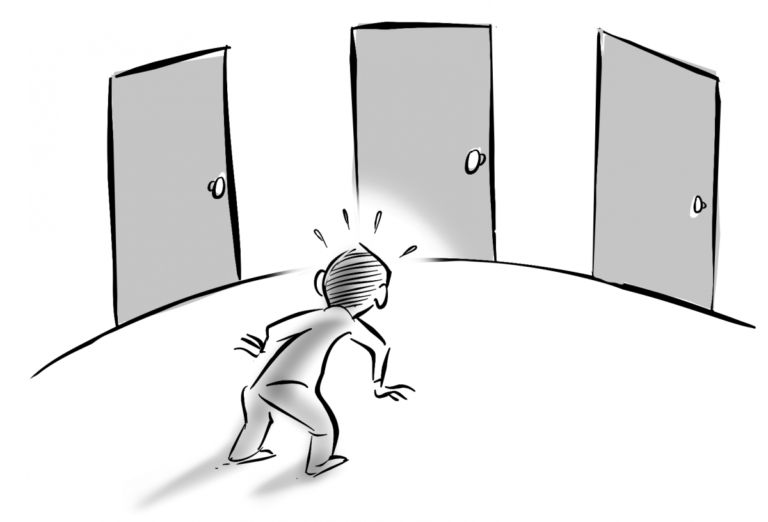
The Trap of the Echo
We are drowning in choices we never wanted to make.
Every morning, the world presents us with an infinite canvas of noise and asks us to paint a masterpiece by noon. We are told that to be alive is to be decisive. We mistake the frantic movement of our hands for the steady direction of a life. We stand before the altar of the immediate, reaching for the most convenient object in the room just to prove to the onlookers that we are not frozen. We pull the trigger before we have even located the target.
Most errors in human life do not occur because we selected the wrong answer. They occur because we accepted a flawed question.
We rush to choose because the open space between a question and an answer feels like a threat to our identity. We treat a period of reflection as if it were a weakness—a blank space in the ledger that must be filled with a commitment. So, we make the deal, we sign the contract, or we say the words that cannot be recalled. Then, we spend the next five years of our lives constructing an intricate fortress of logic to justify an action that was born entirely out of panic.
   [ THE INCOMING SIGNAL ] (A choice, a deal, an open door)
              │
              ▼
    [ THE REACTION LOOP ]  <─── Driven by: Fear of missing out / External noise / Ego
              │
              ▼ (The Great Separation)
    [ THE DELIBERATE GAP ]
              │
              ▼
   [ THE FIRST PRINCIPLE ] ──► Stripping away the excess to find the core truth
To move through the world without constantly stumbling into error requires a radical act of refusal. It requires us to look past the beautiful packaging of the dilemma and inspect the hidden currents that are pulling at our ankles. The unexamined mind asks: How do I win this game? The sovereign mind asks: Who built this table, why am I holding these cards, and what happens if I simply walk out into the yard?
If you do not learn to drop the tools of the culture, you will spend your existence beautifully executing a life that belongs to someone else.
The Sources of the Distortion
The impulses that misguide our steps do not announce themselves as errors. They arrive dressed as logic, as urgency, or as the wise advice of the crowd.
The Internal Static (The Weight of the Ego)
The internal static is a heavy fog that settles over our perception. It distorts the actual distance between objects and makes our own reflection appear much larger than the surrounding landscape.
-
The intoxication of past victories: Assuming that because you successfully crossed a frozen river yesterday, the ice will remain solid under your feet forever. It confuses a fortunate coincidence with a permanent law of nature.
-
The desire to be seen looking correct: Choosing the path that creates the most beautiful story for the audience, even when the ground beneath that path is completely rotten. It values the applause over the destination.
-
The preservation of the investment: Pouring more fuel into a dying engine simply because you have already spent three years driving it down a dead-end street.
The External Current (The Tribal Pull)
The external current is a horizontal force that seeks to smooth out every individual variation until the entire river moves at the exact same speed.
-
The consensus of the frantic: Looking at the people around you to determine the velocity of your own life. It assumes that if the entire room is running toward the cliff, there must be a beautiful view at the bottom.
-
The synthetic emergency: Accepting the deadline of an institution as if it were a physical boundary of the universe. It treats a temporary commercial cycle as an absolute matter of life and death.
-
The optimization of the template: Filling out the forms that were printed by the ancestors, without checking to see if the building they were designed for is still standing.
A Lesson from the Bare Room
In the spring of nineteen ninety-six, I was invited to sit with a prominent executive who was on the verge of making a massive financial commitment. He was about to buy a historical recording studio in Europe that had fallen into bankruptcy. The acquisition was complex, involving international tax laws, real estate negotiations, and a mountain of historical debt.
He had brought an army of advisors into a large hotel room in Los Angeles.
The room was filled with the smell of expensive paper and anxiety. There were three distinct screens on the wall, each displaying a different set of financial projections. The analysts were arguing over micro-percentages, explaining how a three percent reduction in maintenance costs over five years would yield a massive return on the initial investment. The executive sat at the center of the table, his eyes bloodshot, frantically making notes in the margins of a three-hundred-page document.
"We have forty-eight hours before the bank sells the note to a competitor," he told me. His voice carried the tight, brittle frequency of a guitar string that had been tuned too high. "If we don't move now, the opportunity is gone forever. Is this the right play?"
He was asking me to validate his spreadsheet. He wanted me to look at the numbers and tell him that his math would protect him from the dark.
[ The Reactive Route ] ──► Analyze the metrics ──► Focus on the deadline ──► The Blind Leap
[ The Sovereign Stop ] ──► Unplug the screens  ──► Clear the atmosphere  ──► The Pure Look
"Close the notebooks," I said. "And turn off the walls."
The analysts looked at me as if I had suggested we set the building on fire. But the executive, out of sheer exhaustion, nodded his head. We turned off the projectors, closed the laptops, and sat in the sudden silence of a plain room with the curtains drawn. We sat there for nearly ten minutes without a single word being spoken. The air changed. The artificial emergency began to leak out of the space.
"Forget the competitor," I said to him when his breathing had slowed down. "Forget the forty-eight hours. Imagine you walk into that building three months from now. The transaction is complete. The press releases have been sent. You are standing alone on the tracking floor in the dark. What does the air taste like?"
He closed his eyes. The line between his eyebrows deepened, and then it completely dissolved.
"It tastes like old plaster and regret," he said softly. "I don't want the studio. I want the status of having saved it. I am buying a monument to my own vanity because I am afraid that if I stop moving, my competitors will think I have grown old."
The entire apparatus of the acquisition—the numbers, the deadlines, the panic—was just a massive smoke screen generated by his own ego to hide a simple, uncomfortable truth. The decision wasn't a business play; it was a psychological defense mechanism. He didn't sign the papers. The competitor bought the note, went bankrupt within eighteen months, and the executive used his capital to fund an independent distribution system that eventually transformed the way young artists owned their masters. He had to drop the speed to find the direction.
The Grid of Clear Vision
To protect the clarity of your life, you must understand the difference between a move made from the center of your being and a reaction born of environmental pressure.
| The Dimension | The Compulsive Reaction | The Deliberate Pause | The Sovereign Path |
| The Primary Catalyst | A sudden surge of anxiety; the fear of being left behind by the herd. | The recognition of the internal static; the intentional halt. | A direct connection with the ground reality of the event, free from the noise. |
| The Relationship with Space | Crowded, frantic, and filled with the unverified opinions of external experts. | Open, silent, and deliberately stripped of all non-essential data. | A vast landscape where the option is allowed to reveal its true weight. |
| The Execution Method | Addition. Accumulating more facts, more opinions, and more insurance. | Subtraction. Clearing the room until only the irreducible essence remains. | An effortless step forward that feels like an inevitability rather than a struggle. |
| The Ultimate Outcome | A highly polished correction that leaves you trapped in a larger cage. | A temporary stillness that allows the confusion to settle to the bottom. | A clean movement that preserves your energy and respects the truth of the form. |
The Danger of the Polished Mistake
There is a deceptive excellence achieved by those who possess an extraordinary ability to make bad choices look magnificent on paper.
They are the master technicians of the modern world. They can defend an error with such beautiful vocabulary, such flawless charts, and such overwhelming historical precedent that the entire room will nod in agreement as they walk off the edge of the world. They have been trained to treat decision-making as a competitive sport where the person with the most articulate argument wins. They look at their life and see a succession of perfectly organized meetings.
But an elegant map of a desert will not find you water when you are thirsty.
   [ THE TECHNICAL OPERATOR ] ──► Follows the manual ──► Asks "How?"  ──► The Polished Trap
   [ THE ISOLATED THINKER ]   ──► Debates the theory   ──► Asks "Why?" ──► The Stagnant Pond
   [ THE OPEN CONSCIOUSNESS ] ──► Touches the ground   ──► Asks "What?"──► The Free Stream
If you only evaluate your options using the metrics provided by the environment, you are choosing your clothes from a wardrobe that was chosen by a stranger. You are participating in an elaborate piece of theater where the script was written before you arrived at the theater. Your brilliant choice is just a sophisticated form of submission—a clean coat of paint applied to an unstable wall.
The Return to the Source
We do not manufacture correctness. We merely remove the illusions that prevent us from seeing the road.
The world will continue to scream its demands through your window. It will offer you shortcuts that lead to swamps, templates that stifle your breath, and emergencies that are nothing more than the small anxieties of small men. It will tell you that if you do not choose by midnight, your seat will be given to another.
The refusal to make a poor choice is an act of spiritual hygiene.
It is the choice to remain in the room until the dust has settled on the floorboards. It is the decision to lay down your instruments when the light is bad, to look at the opportunity until it strips off its glamorous clothes, and to wait for the direction that comes from the marrow of your bones rather than the ledger of the culture. Trust the silent weight of your own presence, drop the obligation to explain your stillness to the crowd, and let the false choices dissolve in the sun.
- Arts
- Business
- Computers
- Spiele
- Health
- Startseite
- Kids and Teens
- Geld
- News
- Personal Development
- Recreation
- Regional
- Reference
- Science
- Shopping
- Society
- Sports
- Бизнес
- Деньги
- Дом
- Досуг
- Здоровье
- Игры
- Искусство
- Источники информации
- Компьютеры
- Личное развитие
- Наука
- Новости и СМИ
- Общество
- Покупки
- Спорт
- Страны и регионы
- World

 English
 Russian
 French
 Spanish
 Portuguese
 Turkish
 Dutch
Dutch
 Italiano
 Arabic
 Romaian
 Portuguese (Brazil)
 Greek
Greek