
What Is the On-Demand Economy?
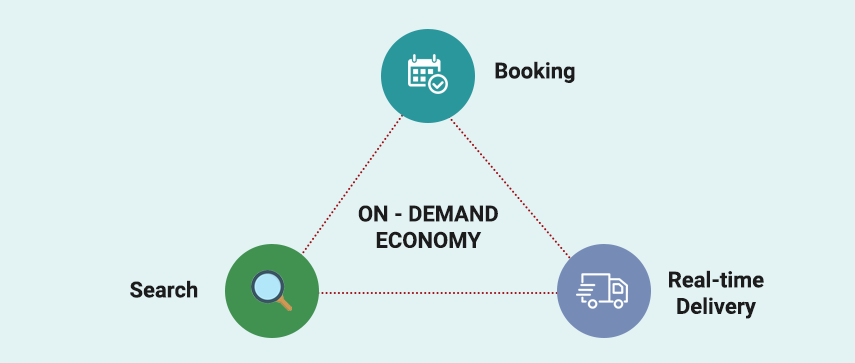
Not long ago, waiting was simply part of everyday life.
You waited for a taxi.
You waited for a movie to arrive in the mail.
You waited for a bank to open.
You waited for a customer service representative to call you back.
Businesses organized themselves around schedules.
Customers adapted.
Then something fundamental shifted.
People stopped asking, "When can I get it?"
Instead, they began asking, "Why can't I get it now?"
That change wasn't merely technological. It was psychological.
Expectations evolved.
Convenience became the baseline.
Immediate access became a competitive advantage.
This transformation gave rise to what we now call the on-demand economy—a business model centered on providing products and services exactly when customers want them, often with minimal friction and remarkable speed.
Yet the most interesting aspect of the on-demand economy isn't speed.
It's the relationship between immediacy and value.
Businesses increasingly compete not only on what they offer but also on how effortlessly customers can receive it.
Understanding that distinction helps explain why on-demand businesses have reshaped industries ranging from transportation and entertainment to healthcare, education, and retail.
What Is the On-Demand Economy?
The on-demand economy is an economic model in which consumers gain immediate or near-immediate access to products, services, or experiences whenever they choose, typically through digital platforms.
Rather than operating according to fixed schedules or traditional purchasing cycles, on-demand businesses prioritize flexibility and convenience.
Customers decide:
- When they want something
- How they want it delivered
- Where they want to access it
- Which provider best fits their needs
Businesses respond in real time.
That responsiveness defines the model.
Why the On-Demand Economy Emerged
Several long-term trends converged to create this shift.
Mobile technology placed entire marketplaces inside people's pockets.
Cloud computing enabled businesses to scale rapidly.
Digital payments reduced transaction friction.
Location-based services connected customers with nearby providers almost instantly.
But technology alone doesn't explain the change.
Consumer expectations evolved just as dramatically.
People became accustomed to immediate access.
Once that expectation formed in one industry, it spread to others.
A customer who could stream a movie instantly began expecting equally convenient banking, healthcare, education, and shopping experiences.
Convenience became contagious.
Core Characteristics of the On-Demand Economy
Although industries differ, successful on-demand businesses typically share several defining characteristics.
Immediate Access
Customers receive products or services quickly after requesting them.
The waiting period becomes dramatically shorter than in traditional models.
Customer Control
Consumers determine timing rather than adapting to business schedules.
The customer drives the experience.
Digital Platforms
Most on-demand businesses rely on websites or mobile applications that simplify ordering, payment, communication, and delivery.
Technology coordinates the relationship.
Flexible Supply
Many businesses dynamically match customer demand with available resources.
This flexibility improves efficiency while reducing unnecessary delays.
Comparing Traditional and On-Demand Business Models
The operational differences are significant.
| Business Characteristic | Traditional Model | On-Demand Model |
|---|---|---|
| Customer Access | Scheduled availability | Immediate or near-immediate access |
| Purchasing Process | Multiple steps | Streamlined digital experience |
| Service Timing | Business determines schedule | Customer determines timing |
| Customer Expectations | Planned transactions | Instant fulfillment |
| Revenue Pattern | Often transactional | Transactional, subscription, or hybrid |
| Technology Role | Operational support | Core business infrastructure |
Neither model is inherently superior.
Each serves different customer needs.
However, industries with high demand for convenience often gravitate toward on-demand experiences.
Industries Driving the On-Demand Economy
The on-demand model now appears across remarkably diverse sectors.
Transportation
Ride-sharing platforms transformed expectations around personal transportation.
Instead of scheduling rides well in advance, customers increasingly expect vehicles to arrive within minutes.
Entertainment
Streaming services replaced rigid programming schedules with instant access to enormous content libraries.
Consumers now choose what to watch—and when.
Food Delivery
Restaurants expanded beyond physical dining rooms through digital ordering and rapid delivery.
Convenience became part of the product itself.
Healthcare
Virtual consultations, prescription delivery, and digital appointment scheduling have made many healthcare services significantly more accessible.
Education
Learning platforms increasingly provide immediate enrollment, self-paced instruction, and continuous access to educational resources.
Learning no longer depends exclusively on classroom schedules.
The Relationship Between On-Demand and Membership
Interestingly, many organizations combine on-demand convenience with recurring membership.
Instead of paying for every individual transaction, customers pay recurring fees for continuous access.
Examples include:
- Unlimited streaming libraries
- Premium educational platforms
- Fitness memberships with digital classes
- Professional learning communities
- Software subscriptions
The combination is powerful.
On-demand delivers convenience.
Membership creates continuity.
Together, they encourage long-term customer relationships.
A Lesson I Learned About Convenience
Several years ago, I worked with an organization that believed adding more content would increase customer satisfaction.
Every quarter, the library expanded.
More articles.
More videos.
More resources.
Usage barely changed.
When we interviewed customers, the feedback surprised everyone.
They weren't asking for more material.
They were asking for easier access.
Navigation felt complicated.
Finding relevant resources required too many clicks.
Search results were inconsistent.
The organization invested less in creating additional content and more in simplifying the experience.
Engagement increased almost immediately.
That project reinforced an important lesson.
Customers often value accessibility as much as abundance.
Convenience isn't superficial.
It's part of the value proposition.
The Advantages of the On-Demand Economy
Organizations embracing on-demand models frequently experience several important benefits.
Greater Customer Satisfaction
Reducing delays improves the overall customer experience.
People appreciate receiving help when they need it.
Higher Engagement
Easy access encourages more frequent usage.
The less friction involved, the more likely customers are to return.
Better Resource Utilization
Digital platforms often allocate resources more efficiently, matching supply with demand as conditions change.
Increased Business Agility
On-demand organizations can respond more quickly to changing customer preferences and market conditions.
Flexibility becomes a competitive strength.
Challenges of the On-Demand Economy
Despite its advantages, the model presents meaningful challenges.
Rising Customer Expectations
Fast service quickly becomes the new standard.
Businesses must continuously improve to remain competitive.
Operational Complexity
Delivering services quickly requires sophisticated logistics, technology, and coordination.
Behind every seamless customer experience lies substantial operational planning.
Balancing Speed and Quality
Customers expect rapid delivery without sacrificing reliability.
Meeting both expectations consistently requires discipline.
Customer Loyalty
Convenience attracts customers.
It doesn't always keep them.
Organizations must still earn trust through quality, service, and ongoing value.
On-Demand Is Not the Same as Instant Gratification
One misconception deserves attention.
The on-demand economy is not simply about making everything faster.
It's about removing unnecessary friction.
Sometimes immediate delivery matters.
Sometimes flexible scheduling matters more.
Sometimes customers simply want confidence that access will be available when needed.
The best on-demand businesses understand that convenience should support meaningful outcomes—not replace them.
The Future of the On-Demand Economy
Artificial intelligence will personalize recommendations more accurately.
Predictive analytics will anticipate customer needs before requests are made.
Automation will simplify fulfillment.
Connected devices will streamline everyday purchasing decisions.
These innovations will undoubtedly improve efficiency.
Yet the organizations that thrive will continue focusing on something fundamentally human.
Helping customers accomplish important tasks with less effort and greater confidence.
Technology provides the infrastructure.
Trust sustains the relationship.
Convenience Is a Promise
Perhaps the greatest misunderstanding about the on-demand economy is that it revolves around technology.
Technology certainly enables it.
But technology is not the promise.
The promise is reliability.
When customers request something, they expect it to be available.
Consistently.
Predictably.
Without unnecessary complexity.
That expectation shapes every interaction.
Organizations that repeatedly fulfill that promise earn something far more valuable than individual transactions.
They earn preference.
The Better Question
Many business leaders ask:
"What is the on-demand economy?"
The definition is relatively straightforward.
It is a model built around delivering products and services whenever customers need them.
The more revealing question is different.
"What problem disappears when customers no longer have to wait?"
That question changes strategic thinking.
It shifts attention away from technology and toward customer experience.
Because the most successful on-demand businesses are not competing to be the fastest simply for the sake of speed.
They are competing to remove friction.
To simplify decisions.
To reduce effort.
To respect customers' time.
Ultimately, the on-demand economy is not about instant access alone.
It is about designing businesses around the rhythms of customers' lives rather than asking customers to adapt to the rhythms of the business.
Organizations that understand this principle often discover that convenience is not merely an operational feature.
It becomes part of the relationship itself.
And relationships built on consistent value—delivered exactly when customers need it—have a remarkable way of enduring.
- Arts
- Business
- Computers
- Jocuri
- Health
- Home
- Kids and Teens
- Money
- News
- Personal Development
- Recreation
- Regional
- Reference
- Science
- Shopping
- Society
- Sports
- Бизнес
- Деньги
- Дом
- Досуг
- Здоровье
- Игры
- Искусство
- Источники информации
- Компьютеры
- Личное развитие
- Наука
- Новости и СМИ
- Общество
- Покупки
- Спорт
- Страны и регионы
- World

 English
 Russian
 French
 Spanish
 Portuguese
 Deutsch
 Turkish
 Dutch
Dutch
 Italiano
 Arabic
 Portuguese (Brazil)
 Greek
Greek