
What is decision making?
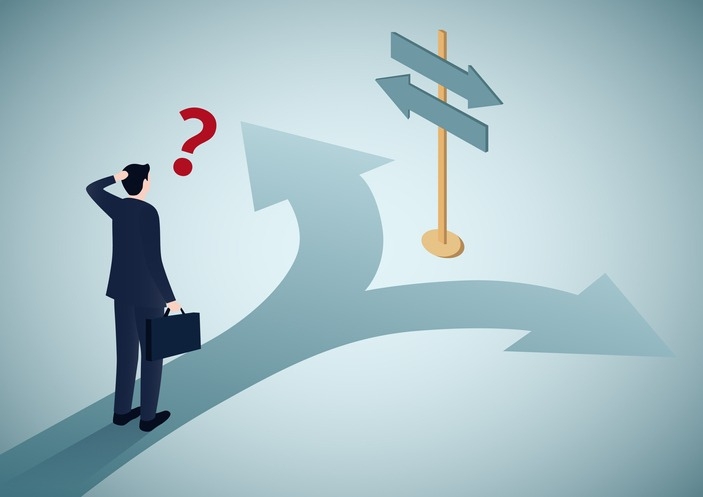
The Architecture of the Pivot
We imagine decision-making to be a formal process. We visualize a scale. We place the options on either side. We add the weights of logic, the data of the past, the expectations of our peers, and the projected outcomes of our future. We wait for the needle to tip, and we call the result a choice.
But this is an illusion. We are not weighing options. We are projecting ghosts.
Decision-making is not a cerebral task of calculation. It is the act of aligning yourself with the frequency of your own intuition. It is the practice of stripping away the layers of "should" until you are left with the raw signal of what actually is. Every time you make a choice, you are not choosing a path; you are defining the geometry of your own existence. You are creating the shape of the room you will inhabit for the next period of your life.
   [ THE EXTERNAL NOISE ] (The Expectations / The Logic / The Fear)
                │
                ▼
   [ THE SACRED PAUSE ] <─── Removing the need to be "right."
                │
                ▼  (The Uncluttered Witness)
   [ THE SOVEREIGN INTUITION ]
                │
                ▼
   [ THE PIVOT ] ──► The path is not chosen; it is realized.
If you are struggling to decide, it is not because you lack data. It is because you are addicted to the safety of the outcome. You are trying to guarantee a result before you have even taken the step. To make a decision, you must be willing to let go of the result entirely. You must be willing to walk into the dark, trusting that the light is not something you carry—it is something you encounter.
The Geography of the Mental Audit
We live in a culture that rewards the "decisive." We treat the quick, unthinking snap of a finger as a sign of strength. But the most powerful decisions are the ones that arise from a foundation of profound stillness.
The Horizontal Tension (The Collision of Premises)
We are limited by the circumference of our own narratives. When we face a choice, we often find ourselves trapped between two variations of the same mistake.
-
The audit of the framework: Before you decide, ask yourself: What is the assumption that is forcing this choice? If you find yourself choosing between two versions of "more," you aren't deciding; you are just choosing the flavor of your own anxiety.
-
The architecture of the neutral stance: The decision is never between "this" and "that." The decision is between the expansion of your own truth and the contraction of your own comfort. When you frame it this way, the options often disappear, leaving only the direction that feels like the truth.
The Vertical Extraction (The Deep Descent)
The analytical mind is a useful servant, but a terrible master. If you rely on it to make your decisions, you will always end up with a logical conclusion—and a hollow result.
-
The silent audit: Present yourself with the decision and stop. Do not think. Do not talk. Do not write a list. Just sit with the weight of the moment. Notice where your body creates tension. Notice where the breath catches. The body knows the decision before the mind has even started to justify it.
-
The subtraction of the secondary metric: We are trained to ask, "What is the ROI?" "What will people think?" "Will I be safe?" These are distractions. These are metrics of the cage. The only question that matters is, "Is this move honest?"
A Lesson from the Muted Session
In the late autumn of two thousand and twelve, I was in a studio with a filmmaker who was at a complete standstill. He had a two-hour edit and no idea which version of the story to release. He had been debating the ending for months. He had shown it to executives, to friends, and to focus groups. He had reams of feedback.
He was drowning in the advice of others. He had a different, "logical" reason for every single frame of the film. He could defend any choice he made. But he couldn't feel any of them.
I asked him to turn off the monitors. We sat in the dark for an hour. I didn't let him speak. I didn't let him analyze the plot points. I told him to focus on the feeling of the film—not the story, but the texture of the sound, the rhythm of the cut, the emotion of the light.
"If you take away all the reasons, what does the film want to be?" I asked.
He was quiet for a long time. Then he laughed. "It wants to be shorter," he said. "The ending I’ve been fighting for is a lie I’ve been telling to please the studio."
[ The Analytical Trap ]   ──► Collect Opinions / Defend the Logic / The Dead Cut
[ The Sovereign Pivot ]   ──► Listen to the Film / Trust the Rhythm / The Living Cut
He went back in, cut thirty minutes in a single day, and found the soul of the work. He didn't make a "better" decision based on data; he made a more honest decision based on alignment. He learned that decision-making isn't about solving a puzzle. It’s about removing the obstacles that keep you from seeing the solution that’s already there.
The Landscape of the Sovereign Discernment
Decision-making is not a skill you acquire. It is a presence you cultivate. It is a way of being in the world that prioritizes the resonance of the truth over the efficiency of the outcome.
| The Arena | The Standardized Manager | The Vertical Auditor | The Sovereign Discernor |
| The Primary Metric | Consistency; how well does this fit the established plan? | Integration; does this move support the integrity of the witness? | Resonance; is this move an alignment with the nature of the reality? |
| The Internal Speed | High-velocity; the race to decide before the doubt sets in. | Interrupted; the creation of a deliberate vacuum between the stimulus and the choice. | A metronomic stillness that waits for the light to clarify the path. |
| The Operational Tool | Addition. Bringing more experts, more data, and more safety nets into the room. | Subtraction. Clearing the table until only the irreducible bone of the truth remains. | An effortless presence that sees the move because it has stopped fighting the terrain. |
| The Human Hazard | Becoming a high-fidelity echo of a narrative that is functionally empty. | Turning into a skeptic who disassembles the process but loses the spirit. | The realization that the decision must serve the life, not the ego of the decision-maker. |
The Fortress of the Certified Illusion
There is a clean, sophisticated failure that waits for the person who masters the art of "rational decision-making." They use frameworks, they use decision-matrices, they use all the latest behavioral science, and they can justify their choices with such surgical precision that the entire boardroom will stand and applaud.
They are the masters of the optimization. They can guarantee the risk profile, they can map the contingencies, and they can ensure that their reputation remains untouched. But the work they produce, the lives they lead, are as stale as the air in a sealed room. They have mastered the method, but they have forgotten how to live.
   [ THE METRIC CLERK ]      ──► Catalogs the risks ──► Asks "Is it safe?"   ──► The Grid of Iron
   [ THE ISOLATED THEORY ]   ──► Debates the method ──► Asks "Who agrees?"  ──► The Stagnant Water
   [ THE SOVEREIGN WITNESS ] ──► Touches the material ──► Asks "What is true?" ──► The Clear Ground
If you only use your decision-making to optimize the narrative you were told to carry, you are not deciding. You are simply becoming a more efficient operator of someone else’s narrow, frightened vision. You are using your intellect to build a more comfortable prison cell for the truth.
The Cleansing of the Room
We do not manufacture the truth. We merely wash the soot off the window so the light can show us where the floorboards are honest.
The institutions will continue to offer you an endless menu of convenient fictions, tailored specifically to match the requirements of the marketplace. They will tell you that the polish of the data is the measure of the intelligence. They will tell you that the speed of the choice is the measure of the leadership.
The decision to practice true, sovereign discernment is a radical act of spiritual hygiene.
It is the choice to step into the room and exist without the armor of the explanation. It is the decision to lay down your need to be "correct," to look at the crossroad until the noise of your own expectations runs out of fuel, and to wait for the movement that arrives from the marrow of your own bones rather than the ledger of your own history. Trust the silent weight of your own direct presence, drop the obligation to defend your choice, and let the false structures of the reasoning dissolve in the sun.
- Arts
- Business
- Computers
- Jeux
- Health
- Domicile
- Kids and Teens
- Argent
- News
- Personal Development
- Recreation
- Regional
- Reference
- Science
- Shopping
- Society
- Sports
- Бизнес
- Деньги
- Дом
- Досуг
- Здоровье
- Игры
- Искусство
- Источники информации
- Компьютеры
- Личное развитие
- Наука
- Новости и СМИ
- Общество
- Покупки
- Спорт
- Страны и регионы
- World

 English
 Russian
 Spanish
 Portuguese
 Deutsch
 Turkish
 Dutch
Dutch
 Italiano
 Arabic
 Romaian
 Portuguese (Brazil)
 Greek
Greek