
Which On-Demand Services Are Most Popular?
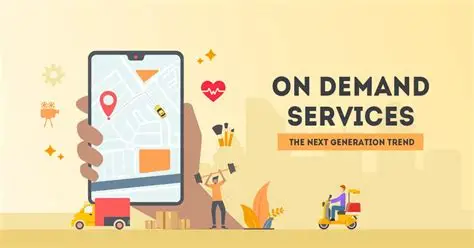
Popularity is an interesting measure.
It doesn't necessarily reveal which businesses are the most innovative.
Or the most profitable.
It tells us something arguably more important.
It shows which services have become so woven into everyday life that we stop noticing them.
Think about the last 24 hours.
Perhaps you streamed music while making breakfast.
Ordered lunch through your phone.
Transferred money between bank accounts.
Scheduled a ride to the airport.
Booked a virtual doctor's appointment.
Purchased groceries without entering a store.
None of these actions feels particularly extraordinary anymore.
That's the hallmark of a successful on-demand service.
It disappears into the background.
The technology matters less than the experience it creates.
Customers simply expect that whatever they need—whether transportation, entertainment, education, or professional advice—will be available at the moment they decide they need it.
This shift has transformed entire industries.
More importantly, it has transformed customer expectations.
Understanding which on-demand services have become the most popular helps explain not only where businesses have succeeded, but why convenience has become one of the defining competitive advantages of modern commerce.
What Is an On-Demand Service?
An on-demand service enables customers to access products, expertise, or experiences whenever they choose, rather than according to predetermined schedules.
Digital platforms typically coordinate:
- Ordering
- Scheduling
- Payment
- Communication
- Fulfillment
- Customer support
The defining feature isn't speed alone.
It's customer control.
Businesses adapt to customer timing—not the reverse.
Why Certain On-Demand Services Become Popular
Popularity rarely happens by accident.
The most widely adopted services usually solve one or more common problems.
They help customers:
- Save time
- Reduce effort
- Eliminate uncertainty
- Increase flexibility
- Access expertise more easily
The less friction involved, the more frequently people use the service.
Eventually, convenience becomes habit.
1. Transportation Services
Transportation remains one of the most recognizable examples of the on-demand economy.
Instead of planning around fixed schedules or calling dispatch centers, customers request rides whenever necessary.
Key advantages include:
- Immediate availability
- GPS tracking
- Digital payments
- Transparent pricing
- Flexible scheduling
Transportation demonstrated that real-time coordination could dramatically improve everyday experiences.
2. Food Delivery
Food delivery has become an essential part of many consumers' routines.
Customers browse menus, customize meals, pay digitally, and monitor deliveries from preparation through arrival.
Restaurants expand their reach.
Customers gain flexibility.
Everyone saves time.
Convenience becomes part of the dining experience.
3. Grocery Delivery
Grocery shopping increasingly extends beyond physical stores.
Popular features include:
- Same-day delivery
- Scheduled delivery windows
- Personal shopping
- Digital inventory
- Saved shopping lists
Busy households often value time savings as much as product selection.
4. Streaming Entertainment
Entertainment underwent one of the earliest and most visible transformations.
Instead of waiting for scheduled programming, audiences now decide:
- What to watch
- When to watch
- Which device to use
- How long to engage
Streaming placed control firmly in the hands of customers.
That expectation now influences many other industries.
5. Music Streaming
Music became similarly flexible.
Rather than purchasing individual albums or waiting for radio broadcasts, listeners access enormous libraries instantly.
Recommendations improve over time.
Personalization enhances discovery.
Convenience encourages continuous engagement.
6. Healthcare Services
Healthcare increasingly incorporates on-demand experiences where appropriate.
Examples include:
- Virtual consultations
- Appointment scheduling
- Prescription renewals
- Patient messaging
- Remote monitoring
While emergency and specialized care still require traditional delivery models, many routine interactions have become substantially more accessible.
7. Banking and Financial Services
Many customers rarely visit physical bank branches anymore.
Instead, they expect immediate access to:
- Account balances
- Transfers
- Bill payments
- Mobile deposits
- Investment management
Financial services increasingly operate according to customer schedules rather than banking hours.
8. Online Education
Learning continues expanding beyond classrooms.
Popular on-demand educational services include:
- Self-paced courses
- Professional certifications
- Recorded lectures
- Skills training
- Digital learning libraries
Students determine both pace and timing.
Learning becomes considerably more flexible.
9. Home Services
Household maintenance has become easier to coordinate.
Customers schedule:
- Cleaning
- Plumbing
- Electrical work
- Appliance repair
- Lawn care
- Furniture assembly
Digital platforms simplify communication while improving scheduling transparency.
10. Professional Expertise
Consulting, coaching, legal advice, financial planning, and technical support increasingly operate through virtual appointments.
Experts reach broader audiences.
Customers receive assistance without geographic limitations.
Convenience benefits both parties.
Comparing Today's Most Popular On-Demand Services
Although these industries differ considerably, their customer experiences reveal striking similarities.
| Service Category | Customer Need | Delivery Method | Primary Value |
|---|---|---|---|
| Transportation | Mobility | Driver network | Immediate travel |
| Food Delivery | Meals | Delivery partner | Convenience |
| Grocery | Shopping | Personal shopper | Time savings |
| Streaming Video | Entertainment | Digital library | Customer choice |
| Music Streaming | Audio content | Cloud platform | Instant access |
| Healthcare | Medical guidance | Virtual consultation | Accessibility |
| Banking | Financial management | Mobile platform | Flexibility |
| Education | Skill development | Digital learning | Self-paced access |
| Home Services | Maintenance | Service professional | Simplified scheduling |
| Professional Services | Expert advice | Virtual meetings | Efficient expertise |
Different industries.
One common objective.
Reduce unnecessary effort.
Why Some On-Demand Services Become Daily Habits
Not every convenient service becomes indispensable.
The most popular ones share several characteristics.
They Solve Frequent Problems
Transportation.
Meals.
Banking.
Entertainment.
People encounter these needs repeatedly.
High-frequency use naturally drives adoption.
They Remove Friction
Successful services simplify complicated processes.
Ordering.
Scheduling.
Paying.
Communicating.
Tracking.
Each improvement compounds over time.
They Build Trust
Customers repeatedly return when businesses consistently deliver reliable experiences.
Convenience attracts attention.
Trust sustains usage.
On-Demand Services and Membership Models
Interestingly, many of today's most successful on-demand businesses also incorporate recurring memberships.
Examples include:
- Streaming platforms
- Digital fitness programs
- Educational communities
- Software platforms
- Premium retail memberships
Membership complements convenience.
Instead of paying for every interaction individually, customers receive continuous access.
Businesses benefit from recurring revenue.
Customers enjoy greater simplicity.
Relationships become stronger.
A Lesson I Learned About Convenience
Several years ago, I worked with a professional association trying to increase participation in its educational programs.
Leadership believed members needed additional webinars.
The organization invested heavily in producing more content.
Attendance barely changed.
When we interviewed members, the problem became surprisingly clear.
People appreciated the content.
They simply couldn't access it conveniently.
Recordings were difficult to locate.
Search functions felt inconsistent.
Resources appeared scattered across multiple systems.
Rather than producing more material, the organization focused on accessibility.
Centralized navigation.
Personalized recommendations.
Improved search.
Engagement rose quickly.
That experience reinforced something I've observed repeatedly.
Customers often don't need more options.
They need existing value delivered with less effort.
Convenience unlocks participation.
Challenges Facing On-Demand Services
Popularity creates opportunity.
It also creates pressure.
Rising Customer Expectations
Once consumers experience exceptional convenience, they expect similar experiences everywhere.
Excellent service quickly becomes the baseline.
Operational Complexity
Simple customer experiences often require remarkably sophisticated logistics behind the scenes.
Scheduling.
Payments.
Support.
Inventory.
Technology.
Everything must work together seamlessly.
Maintaining Quality
Fast delivery means little if reliability suffers.
Organizations must balance responsiveness with consistency.
The Future of Popular On-Demand Services
Artificial intelligence will personalize recommendations more effectively.
Automation will simplify routine transactions.
Predictive technologies may anticipate customer needs before requests occur.
Voice interfaces and connected devices will further reduce friction.
Yet the most successful businesses will continue focusing on something surprisingly timeless.
Helping customers accomplish meaningful tasks with less effort.
Technology will evolve.
Human appreciation for convenience will remain remarkably consistent.
Popularity Reflects More Than Technology
It is tempting to assume that the popularity of on-demand services stems primarily from impressive software.
Technology certainly matters.
But technology alone rarely explains sustained adoption.
Customers continue using services that respect their time.
That communicate clearly.
That consistently deliver what they promise.
That simplify everyday decisions.
Convenience earns attention.
Reliability earns loyalty.
The strongest businesses deliver both.
The Better Question
Business leaders frequently ask:
"Which on-demand services are most popular?"
Transportation.
Food delivery.
Streaming media.
Healthcare.
Education.
Banking.
Home services.
Professional expertise.
The list continues expanding.
A more revealing question is this:
"Which moments in our customers' lives still involve unnecessary waiting, uncertainty, or effort?"
That question shifts the conversation away from industries and toward experiences.
Because the most popular on-demand services are not simply those that adopted mobile apps first.
They are the organizations that consistently removed friction from everyday life.
They respected customers' schedules.
Simplified decisions.
Delivered confidence alongside convenience.
Those qualities transcend industries.
And as customer expectations continue evolving, they are likely to become even more valuable than speed alone.
- Arts
- Business
- Computers
- Giochi
- Health
- Home
- Kids and Teens
- Money
- News
- Personal Development
- Recreation
- Regional
- Reference
- Science
- Shopping
- Society
- Sports
- Бизнес
- Деньги
- Дом
- Досуг
- Здоровье
- Игры
- Искусство
- Источники информации
- Компьютеры
- Личное развитие
- Наука
- Новости и СМИ
- Общество
- Покупки
- Спорт
- Страны и регионы
- World

 English
 Russian
 French
 Spanish
 Portuguese
 Deutsch
 Turkish
 Dutch
Dutch
 Arabic
 Romaian
 Portuguese (Brazil)
 Greek
Greek