
What Are the Differences Between Public, Private, and Hybrid PaaS?
The Cloud Decision That Wasn't Really About the Cloud
A technology executive once told me, "We thought we were choosing a cloud platform. It turned out we were choosing how our company would work for the next decade."
At first, I assumed he was exaggerating.
Then he described the conversations behind the decision.
The engineering team wanted speed. Security leaders wanted tighter controls. Finance preferred predictable costs. Product managers wanted developers shipping new features every week instead of maintaining infrastructure. Compliance teams had their own list of requirements, each one legitimate and non-negotiable.
The debate wasn't about technology specifications. It was about priorities.
Eventually, they realized they weren't asking whether Platform as a Service (PaaS) was the right model. They were asking which kind of PaaS aligned with their business.
That distinction matters more than many organizations realize.
Public, private, and hybrid PaaS all provide a platform for building and deploying applications. Yet each reflects a different philosophy about control, flexibility, security, and operational responsibility.
Choosing among them isn't simply an IT decision. It's a strategic decision about where innovation happens, how risk is managed, and what kind of organization you're trying to build.
Understanding PaaS Before Comparing Deployment Models
Platform as a Service gives developers a managed environment for building, testing, deploying, and maintaining applications. Instead of configuring servers, installing runtime environments, patching operating systems, or managing middleware, developers can focus on writing code and delivering customer value.
That foundational idea stays the same regardless of deployment model.
What changes is where the platform lives, who manages it, and how much control the organization retains.
Think of PaaS as the workshop where software gets built.
Public, private, and hybrid PaaS differ in who owns the workshop, who maintains it, and who has access to it.
What Is Public PaaS?
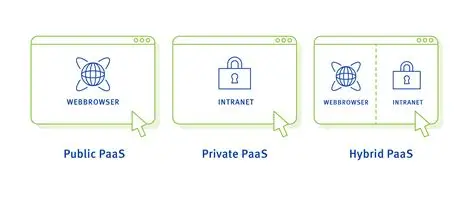
Public PaaS is delivered through a cloud provider that hosts the platform in a shared cloud environment.
The provider manages infrastructure, platform maintenance, operating systems, updates, scalability, and much of the operational complexity.
Customers build and deploy applications without owning the underlying infrastructure.
For many organizations, this creates an appealing proposition.
Developers spend less time on maintenance and more time creating products.
Strengths of Public PaaS
Rapid deployment
Development environments can often be provisioned quickly, reducing delays before coding begins.
Lower upfront investment
Organizations avoid purchasing servers and maintaining physical infrastructure.
Elastic scalability
Resources can expand or contract as demand changes.
Continuous platform updates
Providers maintain the underlying environment, reducing operational overhead.
Public PaaS is often the preferred choice for startups, software companies, innovation teams, and businesses seeking speed over infrastructure customization.
What Is Private PaaS?
Private PaaS delivers many of the same development capabilities but within infrastructure dedicated to a single organization.
The environment may reside in a company's own data center or within dedicated cloud resources.
Unlike public platforms, private PaaS gives organizations greater influence over infrastructure policies, networking, security configurations, and compliance requirements.
The trade-off is straightforward.
More control generally requires greater operational responsibility.
Strengths of Private PaaS
Enhanced governance
Organizations establish infrastructure policies that align with internal standards.
Greater data control
Sensitive information remains within dedicated environments.
Regulatory flexibility
Private environments can support industry-specific compliance obligations.
Infrastructure customization
IT teams can tailor platform components to specialized business needs.
Private PaaS frequently appeals to organizations operating in heavily regulated industries or supporting mission-critical enterprise workloads.
What Is Hybrid PaaS?
Hybrid PaaS combines elements of both public and private environments.
Rather than treating deployment as an either-or decision, organizations place different applications and workloads where they make the most sense.
Customer-facing applications might operate on a public platform for scalability.
Sensitive internal systems may remain within private infrastructure.
Developers interact with both environments through integrated workflows whenever possible.
Hybrid PaaS recognizes something many organizations eventually discover.
Not every application has identical requirements.
Public, Private, and Hybrid PaaS Compared
| Feature | Public PaaS | Private PaaS | Hybrid PaaS |
|---|---|---|---|
| Infrastructure Ownership | Cloud provider | Dedicated to one organization | Combination of provider and dedicated resources |
| Deployment Speed | Fast | Moderate | Varies by workload |
| Upfront Cost | Lower | Higher | Moderate |
| Operational Responsibility | Lowest | Highest | Shared |
| Scalability | Highly elastic | Depends on available infrastructure | Flexible across environments |
| Customization | Moderate | Extensive | High |
| Security Control | Shared responsibility | Greater organizational control | Tailored by workload |
| Compliance Support | Strong for many standards, but shared environment | Ideal for specialized regulatory needs | Adaptable to varying requirements |
| Typical Use Cases | Startups, SaaS products, web applications | Government, healthcare, financial services | Large enterprises with mixed workloads |
| Primary Advantage | Speed and simplicity | Control and governance | Balance and flexibility |
The comparison highlights an important reality.
No deployment model wins every category.
Each optimizes a different set of priorities.
When Public PaaS Is the Right Choice
Public PaaS excels when organizations value agility.
Consider situations where:
Product Development Moves Quickly
Frequent software releases benefit from managed infrastructure and automated scaling.
Budgets Favor Operating Expenses
Public platforms reduce capital investment by shifting infrastructure costs toward subscription-based services.
Internal IT Resources Are Limited
Smaller teams often gain significant productivity when platform maintenance becomes someone else's responsibility.
Demand Is Unpredictable
Elastic cloud resources simplify planning for seasonal traffic spikes or rapid customer growth.
For organizations focused on innovation velocity, public PaaS often removes operational friction.
When Private PaaS Makes More Sense
Not every organization can prioritize convenience above all else.
Private PaaS often becomes attractive when:
Data Sensitivity Is High
Organizations handling confidential information may require dedicated infrastructure and stricter governance.
Regulatory Requirements Are Complex
Industry regulations sometimes dictate how systems are configured and where data resides.
Existing Enterprise Systems Require Deep Integration
Older systems frequently benefit from infrastructure customization unavailable in public platforms.
Internal Standards Drive Architecture
Some organizations maintain technical standards that extend beyond what public environments allow.
Private PaaS emphasizes consistency, governance, and control.
Why Hybrid PaaS Is Becoming More Common
One lesson I've learned over the years is that technology decisions rarely stay static.
Organizations evolve.
Applications multiply.
Regulations change.
Customer expectations shift.
I once worked with a company that initially believed every application belonged in a public cloud environment. For the first few years, that approach worked remarkably well.
Then acquisitions introduced legacy systems. Compliance requirements expanded. Customer-facing services continued growing rapidly, while internal applications demanded tighter governance.
Suddenly, one deployment model no longer fit every workload.
Rather than abandoning their original strategy, they adopted a hybrid approach.
Customer applications remained on public PaaS because speed mattered.
Sensitive operational systems moved into a private environment where governance mattered more.
The lesson wasn't that hybrid PaaS was inherently better.
It was that flexibility often becomes more valuable as organizations mature.
The Hidden Decision Behind Every PaaS Strategy
Technology discussions often emphasize architecture diagrams.
The more interesting conversation concerns organizational attention.
Public PaaS reduces operational work by placing more responsibility on the provider.
Private PaaS increases organizational control while asking internal teams to manage more of the environment.
Hybrid PaaS distributes responsibility according to business priorities.
Viewed this way, deployment models become choices about focus.
What should your teams own?
What should trusted providers manage?
Answer those questions well, and the technology decision often becomes much clearer.
Five Questions to Guide Your Decision
Before selecting a deployment model, ask:
- How sensitive is the data our applications process?
- Which regulations shape our technology decisions?
- Do we need extensive infrastructure customization?
- How important are rapid development and automatic scalability?
- Will different applications benefit from different deployment environments?
These questions shift the conversation away from technical preferences and toward business outcomes.
That's where durable decisions are made.
Conclusion
Public, private, and hybrid PaaS all share the same objective: helping development teams build and deliver applications without managing every layer of infrastructure.
Where they differ is in how they balance speed, control, governance, scalability, and operational responsibility.
Public PaaS emphasizes simplicity and rapid innovation.
Private PaaS prioritizes governance, customization, and dedicated control.
Hybrid PaaS recognizes that modern organizations rarely have just one kind of workload, allowing them to match each application with the environment that best supports its goals.
The most effective strategy isn't determined by whichever deployment model appears most sophisticated.
It's determined by alignment.
When technology choices reflect business priorities rather than assumptions, development teams spend less time navigating unnecessary complexity and more time creating solutions that customers, employees, and partners genuinely value.
That may be the most important distinction of all.
- Arts
- Business
- Computers
- Игры
- Health
- Главная
- Kids and Teens
- Деньги
- News
- Personal Development
- Recreation
- Regional
- Reference
- Science
- Shopping
- Society
- Sports
- Бизнес
- Деньги
- Дом
- Досуг
- Здоровье
- Игры
- Искусство
- Источники информации
- Компьютеры
- Личное развитие
- Наука
- Новости и СМИ
- Общество
- Покупки
- Спорт
- Страны и регионы
- World

 English
 French
 Spanish
 Portuguese
 Deutsch
 Turkish
 Dutch
Dutch
 Italiano
 Arabic
 Romaian
 Portuguese (Brazil)
 Greek
Greek