
What Are the Risks of Using PaaS?
The Risk Wasn't the Platform. It Was the Assumption.
I once joined a post-launch review for a company that had recently migrated one of its flagship applications to a Platform as a Service (PaaS) environment. On paper, everything looked promising. Deployment times had fallen from hours to minutes. Developers were shipping updates more frequently. Infrastructure maintenance had nearly disappeared from engineering meetings.
Then the conversation shifted.
A product manager asked why a planned feature had been delayed.
The answer surprised everyone outside engineering.
The team wasn't struggling with the feature itself. They were untangling platform-specific integrations that made the application harder to evolve than expected. At the same time, the security team was reviewing new compliance requirements that the existing architecture hadn't anticipated.
The migration wasn't a mistake.
The assumption was.
Leadership had treated PaaS as a solution without acknowledging that every solution introduces new constraints alongside new opportunities.
That's the real conversation organizations should have before adopting any cloud platform.
The question isn't whether Platform as a Service is risky.
Every technology strategy carries risk.
The better question is whether you understand which risks you're accepting—and whether they're worth the advantages you gain in return.
Why Every Cloud Decision Involves Trade-Offs
Platform as a Service simplifies application development by managing much of the underlying infrastructure. Providers typically handle servers, operating systems, runtime environments, middleware, scalability, and much of the operational maintenance.
Developers focus on building software instead of maintaining infrastructure.
For many organizations, that's an extraordinary advantage.
But abstraction comes with a price.
The more responsibility a provider assumes, the more your organization depends on the provider's architecture, roadmap, and operational decisions.
That dependency isn't inherently negative.
It simply changes where risk lives.
Risk #1: Vendor Lock-In Can Limit Future Flexibility
One of the most widely discussed PaaS risks is vendor lock-in.
Modern PaaS platforms often offer managed databases, messaging services, authentication tools, deployment pipelines, monitoring solutions, and proprietary APIs.
These services make development easier.
They also encourage applications to become closely aligned with a specific ecosystem.
The immediate benefits are obvious.
Migration becomes the longer-term question.
Changing providers may require:
- Rewriting application components
- Replacing platform-specific APIs
- Retesting integrations
- Updating deployment pipelines
- Retraining development teams
Vendor lock-in isn't inevitable, but it deserves attention early—before applications become deeply dependent on proprietary services.
Risk #2: Reduced Infrastructure Control
PaaS intentionally hides infrastructure complexity.
That's part of its appeal.
However, organizations with specialized requirements sometimes discover that platform abstraction limits flexibility.
Examples include:
- Custom operating system configurations
- Specialized networking requirements
- Unique runtime environments
- Non-standard middleware
- Advanced performance tuning
When these capabilities become essential, organizations may find themselves constrained by platform limitations rather than enabled by them.
Control and simplicity rarely increase together.
Risk #3: Compliance Challenges
Many cloud platforms support well-established compliance frameworks.
Yet regulatory requirements vary dramatically across industries.
Financial institutions, healthcare providers, government agencies, and multinational enterprises often operate under unique obligations involving:
- Data residency
- Audit requirements
- Encryption standards
- Operational controls
- Access governance
A platform that satisfies one compliance framework may not satisfy another.
Organizations should evaluate compliance capabilities before migration rather than after deployment.
Risk #4: Shared Responsibility Misunderstandings
Perhaps the most underestimated risk isn't technical.
It's organizational.
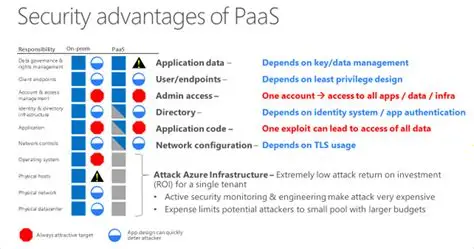
Many teams mistakenly believe moving to PaaS transfers responsibility for security to the provider.
It doesn't.
Providers generally secure the platform.
Customers remain responsible for:
- Application security
- Identity management
- User permissions
- API protection
- Data governance
- Secure coding
- Configuration management
When those responsibilities become unclear, security gaps often emerge—not because the platform failed, but because ownership was misunderstood.
Risk #5: Platform Outages
Even the most reliable cloud providers occasionally experience service disruptions.
Applications built entirely on managed platform services inherit those interruptions.
Unlike self-managed infrastructure, organizations have limited ability to troubleshoot or restore provider-managed components during a widespread outage.
This doesn't necessarily argue against PaaS.
It emphasizes the importance of resilience planning.
Organizations should ask:
- How long can our application tolerate downtime?
- Do we require geographic redundancy?
- What recovery options exist?
- Which services represent single points of failure?
Risk becomes more manageable when availability expectations are realistic.
Risk #6: Rising Costs at Scale
PaaS often reduces upfront investment.
Long-term economics can look different.
Managed services provide convenience through automation, integrated tooling, and reduced maintenance.
Those conveniences carry ongoing costs.
As applications grow, organizations sometimes discover that usage-based pricing exceeds the cost of operating comparable self-managed infrastructure.
The comparison isn't simply financial.
Higher platform fees may still produce greater business value if developers release products faster and operational staffing requirements remain lower.
The key is measuring total cost—not cloud invoices in isolation.
Risk #7: Performance Constraints
Highly specialized applications occasionally require infrastructure optimization beyond what managed platforms expose.
Examples include:
- Real-time financial systems
- High-performance scientific computing
- Specialized artificial intelligence workloads
- Low-latency industrial applications
PaaS intentionally standardizes infrastructure.
Most applications benefit from that consistency.
Some specialized workloads require greater control than standardized environments allow.
Risk #8: Technology Restrictions
Innovation rarely moves at a perfectly predictable pace.
Development teams sometimes want to adopt:
- Emerging programming languages
- Experimental frameworks
- Specialized databases
- New runtime versions
Managed platforms prioritize stability.
That often means officially supporting technologies only after extensive testing.
Organizations eager to adopt the newest tools may experience delays while providers update platform support.
Risk #9: Legacy Application Compatibility
Not every application fits naturally into a modern cloud platform.
Many enterprise systems were designed years before today's cloud-native architectures.
Dependencies on older operating systems, proprietary middleware, or tightly coupled infrastructure can complicate migration.
Modernizing these applications frequently requires additional investment.
The platform isn't creating the complexity.
It's exposing technical debt accumulated over time.
Risk #10: Skills and Organizational Readiness
Technology transformations are rarely successful through technology alone.
They require people to change as well.
Development teams adopting PaaS often need to learn:
- Cloud-native architecture
- Containerization concepts
- Continuous integration and deployment
- Infrastructure automation
- Identity and access management
- Cloud cost optimization
Without appropriate training, organizations may struggle to realize the productivity improvements they expected.
Platforms accelerate capable teams.
They don't automatically create them.
Comparing the Major Risks of PaaS
| Risk | Why It Occurs | Potential Business Impact | Mitigation Strategy |
|---|---|---|---|
| Vendor Lock-In | Dependence on proprietary services | Difficult migration | Favor portable architectures where practical |
| Limited Infrastructure Control | Managed platform abstraction | Reduced customization | Validate technical requirements before adoption |
| Compliance Challenges | Regulatory complexity | Audit or legal concerns | Map platform capabilities to compliance needs |
| Shared Responsibility Gaps | Unclear ownership | Security exposure | Define responsibilities explicitly |
| Platform Outages | Provider service disruption | Temporary downtime | Design for resilience and recovery |
| Rising Costs | Consumption-based pricing | Higher operating expenses | Monitor usage and optimize resources |
| Performance Constraints | Limited infrastructure tuning | Reduced optimization | Benchmark workloads before migration |
| Technology Restrictions | Managed platform support cycles | Slower adoption of new tools | Align technology roadmap with platform roadmap |
| Legacy Compatibility | Older architectures | Complex modernization | Assess migration readiness early |
| Skills Gaps | Organizational change | Slower implementation | Invest in cloud training and governance |
One pattern stands out.
Most risks aren't technical failures.
They're planning failures.
Organizations rarely encounter surprises because PaaS behaves unpredictably.
They encounter surprises because expectations weren't aligned with reality.
A Lesson That Changed My Perspective
Early in my career, I evaluated cloud platforms primarily through feature comparisons.
How many services were available?
How quickly could applications scale?
What deployment tools were included?
Eventually, I realized those weren't the questions separating successful implementations from disappointing ones.
The organizations that gained the most from PaaS weren't those choosing the "best" platform.
They were the ones that clearly understood what they expected the platform to do—and equally important, what they didn't expect it to do.
That distinction seems subtle.
In practice, it changes everything.
Successful cloud strategies aren't built on eliminating risk.
They're built on selecting risks intentionally.
Should These Risks Prevent You From Choosing PaaS?
Usually, no.
For many organizations, the benefits of PaaS—including faster development, simplified operations, automatic scaling, reduced infrastructure management, and improved developer productivity—far outweigh the risks.
The important consideration isn't whether risk exists.
It's whether the identified risks align with your business priorities.
A startup launching a new SaaS product may gladly accept some vendor dependency in exchange for rapid delivery.
A heavily regulated financial institution may prioritize infrastructure control and governance instead.
Neither decision is universally correct.
Both can be strategically sound.
Conclusion
Platform as a Service introduces genuine risks, including vendor lock-in, reduced infrastructure control, compliance complexity, shared security responsibilities, provider outages, evolving costs, performance limitations, technology constraints, migration challenges, and organizational readiness requirements.
Yet these risks shouldn't be viewed in isolation.
Every technology model shifts responsibility from one place to another.
PaaS shifts much of the operational burden away from infrastructure management and toward application development. In doing so, it asks organizations to trust a provider with more of the technology stack while taking greater ownership of architecture, governance, and software quality.
The most effective cloud strategies don't emerge from avoiding risk altogether.
They emerge from understanding which risks your organization is uniquely equipped to manage—and which responsibilities are better entrusted to a trusted platform provider.
That's the decision that matters far more than the technology itself.
- Arts
- Business
- Computers
- Juegos
- Health
- Home
- Kids and Teens
- Money
- News
- Personal Development
- Recreation
- Regional
- Reference
- Science
- Shopping
- Society
- Sports
- Бизнес
- Деньги
- Дом
- Досуг
- Здоровье
- Игры
- Искусство
- Источники информации
- Компьютеры
- Личное развитие
- Наука
- Новости и СМИ
- Общество
- Покупки
- Спорт
- Страны и регионы
- World

 English
 Russian
 French
 Portuguese
 Deutsch
 Turkish
 Dutch
Dutch
 Italiano
 Arabic
 Romaian
 Portuguese (Brazil)
 Greek
Greek