
Is PaaS Compliant with GDPR?
A founder once asked me a question that sounded deceptively simple.
His company had finally gained traction in Europe. New customers were arriving every week. Revenue was growing. The product team was celebrating.
Then a legal advisor asked where customer data was being stored.
The celebration paused.
The founder looked at his engineering lead.
The engineering lead looked at the cloud provider.
The cloud provider pointed toward documentation.
And suddenly everyone realized they were asking a much larger question:
If our application runs on a Platform as a Service, are we GDPR compliant?
What followed was a familiar journey. Meetings multiplied. Compliance checklists appeared. Technical teams reviewed infrastructure diagrams they had not examined in months.
The surprising lesson was that nobody had intentionally ignored privacy requirements. They simply assumed that using a reputable cloud platform automatically solved the problem.
It didn't.
And that misconception remains remarkably common.
Organizations often ask whether PaaS is GDPR compliant as though compliance were a product feature that can be switched on.
The reality is more nuanced.
More important.
And, ultimately, more useful to understand.
The Short Answer: PaaS Can Support GDPR Compliance, But It Does Not Automatically Make You Compliant
Let's begin with the most important distinction.
A PaaS provider can offer infrastructure, controls, certifications, and contractual commitments that support GDPR requirements.
However, using a GDPR-ready platform does not automatically make an organization GDPR compliant.
Compliance is a shared responsibility.
The platform provider has obligations.
The customer organization has obligations.
Neither party can satisfy the regulation independently.
This distinction sits at the center of nearly every GDPR discussion involving cloud platforms.
Understanding GDPR in the Context of PaaS
The General Data Protection Regulation (GDPR) governs how organizations collect, process, store, and protect personal data belonging to individuals in the European Union.
The regulation applies broadly.
It affects:
- Software companies
- E-commerce businesses
- SaaS providers
- Financial institutions
- Healthcare organizations
- Marketing platforms
If personal data is involved, GDPR likely matters.
When a company uses a PaaS platform, personal data often flows through the infrastructure supporting the application.
That raises several questions:
Where is the data stored?
Who can access it?
How is it protected?
How can it be deleted?
How is consent managed?
The answers determine compliance far more than the choice of platform alone.
The Shared Responsibility Model
One reason GDPR creates confusion is that responsibilities are divided.
A useful way to think about it is this:
The platform manages the environment.
The customer manages the data.
That division is not absolute, but it provides a helpful framework.
PaaS Provider Responsibilities
Most major providers handle:
- Infrastructure security
- Physical data center protection
- Network controls
- System availability
- Platform maintenance
- Security certifications
Customer Responsibilities
Organizations remain responsible for:
- Lawful data collection
- Consent management
- User rights requests
- Data retention policies
- Application security
- Access controls
- Data processing activities
The platform creates the foundation.
The organization determines how personal data is used.
That distinction matters enormously.
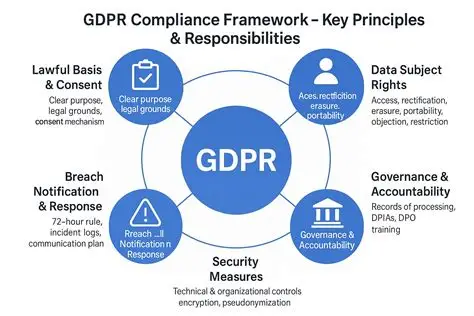
What GDPR Requires from Cloud Environments
Although GDPR contains numerous provisions, several areas are particularly relevant to PaaS environments.
Data Protection
Organizations must implement appropriate technical and organizational safeguards.
Examples include:
- Encryption
- Access management
- Security monitoring
- Authentication controls
Data Subject Rights
Individuals have rights including:
- Access requests
- Data correction
- Data deletion
- Data portability
Applications running on PaaS platforms must support these rights.
Breach Notification
Organizations must respond appropriately when personal data is compromised.
Monitoring and visibility become critical.
Data Processing Agreements
Providers processing personal data on behalf of customers generally require formal contractual arrangements.
These agreements define responsibilities and obligations.
GDPR Readiness Across Major PaaS Providers
Most leading PaaS providers recognize GDPR as a fundamental business requirement.
As a result, they offer a variety of compliance-related capabilities.
PaaS GDPR Support Comparison
| Provider | GDPR Support Resources | EU Data Regions | Data Processing Agreement | Security Certifications |
|---|---|---|---|---|
| Microsoft Azure App Service | Extensive | Yes | Yes | Extensive |
| Google Cloud Run | Extensive | Yes | Yes | Extensive |
| AWS Elastic Beanstalk | Extensive | Yes | Yes | Extensive |
| Heroku | Available | Limited by architecture | Yes | Strong |
| Render | Growing support | Regional options | Available | Developing |
| Platform.sh | Strong European focus | Yes | Yes | Strong |
| OpenShift | Enterprise-focused | Depends on deployment | Yes | Extensive |
The table highlights an important reality.
Major providers generally support GDPR-related requirements.
The challenge lies in how organizations configure and operate their applications.
Data Residency: One of the First Questions Organizations Ask
Data residency often becomes the focal point of GDPR conversations.
Executives frequently ask:
“Can we store customer data in Europe?”
Most major providers offer European regions.
Examples include:
- Frankfurt
- Dublin
- Paris
- Amsterdam
- Milan
- Madrid
Selecting an EU-based region can simplify compliance efforts.
However, residency alone does not guarantee compliance.
Organizations must also consider:
- Backups
- Log storage
- Analytics services
- Third-party integrations
Personal data can travel in unexpected ways.
The infrastructure location is only one piece of the puzzle.
A Lesson Learned During a European Expansion
Several years ago, I worked with a software company expanding aggressively into European markets.
The leadership team assumed that selecting an EU hosting region solved their GDPR concerns.
Initially, the strategy seemed sound.
Customer data remained in Europe.
Infrastructure documentation looked reassuring.
Then a compliance review uncovered something unexpected.
A third-party analytics platform was transferring information outside the intended jurisdiction.
The application itself was configured correctly.
The broader ecosystem was not.
That experience reinforced an important lesson.
Compliance rarely depends on a single decision.
It emerges from the interaction of many decisions.
The strongest compliance programs examine the entire data journey, not merely the hosting environment.
Encryption and GDPR
Encryption plays a significant role in modern compliance strategies.
Most reputable PaaS providers support:
Encryption at Rest
Data stored in databases, storage systems, and backups can be encrypted.
Encryption in Transit
Data moving between systems can be protected through secure protocols.
Encryption is not explicitly mandated in every circumstance under GDPR.
However, regulators consistently view strong encryption as an important safeguard.
Organizations should consider it foundational rather than optional.
Access Controls and Identity Management
Another critical GDPR consideration involves access.
Who can view personal data?
Who can modify it?
Who can export it?
Modern PaaS platforms provide identity and access management capabilities that help organizations answer these questions.
Common controls include:
- Role-based access management
- Multi-factor authentication
- Audit logging
- Permission controls
Technology alone does not guarantee appropriate governance.
But it provides the necessary tools.
Data Processing Agreements Matter More Than Many Teams Realize
One of the least discussed aspects of GDPR is contractual compliance.
Organizations frequently focus on technical controls.
The legal framework receives less attention.
Yet GDPR often requires formal Data Processing Agreements (DPAs).
These agreements define:
- Processing responsibilities
- Security obligations
- Data handling expectations
- Regulatory commitments
Most major PaaS providers offer standardized DPAs.
Reviewing and executing these agreements is an essential compliance step.
Ignoring them creates unnecessary risk.
Can PaaS Help with GDPR Audits?
Yes.
In many cases, PaaS environments simplify audit preparation.
Platforms often provide:
- Security documentation
- Compliance reports
- Audit logs
- Access histories
- Infrastructure controls
These resources help organizations demonstrate due diligence.
However, auditors typically evaluate the entire system.
They assess:
- Policies
- Procedures
- Application behavior
- Vendor relationships
- Data governance practices
Infrastructure evidence supports compliance.
It rarely proves compliance independently.
Common GDPR Mistakes in PaaS Environments
Several issues appear repeatedly.
Assuming the Provider Handles Everything
This remains the most common misconception.
PaaS providers support compliance.
They do not assume responsibility for all compliance obligations.
Ignoring Third-Party Services
Applications often rely on:
- Analytics platforms
- Payment systems
- Marketing tools
- Support software
These integrations introduce additional compliance considerations.
Overlooking Data Retention
Organizations frequently collect data effectively.
Deleting unnecessary data receives less attention.
Retention policies matter.
Weak Access Controls
Excessive permissions create unnecessary exposure.
Access should be limited appropriately.
The Relationship Between Security and Compliance
Security and compliance are related.
They are not identical.
A secure platform does not automatically satisfy regulatory obligations.
Likewise, a compliant organization cannot ignore security fundamentals.
The strongest GDPR strategies integrate both disciplines.
Security protects data.
Compliance governs its use.
The relationship is complementary.
Not interchangeable.
How AI and Modern Applications Are Raising New Questions
As organizations adopt AI-driven products, GDPR discussions become even more complex.
Questions emerge around:
- Training data
- User consent
- Data minimization
- Automated decision-making
PaaS providers continue evolving their offerings to support these needs.
Yet the underlying principle remains unchanged.
Technology provides capabilities.
Organizations remain responsible for governance.
That reality is unlikely to change.
Conclusion: GDPR Compliance Is Not a Platform Feature
So, is PaaS compliant with GDPR?
The answer is both yes and no.
Yes, because leading PaaS providers offer infrastructure, controls, certifications, security features, regional hosting options, and contractual frameworks designed to support GDPR requirements.
No, because compliance cannot be outsourced entirely.
A platform cannot determine whether your organization collects data lawfully.
A platform cannot define your retention policies.
A platform cannot manage customer consent on your behalf.
Compliance emerges from how technology, processes, governance, and people work together.
That may be the most important lesson for organizations evaluating PaaS environments.
The question is not whether the platform is GDPR compliant.
The better question is whether the platform provides the tools necessary for your organization to build and maintain a compliant operation.
Most leading providers do.
What happens next depends on how those tools are used.
And in the world of data protection, that distinction makes all the difference.
- Arts
- Business
- Computers
- Oyunlar
- Health
- Home
- Kids and Teens
- Money
- News
- Personal Development
- Recreation
- Regional
- Reference
- Science
- Shopping
- Society
- Sports
- Бизнес
- Деньги
- Дом
- Досуг
- Здоровье
- Игры
- Искусство
- Источники информации
- Компьютеры
- Личное развитие
- Наука
- Новости и СМИ
- Общество
- Покупки
- Спорт
- Страны и регионы
- World

 English
 Russian
 French
 Spanish
 Portuguese
 Deutsch
 Dutch
Dutch
 Italiano
 Arabic
 Romaian
 Portuguese (Brazil)
 Greek
Greek