
Can children learn lateral thinking?
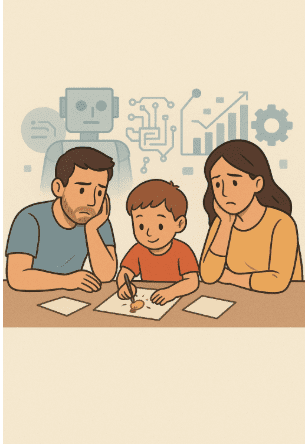
The Architecture of the Intellectual Pivot
The mind is a pattern-making machine. It is designed, with exquisite efficiency, to take the chaos of sensory input and organize it into stable, reliable, and entirely predictable configurations. We call this maturity. But is this maturity? Or is it merely the hardening of the neural pathways into a rigid, sequential structure? To truly think—to move beyond the mere arrangement of existing patterns—one must be prepared to do something entirely unnatural.
One must be prepared to remain perpetually open to the disruption of one’s own logic.
The question is often asked: Can children learn lateral thinking? The question itself is fundamentally flawed. It assumes that lateral thinking is a complex, adult acquisition—a rare faculty to be bestowed upon the young after years of formal schooling. The inverse is closer to the truth. Children are natural lateral thinkers. They are the masters of the "what if." They are the architects of the impossible connection. It is the education system that trains the lateral capacity out of them.
We do not need to "teach" children to think laterally; we need to stop teaching them to stop.
The Trap of the Sequential Schooling
Most academic achievement is a pursuit of depth. We dig deeper into the subjects. We refine our memorization. We optimize our exam techniques. This is the vertical approach: digging the same hole deeper in the hope that we might eventually strike the "right" answer.
But what if the child is digging in the wrong place?
Vertical thinking is inherently conservative. It operates on the assumption that the current syllabus is comprehensive and merely requires acquisition. It assumes that the rules of the subject are permanent. When those rules change—when the context of the world shifts, when a new perspective emerges—the vertical student is blindsided. They are staring at the bottom of a hole they have spent years perfecting, unaware that the game has moved to a completely different field.
Lateral thinking is the move to that field. It is the deliberate, structural act of looking at the knowledge not as a series of facts, but as a series of potential configurations. Children do this spontaneously. They see a box and see a spaceship. The educator sees a box and sees trash. The conflict is not in the child; it is in the educator’s perception of the child’s purpose.
The Anatomy of the Natural Pivot
Consider the challenge of a complex science experiment. A vertical student immediately begins to look for the "standard" result. They are doubling down on the existing logic: The outcome is dependent on the procedure; therefore, the procedure must be replicated.
A child, uncorrupted by sequential schooling, responds with a question: Po, what if I add the ingredients in reverse order? What if the failure is the result?
They look at the same data and see a different configuration of possibilities. They realize that the "experiment" is merely a placeholder for an underlying function. By shifting their perception, they don't just complete the assignment; they investigate the nature of the phenomenon. They have not just learned the lesson; they have mastered the thinking.
The Taxonomy of Lateral Necessity
To master the preservation of lateral thinking in child development is to recognize that we require different tools for different phases of cognitive growth. We categorize these requirements by how they protect the learner from the atrophy of the known.
| The Developmental Context | The Vertical Risk | The Lateral Opportunity |
| Information Acquisition | Memorization becomes a form of blindness. | Re-defining the "why" behind the data. |
| Problem Solving | Relying on textbook formulas as immutable laws. | Repurposing known concepts for entirely new domains. |
| Group Discussion | Validating errors through shared, logical agreement. | Introducing "Po" to break the cycle of logical consistency. |
| Creative Play | Assuming the game must reflect standard rules. | Designing a portfolio of "provocations" to test narrative scenarios. |
Designing for Intellectual Disruption
If we accept that the human mind is a prisoner of its own patterns, we must shift our methodology. We are no longer the ones delivering the "correct" information. We are the architects of the potential.
The Power of "Conceptual Movement"
The most common error teachers make when introduced to lateral thinking is treating it as a "creative" add-on. They use a technique for a project, then return to the vertical machinery of rote learning. This is a waste of time. Lateral thinking is not a project; it is a discipline. It is the institutionalized practice of "movement"—the ability to take a concept and move it into a new context, a new frame, or a new structural arrangement.
The Art of the "Unnatural Act"
In a high-functioning student, every study habit has a justification. You study X because it yields Y. To teach laterally, you must occasionally invite the student to study something because it defies the standard logic. You must deliberately perform the unnatural act—the challenge that feels wrong, the inquiry that defies the standard path. You do this to see what the subject does when you break the patterns. That is where the students find the breakthrough.
A Lesson in Intellectual Abandonment
I recall a teaching engagement with a class of students struggling with history. They were paralyzed by the "logic" of the curriculum: History is a sequence of dates. They were trying to make their essays more "accurate." They were caught in a vertical loop of imitation.
I stopped the lecture. "Define the concept of the event," I asked.
"It is a point in time where something happens," they said.
"Fine," I said. "Po, the event is not a point, but a failure of communication."
The tension in the room was palpable. "That’s wrong," a student snapped. "The event is about the military strategy!"
"Precisely," I said. "So, if the event is about the strategy, why are you selling only the troop movements?"
We stopped looking at the maps. We looked at how diplomatic failures manifest. We looked at how propaganda curates perception. We realized the students didn't need "more dates"; they needed to be "context-integrators" that turned the history lesson into a real-time analysis of human error. They were not in the business of memorizing events; they were in the business of facilitating structural understanding.
We solved the crisis, not by thinking harder about "dates," but by challenging the assumption of what "history" actually was.
The Provocative Conclusion: Are You Thinking, or Just Processing?
The next time you are faced with a challenging problem in your classroom, look at your notes. Are you trying to find the truth, or are you trying to find the most acceptable repetition of the textbook? Are you asking "What is the new way to achieve this?" or are you asking "How can I make the old way work just a little bit better?"
If you cannot identify an idea that feels fundamentally uncomfortable, or perhaps even a little bit ridiculous, you are not thinking. You are merely processing. You are playing the pattern-matching game of a machine, rather than the creative game of a human.
True intellectual leadership is the art of the disruption. It is the practice of systematically identifying where your patterns blind you, where your expertise distorts you, and where the weight of your own certainty interferes with your capacity to see what is possible. We are not, and we never will be, neutral observers. But we can be procedurally disciplined.
Lateral thinking is not the opposite of logic. It is the escape hatch from the prison of your own logic. Use it not to find the answer, but to create the space where the answer might finally have the room to emerge.
- Arts
- Business
- Computers
- الألعاب
- Health
- الرئيسية
- Kids and Teens
- مال
- News
- Personal Development
- Recreation
- Regional
- Reference
- Science
- Shopping
- Society
- Sports
- Бизнес
- Деньги
- Дом
- Досуг
- Здоровье
- Игры
- Искусство
- Источники информации
- Компьютеры
- Личное развитие
- Наука
- Новости и СМИ
- Общество
- Покупки
- Спорт
- Страны и регионы
- World

 English
 Russian
 French
 Spanish
 Portuguese
 Deutsch
 Turkish
 Dutch
Dutch
 Italiano
 Romaian
 Portuguese (Brazil)
 Greek
Greek