
How Do I Reduce Stockouts and Overstock? Solving Retail’s Most Expensive Contradiction
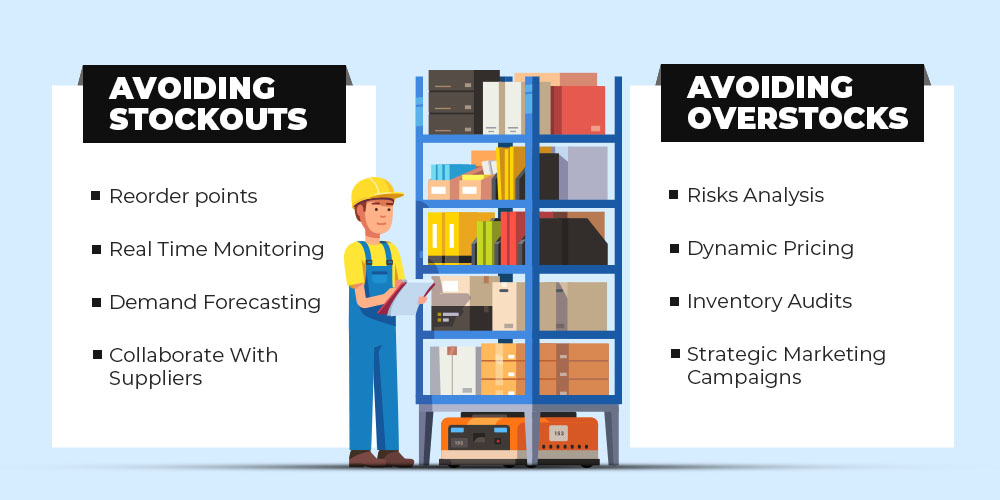
A customer walks into a store determined to buy.
The intent is there. The budget is there. The product selection process is over.
Then comes the disappointment.
The item is unavailable.
A few aisles away, another product sits untouched. Weeks pass. Then months. The inventory remains. Eventually, markdown stickers appear. Profit margins shrink. Valuable shelf space is consumed by merchandise customers never wanted in the first place.
These two situations appear unrelated.
One reflects scarcity.
The other reflects excess.
Yet they are actually symptoms of the same underlying problem: inventory imbalance.
For retailers, few operational challenges are more frustrating—or more expensive. Stockouts create lost sales, frustrated customers, and damaged loyalty. Overstock creates bloated carrying costs, markdown pressure, and trapped capital. One starves the business of revenue. The other suffocates it with inefficiency.
The objective, therefore, is not simply having more inventory or less inventory.
It is having the right inventory.
At the right location.
At the right time.
That sounds deceptively straightforward.
It rarely is.
Because inventory management is fundamentally an exercise in prediction. Retailers must make decisions today based on customer behavior that has not happened yet. Every purchase order represents a forecast. Every replenishment decision reflects an assumption. Every stock level embodies a bet.
Some bets pay off.
Others accumulate dust in the stockroom.
The retailers that consistently reduce both stockouts and overstock understand an essential truth: inventory optimization is not about controlling products. It is about understanding demand.
Why Stockouts and Overstock Often Share the Same Cause
Many organizations treat stockouts and overstock as separate problems.
They are not.
Both frequently emerge from the same root issue: poor demand alignment.
Imagine a retailer forecasting demand inaccurately.
Certain products receive excessive inventory allocations.
Others receive insufficient allocations.
The result is predictable.
Some shelves remain full.
Others sit empty.
The organization simultaneously experiences overstock and stockouts.
This happens far more often than most executives realize.
Inventory challenges are rarely caused by inventory alone. They are usually caused by inaccurate assumptions about customer behavior.
That distinction matters because it shifts attention away from reactive inventory adjustments and toward better forecasting.
The Hidden Cost of Stockouts
Stockouts create obvious losses.
A customer wants a product.
The product is unavailable.
The sale disappears.
Yet the true cost often extends beyond the transaction itself.
Customers frequently remember disappointment more vividly than satisfaction.
When shoppers repeatedly encounter unavailable products, several things occur:
- Brand trust weakens.
- Store loyalty declines.
- Competitive alternatives become more attractive.
- Future purchasing behavior changes.
The immediate revenue loss is measurable.
The long-term loyalty erosion is considerably harder to quantify.
And often far more expensive.
What Stockouts Really Cost
Retailers commonly underestimate stockout costs because they focus solely on lost sales.
The broader impact includes:
- Lost customer lifetime value
- Reduced basket size
- Increased competitor purchases
- Lower satisfaction scores
- Negative word-of-mouth
In other words, stockouts affect both current revenue and future demand.
The Less Visible Problem: Overstock
Stockouts attract attention.
Overstock often hides in plain sight.
A product sitting quietly in storage does not generate customer complaints. It does not trigger urgent replenishment alerts. It does not produce visible operational crises.
Instead, it slowly drains profitability.
Excess inventory creates:
- Storage expenses
- Insurance costs
- Obsolescence risk
- Markdowns
- Working capital constraints
The danger lies in its gradual nature.
Unlike stockouts, which generate immediate consequences, overstock accumulates incrementally.
By the time the financial impact becomes obvious, corrective actions are often expensive.
Retail history is filled with examples of retailers that failed not because they lacked customers but because they invested too heavily in inventory customers ultimately did not want.
Forecasting Is the Foundation
Reducing stockouts and overstock begins with forecasting.
Everything else follows.
The challenge, of course, is that forecasting is inherently imperfect.
Customers change their minds.
Weather patterns shift.
Economic conditions fluctuate.
Trends emerge unexpectedly.
Nevertheless, better forecasting dramatically improves inventory outcomes.
The Most Useful Demand Inputs
Strong forecasting incorporates multiple variables:
| Demand Signal | Inventory Impact | Strategic Value |
|---|---|---|
| Historical Sales | Establishes baseline demand | High |
| Seasonal Trends | Anticipates recurring patterns | High |
| Promotions | Predicts temporary spikes | High |
| Regional Preferences | Improves local inventory allocation | Medium-High |
| Supplier Lead Times | Supports replenishment planning | High |
| Market Trends | Identifies emerging demand shifts | Medium |
| Customer Behavior Data | Enhances forecasting precision | High |
No single variable predicts demand perfectly.
The objective is not certainty.
The objective is reducing uncertainty.
Retailers who combine multiple demand signals consistently outperform those relying on historical sales alone.
Inventory Visibility Changes Decision Quality
One of the most common causes of inventory imbalance is surprisingly simple.
Retailers do not know exactly what inventory they possess.
Inventory records may be inaccurate.
Store counts may be outdated.
Warehouse data may lag reality.
Products may exist physically while appearing unavailable in systems—or vice versa.
This creates cascading consequences.
Forecasts become distorted.
Replenishment decisions become flawed.
Customer experiences deteriorate.
Accurate inventory visibility provides a foundation for intelligent decision-making.
Without it, even sophisticated forecasting models struggle.
Questions Every Retailer Should Answer Instantly
Can you identify:
- Current inventory levels?
- Inventory by location?
- Products approaching stockout?
- Slow-moving inventory?
- Supplier replenishment timelines?
If these answers require extensive investigation, inventory visibility likely needs improvement.
My Lesson Learned About Inventory Imbalance
Several years ago, I worked with a retailer convinced that stockouts represented its biggest inventory challenge.
Management meetings focused almost entirely on availability.
Teams were rewarded for keeping shelves full.
The strategy appeared customer-centric.
Initially.
As inventory levels increased, stockouts declined.
Leadership celebrated.
Then a different problem emerged.
Markdowns surged.
Inventory carrying costs rose.
Profitability weakened.
The company had solved one problem by amplifying another.
What became clear was that inventory management is rarely about maximizing a single metric. It requires balancing competing objectives simultaneously.
The lesson was memorable: eliminating stockouts completely is neither practical nor economically desirable. The goal is optimization, not perfection.
That distinction fundamentally changed how I evaluate inventory performance.
Safety Stock: Useful but Frequently Misunderstood
Safety stock exists to absorb uncertainty.
Demand fluctuations happen.
Supplier delays happen.
Transportation disruptions happen.
Safety stock provides protection.
Yet many retailers misuse it.
When uncertainty increases, organizations often respond by increasing inventory buffers dramatically.
This creates a false sense of security.
Excessive safety stock frequently becomes overstock.
The more effective approach is calculating safety stock based on measurable variables such as:
- Demand variability
- Lead-time variability
- Desired service levels
- Historical performance patterns
Safety stock should be strategic.
Not emotional.
Fear-based inventory decisions rarely produce efficient outcomes.
Supplier Performance Directly Influences Inventory Levels
Retailers often focus internally when addressing inventory challenges.
Yet supplier reliability plays a crucial role.
Consider two scenarios.
Supplier A delivers consistently within five days.
Supplier B delivers unpredictably between five and fifteen days.
The second supplier introduces uncertainty.
To compensate, retailers carry additional inventory.
Overstock increases.
Capital requirements increase.
Inventory efficiency declines.
Reliable suppliers allow retailers to operate with greater precision.
That precision reduces both stockout risk and inventory excess.
Supplier Metrics Worth Monitoring
Retailers should regularly evaluate:
- On-time delivery rates
- Lead-time consistency
- Order accuracy
- Fill rates
- Responsiveness
Inventory optimization frequently depends as much on supplier performance as internal forecasting capabilities.
Inventory Segmentation Creates Focus
Not all products deserve equal attention.
Some items generate significant revenue.
Others contribute relatively little.
Treating every product identically often leads to inefficient resource allocation.
This is where inventory segmentation becomes valuable.
The ABC Framework
A Products
- Highest revenue contribution
- Tight monitoring
- Frequent replenishment review
B Products
- Moderate importance
- Balanced oversight
C Products
- Lower financial impact
- Simplified management processes
The framework creates prioritization.
Retailers can devote forecasting resources where mistakes carry the greatest consequences.
This improves inventory outcomes without increasing complexity across the entire assortment.
Omnichannel Retail Raises the Stakes
Inventory management has become more complicated as retail channels converge.
Products now serve multiple purchasing pathways simultaneously.
A single inventory unit may support:
- In-store purchases
- Online orders
- Buy-online-pickup-in-store programs
- Same-day delivery
- Marketplace fulfillment
The result is increased inventory pressure.
Without unified visibility, stockouts become more likely.
Overstock also becomes more difficult to identify.
Retailers that maintain integrated inventory systems gain a significant advantage because inventory can be allocated dynamically based on demand patterns.
The inventory remains the same.
The intelligence improves.
Measure Inventory Health Beyond Stock Levels
Many retailers evaluate inventory primarily through quantity metrics.
That perspective is incomplete.
Inventory health requires broader measurement.
Key Inventory Metrics
Inventory Turnover
Measures how quickly inventory sells and replenishes.
Stockout Rate
Tracks product availability failures.
Sell-Through Rate
Measures percentage of inventory sold during a period.
Gross Margin Return on Inventory Investment (GMROII)
Evaluates profitability generated by inventory investments.
Days of Inventory on Hand
Estimates how long current inventory levels can support sales.
Together, these metrics provide a more nuanced view of inventory performance.
No single metric can capture inventory health comprehensively.
Technology Improves Execution, Not Judgment
Modern inventory systems offer remarkable capabilities.
They forecast demand.
They automate replenishment.
They identify anomalies.
They generate alerts.
These tools undoubtedly enhance performance.
Yet technology does not eliminate managerial responsibility.
Algorithms learn from historical patterns.
Customers occasionally ignore historical patterns.
Consumer behavior remains dynamic.
Unexpected demand shifts still occur.
The strongest retailers combine analytical sophistication with practical judgment.
Technology accelerates decision-making.
It does not replace strategic thinking.
Conclusion: The Goal Is Not More Inventory or Less Inventory
When retailers ask, “How do I reduce stockouts and overstock?” they often search for inventory formulas.
The answer is broader.
Stockouts and overstock are not inventory problems alone. They are manifestations of how effectively an organization understands customer demand, forecasts future behavior, collaborates with suppliers, and allocates resources.
The most successful retailers recognize that inventory exists for one purpose: serving customers profitably.
Too little inventory undermines service.
Too much inventory undermines profitability.
The challenge lies in managing both simultaneously.
That challenge never disappears.
Demand evolves.
Markets shift.
Consumer preferences change.
Yet retailers that focus on demand visibility, forecasting accuracy, supplier reliability, and disciplined inventory management consistently move closer to equilibrium.
And equilibrium, while rarely perfect, is where retail performance becomes sustainable.
Not because shelves are always full.
Not because warehouses are always lean.
But because inventory finally reflects what customers actually want rather than what retailers merely hope they will buy.
- Arts
- Business
- Computers
- Spiele
- Health
- Startseite
- Kids and Teens
- Geld
- News
- Personal Development
- Recreation
- Regional
- Reference
- Science
- Shopping
- Society
- Sports
- Бизнес
- Деньги
- Дом
- Досуг
- Здоровье
- Игры
- Искусство
- Источники информации
- Компьютеры
- Личное развитие
- Наука
- Новости и СМИ
- Общество
- Покупки
- Спорт
- Страны и регионы
- World

 English
 Russian
 French
 Spanish
 Portuguese
 Turkish
 Dutch
Dutch
 Italiano
 Arabic
 Romaian
 Portuguese (Brazil)
 Greek
Greek
