
How Does Self-Checkout Work? The Technology Behind the Register That Doesn't Need a Cashier
A customer picks up a carton of milk, a loaf of bread, and a bag of coffee.
Three items.
A quick trip.
Twenty years ago, the experience would have followed a familiar script. The customer joins a line, waits for a cashier, watches items get scanned, pays, collects a receipt, and leaves.
Today, in many stores, the script is different.
The customer scans the products personally. A machine announces the price. A screen displays the total. Payment is completed in seconds. No cashier. No conversation. No traditional checkout lane.
The interaction feels remarkably ordinary now.
Yet beneath that simplicity lies a surprisingly sophisticated network of hardware, software, sensors, payment systems, inventory databases, and security controls working together in real time.
Self-checkout has become one of the most visible forms of retail technology. Consumers encounter it in grocery stores, pharmacies, home improvement chains, airports, convenience stores, and increasingly, specialty retailers.
What began as an experiment in operational efficiency has evolved into a fundamental part of modern retail strategy.
But how exactly does self-checkout work?
The answer reveals something larger than technology alone. It reveals how retailers are redesigning the relationship between customers, employees, and transactions.
What Is Self-Checkout?
Self-checkout is a retail system that allows customers to scan, bag, and pay for products without direct assistance from a cashier.
Instead of a traditional checkout employee performing the transaction, customers complete most of the process independently using a self-service kiosk.
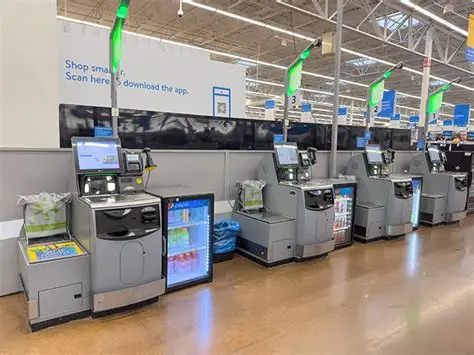
A typical self-checkout station includes:
- Barcode scanner
- Touchscreen display
- Payment terminal
- Bagging area
- Receipt printer
- Security monitoring systems
- POS software integration
While customers see a simple interface, the system itself is connected to multiple retail technologies operating simultaneously behind the scenes.
That complexity is intentional.
The easier the experience feels, the more sophisticated the underlying system usually is.
The Basic Self-Checkout Process
At a high level, the workflow is straightforward.
Step 1: Scanning Products
Customers scan each item using a barcode scanner.
The scanner reads the barcode and sends the information to the store's point-of-sale system.
The POS system instantly retrieves:
- Product description
- Pricing information
- Tax calculations
- Promotional discounts
Within milliseconds, the product appears on the screen.
A seemingly simple action triggers multiple database interactions.
Step 2: Verification
After scanning, customers place items in the designated bagging area.
This is where things become more interesting.
Most self-checkout systems contain weight sensors.
The system compares the expected weight of the scanned product with the actual weight detected in the bagging area.
If the numbers align, the transaction continues.
If they do not, the system may pause and request assistance.
This verification process helps reduce scanning errors and certain forms of theft.
Step 3: Payment
Once all items are scanned, customers select a payment method.
Most systems accept:
- Credit cards
- Debit cards
- Mobile wallets
- Contactless payments
- Gift cards
Some locations also accept cash.
The payment terminal processes authorization and confirms the transaction.
Step 4: Receipt Generation
The system completes the purchase and generates a receipt.
Inventory records update automatically.
Sales data enters reporting systems.
Loyalty accounts may update simultaneously.
The customer leaves.
The retailer records a completed transaction.
Simple on the surface.
Remarkably intricate underneath.
The Technology Behind Self-Checkout
Many consumers assume self-checkout machines function as standalone devices.
They do not.
They operate as part of a much larger retail ecosystem.
Several technologies work together to make the experience possible.
Barcode Scanning Technology
Every product carries a unique barcode.
When scanned, that code acts as an identifier.
The scanner retrieves information stored within the retailer's database.
This includes:
- SKU numbers
- Product names
- Pricing
- Tax status
- Promotional eligibility
Without barcode technology, modern self-checkout would be difficult to scale efficiently.
POS Software Integration
The self-checkout station connects directly to the store's POS system.
This integration enables:
- Real-time pricing
- Inventory updates
- Transaction recording
- Loyalty program functionality
- Sales reporting
The kiosk is not making decisions independently.
It is communicating continuously with centralized retail systems.
Weight Verification Systems
Weight verification remains one of the most important security features.
Each scanned item has an expected weight range.
The system compares that expectation against the physical item placed in the bagging area.
If discrepancies occur, alerts are triggered.
This process helps retailers reduce losses while maintaining customer convenience.
Why Retailers Invest in Self-Checkout
The appeal extends beyond reducing cashier involvement.
Retailers pursue self-checkout for several strategic reasons.
Faster Transaction Processing
Many customers purchasing only a few items prefer speed over interaction.
Self-checkout provides an alternative.
The result can be shorter lines and improved throughput.
Greater Checkout Capacity
Stores can often fit multiple self-checkout stations within the space occupied by traditional lanes.
This increases transaction capacity without requiring extensive remodeling.
Operational Flexibility
Labor remains one of retail's largest expenses.
Self-checkout allows employees to focus on:
- Customer assistance
- Inventory management
- Store operations
- Merchandising activities
Rather than eliminating labor entirely, many retailers redeploy it.
Customer Preference
Perhaps surprisingly, many consumers actively choose self-checkout.
The reasons vary:
- Privacy
- Speed
- Convenience
- Independence
The appeal is not universal.
But it is substantial.
Self-Checkout vs. Traditional Checkout
The comparison is more nuanced than many discussions suggest.
Each model offers advantages and disadvantages.
| Feature | Self-Checkout | Traditional Checkout |
|---|---|---|
| Transaction Speed (Small Baskets) | High | Moderate |
| Transaction Speed (Large Baskets) | Moderate | High |
| Labor Requirements | Lower | Higher |
| Customer Interaction | Minimal | Extensive |
| Checkout Capacity | High | Moderate |
| Theft Risk | Higher | Lower |
| Assistance Availability | Limited | Immediate |
| Technology Dependence | High | Moderate |
| Customer Control | High | Lower |
| Training Requirements | Lower for customers, higher for system oversight | Higher for cashiers |
The table highlights an important reality.
Self-checkout does not replace every retail scenario equally well.
A customer buying two items experiences one set of benefits.
A customer purchasing a full cart of groceries may experience another.
Context matters.
The Security Challenge
Whenever self-checkout is discussed, loss prevention inevitably enters the conversation.
Retailers face a difficult balancing act.
Customers want convenience.
Retailers need accountability.
Self-checkout systems therefore incorporate multiple security measures.
Weight-Based Verification
The most familiar method.
Products must match expected weights.
Computer Vision Systems
Many newer systems employ cameras and AI-powered monitoring.
These technologies can detect behaviors such as:
- Unscanned items
- Product substitution
- Suspicious movement patterns
Transaction Monitoring
Retailers increasingly analyze transaction data for unusual activity.
Patterns may reveal:
- Frequent intervention requests
- High-risk transactions
- Repeated anomalies
The objective is not merely enforcement.
It is prevention.
The Rise of AI-Powered Self-Checkout
Artificial intelligence is reshaping self-checkout in meaningful ways.
Historically, systems relied primarily on barcodes and weight verification.
Today, AI introduces additional capabilities.
Product Recognition
Computer vision systems can identify products visually.
This is particularly useful for:
- Produce
- Bakery items
- Unpackaged goods
Customers may no longer need to search lengthy menus.
The system recognizes the item automatically.
Behavioral Analysis
AI can identify unusual transaction behavior.
The technology helps reduce fraud while minimizing disruptions for legitimate shoppers.
Personalized Experiences
Some retailers integrate loyalty programs directly into self-checkout systems.
The result may include:
- Personalized offers
- Targeted discounts
- Product recommendations
The checkout process becomes more intelligent.
Not simply more automated.
What I Learned Watching Customers Use Self-Checkout
Several years ago, I spent time observing checkout behavior during a retail technology implementation.
Leadership was focused on efficiency metrics.
Transaction times.
Queue lengths.
Labor utilization.
All important measures.
Yet something else stood out.
Customers used self-checkout in dramatically different ways.
Some approached with confidence.
Others hesitated.
Some valued speed above all else.
Others wanted reassurance and assistance.
The lesson was surprisingly simple.
Technology adoption is rarely about technology alone.
It is about psychology.
Retailers often evaluate systems through operational metrics.
Customers evaluate them through experience.
The most successful implementations recognize both perspectives.
That insight remains relevant today.
The Future of Self-Checkout
Self-checkout continues to evolve.
Several emerging trends are shaping its future.
Frictionless Checkout
Some retailers are experimenting with systems that eliminate scanning entirely.
Products are identified automatically through:
- Computer vision
- RFID technology
- Sensor networks
Customers simply leave with purchases.
Transactions occur automatically.
Mobile Self-Checkout
Consumers increasingly use smartphones to scan products while shopping.
Payment occurs directly through mobile applications.
The traditional checkout station becomes less central.
Smarter Personalization
Future systems will likely integrate more deeply with loyalty programs, customer profiles, and purchasing histories.
Checkout may become increasingly tailored to individual shoppers.
Not merely transactional.
Contextual.
Conclusion: Self-Checkout Is Not Really About Technology
At first glance, self-checkout appears to be a story about machines.
Scanners.
Sensors.
Screens.
Algorithms.
Those elements matter.
But they are not the most interesting part of the story.
The deeper story involves choice.
Retailers are recognizing that customers value different experiences.
Some prefer conversation.
Others prefer speed.
Some enjoy assistance.
Others prefer independence.
Self-checkout accommodates one side of that spectrum.
It gives customers greater control over how transactions occur.
That control explains much of its appeal.
And perhaps that is why self-checkout continues to expand despite ongoing debates around labor, theft, and customer service.
Retail has always been a business of reducing friction.
Helping customers obtain what they want with less effort, less confusion, and less delay.
Self-checkout represents another chapter in that pursuit.
Not a perfect solution.
Not a universal solution.
But a revealing one.
Because every time a customer scans an item, taps a payment card, and walks away without speaking to a cashier, they are participating in a subtle shift that extends far beyond checkout lanes.
They are helping redefine what convenience means in modern retail.
- Arts
- Business
- Computers
- Spellen
- Health
- Home
- Kids and Teens
- Money
- News
- Personal Development
- Recreation
- Regional
- Reference
- Science
- Shopping
- Society
- Sports
- Бизнес
- Деньги
- Дом
- Досуг
- Здоровье
- Игры
- Искусство
- Источники информации
- Компьютеры
- Личное развитие
- Наука
- Новости и СМИ
- Общество
- Покупки
- Спорт
- Страны и регионы
- World

 English
 Russian
 French
 Spanish
 Portuguese
 Deutsch
 Turkish
 Italiano
 Arabic
 Romaian
 Portuguese (Brazil)
 Greek
Greek
