
What Is Safety Stock?
Walk into a retail stockroom and look around.
You will see products waiting patiently on shelves. Cases stacked in corners. Inventory organized by category, season, or supplier. To the untrained eye, much of it appears excessive. Why keep so much merchandise sitting around?
After all, inventory is expensive. It ties up cash. It occupies space. It requires management.
Yet experienced retailers know something that newcomers often learn the hard way: running out of inventory is usually more expensive than carrying a little extra.
That “little extra” has a name.
It is called safety stock.
At first glance, safety stock sounds simple. It is the additional inventory a company keeps on hand to protect against uncertainty. But like many concepts in retail and supply chain management, the simplicity is deceptive.
Safety stock is not merely extra inventory.
It is insurance.
It is risk management.
It is a strategic decision about how much uncertainty a business is willing to tolerate.
And perhaps most importantly, it reflects a fundamental truth about commerce: forecasts are never perfect.
Safety Stock Exists Because Reality Refuses to Follow the Plan
Every inventory plan begins with assumptions.
Retailers estimate future demand. Manufacturers estimate production schedules. Logistics teams estimate delivery times.
The keyword is estimate.
Demand may rise unexpectedly.
Suppliers may experience delays.
Transportation networks may encounter disruptions.
Weather events may intervene.
Consumer trends may accelerate faster than anticipated.
The plan says one thing.
Reality occasionally says another.
Safety stock exists to absorb that gap.
Without safety stock, businesses operate with very little room for error. A minor forecasting mistake or a modest supply-chain disruption can quickly create stockouts.
Customers rarely care why a product is unavailable.
They simply notice that it is unavailable.
And they often purchase elsewhere.
Defining Safety Stock
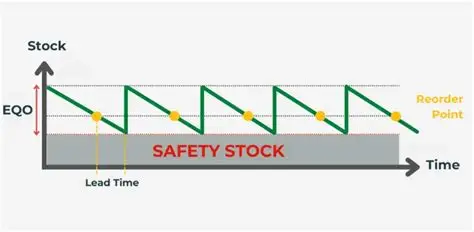
At its most basic level, safety stock refers to the reserve inventory maintained beyond expected demand.
It serves as a buffer against uncertainty.
Suppose a retailer expects to sell 1,000 units of a product before the next replenishment arrives.
Rather than stocking exactly 1,000 units, the retailer may carry 1,200 units.
The additional 200 units represent safety stock.
Those units are not intended for normal operating conditions.
They exist for abnormal conditions.
The distinction matters.
Safety stock is not inventory designed to generate planned sales. It is inventory designed to protect sales when conditions deviate from expectations.
Why Demand Variability Creates Problems
One of the primary reasons safety stock exists is demand variability.
Consumers are remarkably difficult to predict.
Retailers can forecast.
They can model.
They can analyze historical patterns.
Yet customer behavior remains dynamic.
A product featured by an influencer may experience a sudden sales surge.
A seasonal trend may emerge earlier than expected.
Competitive pricing changes can redirect demand.
A forecast might estimate weekly sales of 500 units.
Actual demand could be 650.
Or 800.
Or even 1,000.
Safety stock provides protection when demand exceeds expectations.
Without it, inventory depletion occurs rapidly.
The resulting stockout damages revenue and customer satisfaction simultaneously.
Lead Time Variability Is Equally Important
Demand uncertainty receives most of the attention.
Supply uncertainty deserves equal consideration.
Retailers often assume replenishment will arrive according to schedule.
Unfortunately, supply chains are rarely that cooperative.
A shipment expected in ten days may arrive in twelve.
Or fifteen.
Or twenty.
Supplier delays, transportation bottlenecks, labor shortages, customs inspections, and weather disruptions can all extend lead times.
Safety stock acts as a bridge during these delays.
The longer replenishment takes, the more important safety stock becomes.
This is why inventory management is never solely about forecasting customers.
It is also about forecasting suppliers.
Safety Stock Versus Cycle Stock
The distinction between safety stock and cycle stock is frequently misunderstood.
Cycle stock represents inventory intended for expected sales.
Safety stock represents inventory intended for unexpected events.
Consider a retailer that normally sells 5,000 units between replenishment orders.
Those 5,000 units constitute cycle stock.
If the retailer carries an additional 1,000 units as protection against uncertainty, that quantity constitutes safety stock.
Both types of inventory occupy warehouse space.
Both require investment.
Yet they serve fundamentally different purposes.
One supports predictable demand.
The other protects against unpredictability.
Inventory Types Compared
| Inventory Type | Primary Purpose | Demand Assumption | Risk Protection |
|---|---|---|---|
| Cycle Stock | Meet expected demand | Forecast is accurate | Limited |
| Safety Stock | Protect against uncertainty | Forecast may be inaccurate | High |
| Seasonal Stock | Prepare for demand peaks | Predictable seasonal demand | Moderate |
| Pipeline Stock | Cover goods in transit | Continuous replenishment | Low |
| Anticipation Stock | Prepare for planned events | Known future demand increases | Moderate |
| Buffer Inventory | Absorb operational disruptions | Variable conditions | High |
Notice something interesting.
Several inventory categories involve preparation for future uncertainty.
Safety stock simply addresses uncertainty more directly than most.
The Cost of Carrying Safety Stock
At this point, safety stock sounds like an obvious solution.
Why not carry as much as possible?
Because inventory has costs.
Substantial costs.
Every additional unit requires:
- Capital investment
- Storage space
- Insurance
- Handling
- Tracking
- Potential markdown exposure
A retailer carrying excessive safety stock may avoid stockouts but create a different problem: excess inventory.
Products become obsolete.
Storage expenses increase.
Cash becomes trapped in inventory.
The objective is not maximizing safety stock.
The objective is optimizing safety stock.
That single word changes everything.
The Balancing Act
Inventory management often resembles a negotiation between two competing risks.
On one side sits stockout risk.
On the other sits excess inventory risk.
Reducing one usually increases the other.
Carry too little inventory and stockouts become frequent.
Carry too much inventory and carrying costs escalate.
Safety stock exists in the middle of that tension.
Retailers must determine how much protection justifies the associated cost.
There is no universal answer.
Luxury brands, grocery retailers, pharmaceutical companies, and fast-fashion chains all make different decisions because their risk profiles differ.
How Companies Calculate Safety Stock
The mathematics behind safety stock can become sophisticated.
Yet the underlying logic remains straightforward.
Retailers evaluate three key variables:
Demand Variability
How much does demand fluctuate?
Greater fluctuations generally require more safety stock.
Lead Time Variability
How inconsistent are supplier delivery times?
Longer or less predictable lead times increase inventory risk.
Desired Service Level
How often does the company want products available?
A 99 percent service level requires more safety stock than a 90 percent service level.
The desired customer experience directly influences inventory investment.
Higher availability comes at a cost.
Companies must decide whether that cost is worthwhile.
A Lesson I Learned Watching Inventory Teams Debate Safety Stock
Several years ago, I observed a retail planning team discussing inventory levels for a highly popular product category.
One group argued for reducing safety stock aggressively.
Their logic was compelling.
Carrying costs were rising. Inventory productivity metrics would improve. Cash flow would benefit.
Another group resisted.
They worried about stockouts during peak demand periods.
What fascinated me was that both sides were technically correct.
The disagreement centered on risk tolerance.
Eventually, the company reduced safety stock significantly.
For several months, results looked excellent.
Then demand unexpectedly surged.
Stockouts spread across stores.
Customers became frustrated.
Emergency replenishment costs increased dramatically.
The lesson was not that safety stock should always be high.
The lesson was that inventory decisions often appear successful until uncertainty arrives.
Safety stock reveals its value precisely when things stop going according to plan.
And by then, it is often too late to create it.
Safety Stock and Customer Experience
Inventory discussions frequently focus on operational efficiency.
Customers experience something different.
Availability.
A customer rarely notices excellent inventory planning.
They simply find the product they want.
The planning remains invisible.
Stockouts, however, are highly visible.
Consumers notice immediately.
A missing product creates friction.
The shopping journey becomes more complicated.
Trust may erode.
Loyalty may weaken.
The customer experience implications are significant.
Safety stock helps preserve consistency.
And consistency often matters more than occasional perfection.
Why E-Commerce Increased the Importance of Safety Stock
Many observers assumed e-commerce would reduce inventory challenges.
In certain respects, it did.
In others, it amplified them.
Online retail introduces additional complexity:
- Faster delivery expectations
- Broader assortment requirements
- National demand variability
- Greater promotional responsiveness
Consumers expect products to remain available.
They expect fulfillment speed.
They expect reliability.
Safety stock supports these expectations.
The faster customers want products delivered, the less time retailers have to react to inventory shortages.
Preparation becomes increasingly valuable.
Not Every Product Needs the Same Safety Stock
One of the most common mistakes in inventory management involves applying uniform rules across products.
Different products deserve different treatment.
High-demand items often require substantial protection.
Slow-moving products may require very little.
Critical products frequently justify higher inventory investments than nonessential products.
Retailers increasingly segment inventory according to factors such as:
- Sales velocity
- Profitability
- Demand variability
- Strategic importance
The result is a more targeted approach to safety stock allocation.
Not all inventory risks are equal.
Neither should inventory policies be.
The Future of Safety Stock
Advances in forecasting technology continue to improve inventory management.
Machine learning models process vast amounts of information.
Real-time demand signals provide earlier visibility.
Supply-chain monitoring tools increase transparency.
These developments help reduce uncertainty.
Notice the wording.
Reduce.
Not eliminate.
Uncertainty remains a permanent feature of commerce.
Consumers will continue surprising retailers.
Supply chains will continue experiencing disruptions.
External events will continue creating volatility.
As long as uncertainty exists, safety stock will remain relevant.
The specific calculations may evolve.
The underlying need will not.
Conclusion: Safety Stock Is a Measure of Prudence
Businesses often celebrate efficiency.
Lean operations. Faster turns. Reduced inventory. Lower costs.
These objectives matter.
Yet efficiency without resilience can become fragile.
That is where safety stock enters the conversation.
At its core, safety stock represents a willingness to prepare for uncertainty.
It acknowledges that forecasts are imperfect, supply chains are vulnerable, and consumer behavior is inherently variable.
Some executives see safety stock as excess inventory.
Others see it as strategic protection.
The difference is revealing.
Because safety stock is not really about products sitting on shelves.
It is about preserving customer trust when demand exceeds expectations. It is about maintaining service levels when suppliers encounter problems. It is about ensuring that a temporary disruption does not become a lasting business problem.
Perhaps the most provocative way to think about safety stock is this: it is inventory purchased not for the future you expect, but for the future you cannot predict.
And in retail, that future arrives more often than most plans anticipate.
- Arts
- Business
- Computers
- Giochi
- Health
- Home
- Kids and Teens
- Money
- News
- Personal Development
- Recreation
- Regional
- Reference
- Science
- Shopping
- Society
- Sports
- Бизнес
- Деньги
- Дом
- Досуг
- Здоровье
- Игры
- Искусство
- Источники информации
- Компьютеры
- Личное развитие
- Наука
- Новости и СМИ
- Общество
- Покупки
- Спорт
- Страны и регионы
- World

 English
 Russian
 French
 Spanish
 Portuguese
 Deutsch
 Turkish
 Dutch
Dutch
 Arabic
 Romaian
 Portuguese (Brazil)
 Greek
Greek
