
What Is SKU Management?
Walk into a supermarket and stand in front of the cereal aisle.
You will see dozens of boxes that appear remarkably similar.
Some differ by flavor. Others by package size. Others by nutritional profile. Some are family-sized. Some are individually portioned. Some target children. Others target health-conscious adults.
To a shopper, this abundance feels like choice.
To a retailer, it feels like complexity.
Every variation sitting on that shelf represents a unique SKU.
And every SKU creates decisions.
How much inventory should be ordered? Where should it be displayed? How quickly is it selling? Is it profitable? Does it deserve shelf space next month?
These questions sit at the heart of SKU management.
At first glance, SKU management sounds like an operational task buried somewhere between inventory control and merchandising. In reality, it is one of the most consequential disciplines in retail. Done well, it improves profitability, inventory productivity, customer satisfaction, and supply chain efficiency. Done poorly, it creates bloated assortments, stockouts, excess inventory, and customer confusion.
The irony is striking.
Retailers spend enormous effort acquiring products.
The more difficult challenge often involves deciding which products deserve to stay.
Understanding the SKU
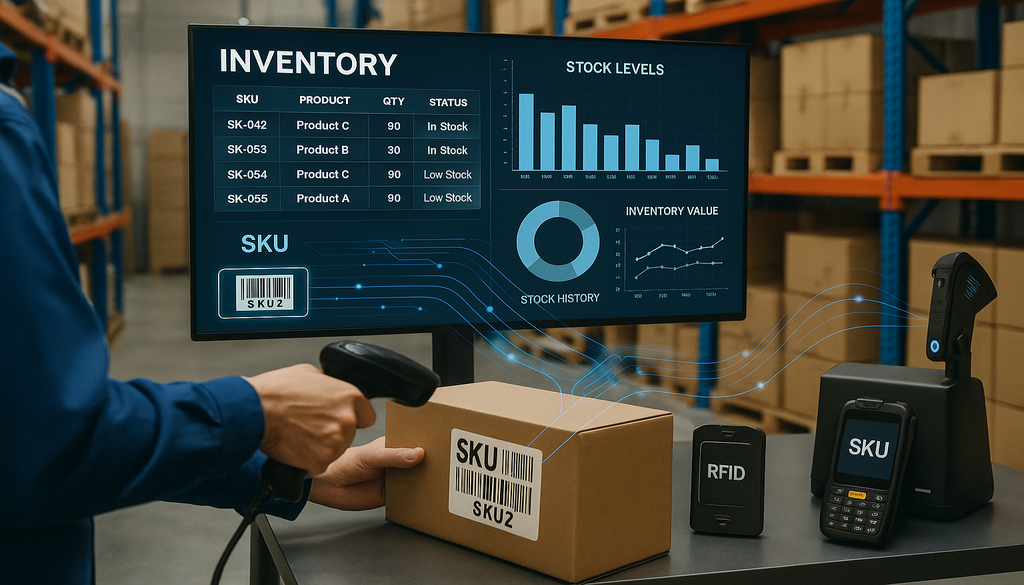
SKU stands for Stock Keeping Unit.
A SKU is a unique identifier assigned to a specific product variation.
The important word here is variation.
A blue shirt and a black shirt may appear nearly identical. From an inventory perspective, they are entirely different products.
Different color.
Different SKU.
Likewise:
- Medium size versus large size
- One-pack versus three-pack
- Vanilla flavor versus chocolate flavor
- Online-exclusive version versus in-store version
Each variation requires its own tracking, forecasting, replenishment, and performance measurement.
A retailer carrying 10,000 products may actually be managing 100,000 or more SKUs.
The distinction matters because complexity expands far faster than most people realize.
SKU Management Is Really About Managing Choice
Retailers often believe customers want unlimited variety.
Consumers frequently claim they do.
Yet reality is more nuanced.
Customers appreciate meaningful choice.
They do not necessarily appreciate excessive choice.
This is where SKU management becomes strategically important.
The objective is not maximizing the number of SKUs.
The objective is optimizing the assortment.
Retailers must determine:
- Which SKUs generate demand
- Which SKUs generate profit
- Which SKUs attract customers
- Which SKUs simply consume resources
Every additional SKU creates opportunities.
Every additional SKU also creates costs.
The challenge lies in balancing both.
Why More SKUs Are Not Always Better
There is a temptation in retail to equate assortment breadth with competitive advantage.
If five options are good, ten must be better.
If ten are good, twenty should be even better.
Not necessarily.
As assortments expand, complexity increases dramatically.
Additional SKUs require:
- More forecasting
- More inventory investment
- More storage capacity
- More replenishment activity
- More shelf space
- More data management
Meanwhile, sales do not always grow proportionally.
In some cases, new SKUs simply cannibalize existing products.
Customers shift purchases rather than increasing them.
The retailer gains complexity without gaining meaningful revenue.
This is one reason sophisticated SKU management focuses as much on elimination as expansion.
The Hidden Cost of SKU Proliferation
One of the most common retail problems is SKU proliferation.
This occurs when products accumulate faster than they are evaluated.
New items enter the assortment.
Very few leave.
Over time, complexity compounds.
The consequences often emerge gradually.
Inventory productivity declines.
Forecasting becomes less accurate.
Stock levels increase.
Supply chains become more difficult to manage.
Profitability suffers.
What makes SKU proliferation particularly dangerous is that individual decisions often seem harmless.
One new flavor.
One additional package size.
One seasonal variation.
One retailer-exclusive version.
None appears problematic in isolation.
Collectively, they can transform a manageable assortment into an operational burden.
SKU Performance Comparison
| SKU Characteristic | High-Performing SKU | Low-Performing SKU |
|---|---|---|
| Sales Velocity | Strong and consistent | Slow and irregular |
| Inventory Turnover | Fast | Slow |
| Shelf Productivity | High revenue per foot | Low revenue per foot |
| Profit Contribution | Significant | Limited |
| Forecast Accuracy | More predictable | Highly variable |
| Replenishment Efficiency | Efficient ordering cycles | Frequent imbalances |
| Customer Demand | Consistent demand signals | Weak demand signals |
| Inventory Risk | Lower | Higher |
The table reveals something important.
Not all SKUs contribute equally.
In many retail businesses, a relatively small percentage of SKUs generates a disproportionately large share of sales and profits.
This observation drives many assortment optimization strategies.
SKU Management and Inventory Planning
SKU management cannot be separated from inventory management.
Every SKU introduces forecasting requirements.
A retailer may accurately forecast demand for a category overall while struggling to forecast individual product variations.
Consider bottled water.
Total category demand may be relatively stable.
Demand across dozens of package sizes, flavors, and brands may fluctuate considerably.
This creates forecasting complexity.
Each SKU requires decisions regarding:
- Order quantities
- Safety stock levels
- Replenishment timing
- Distribution allocation
The larger the SKU count, the greater the forecasting burden.
Inventory planning becomes exponentially more challenging as assortment complexity expands.
Why Data Matters
Modern SKU management depends heavily on data.
Retailers analyze performance metrics such as:
Sales Velocity
How quickly does the SKU sell?
Gross Margin
How much profit does the SKU generate?
Inventory Turnover
How efficiently is inventory moving?
Stockout Frequency
How often is availability compromised?
Customer Demand Trends
Is demand growing, stable, or declining?
These metrics help retailers identify which SKUs deserve continued investment.
The goal is not simply measuring performance.
The goal is improving decision-making.
Data transforms SKU management from intuition into discipline.
The Customer Perspective
Retailers often evaluate SKUs through operational metrics.
Customers evaluate them differently.
Consumers care about finding what they want.
Nothing more.
Nothing less.
This creates an interesting tension.
Too few SKUs can limit customer choice.
Too many SKUs can create confusion.
Behavioral research consistently demonstrates that excessive choice can complicate decision-making.
Customers may delay purchases.
They may abandon purchases entirely.
Or they may experience lower satisfaction after purchasing.
Effective SKU management therefore balances variety with simplicity.
The best assortments feel comprehensive without feeling overwhelming.
Achieving that balance is far more difficult than it appears.
A Lesson I Learned Watching an Assortment Review
Several years ago, I observed a retailer conducting a comprehensive SKU rationalization project.
The company had accumulated thousands of SKUs over time.
Many had been introduced with good intentions.
Very few had been removed.
The planning team expected resistance when discussing product elimination.
Instead, something surprising happened.
Many store managers welcomed the changes.
Certain low-performing SKUs consumed inventory resources, replenishment effort, and shelf space while contributing little value.
Once those products disappeared, execution improved.
Shelves became easier to maintain.
Inventory became more productive.
Customers still found the products they wanted.
The experience reinforced an important lesson.
Retail success is not determined by how many products a company carries.
It is determined by how effectively those products serve customer needs.
Sometimes subtraction creates more value than addition.
SKU Rationalization: The Art of Elimination
SKU rationalization refers to the process of evaluating and removing underperforming products.
For many retailers, this process is essential.
Without rationalization, assortments tend to expand continuously.
SKU rationalization typically examines:
- Sales performance
- Profitability
- Customer demand
- Inventory productivity
- Strategic importance
Products that consistently underperform become candidates for removal.
The objective is not reducing choice indiscriminately.
The objective is preserving valuable choice while eliminating unnecessary complexity.
Successful retailers view SKU rationalization as an ongoing process rather than a one-time event.
The Supply Chain Connection
SKU management extends far beyond the sales floor.
Every SKU affects the supply chain.
Additional SKUs increase:
- Procurement complexity
- Warehouse complexity
- Transportation complexity
- Inventory allocation complexity
A single new product variation may require separate forecasting, sourcing, storage, and replenishment processes.
When multiplied across thousands of products, the operational impact becomes substantial.
This is why supply chain leaders often participate actively in assortment decisions.
What appears attractive from a merchandising perspective may create disproportionate operational costs.
The most effective organizations evaluate both dimensions simultaneously.
SKU Management in Omnichannel Retail
Omnichannel retail introduces new challenges.
Consumers increasingly shop across:
- Physical stores
- Websites
- Mobile applications
- Marketplaces
SKU visibility must remain consistent across channels.
Inventory accuracy becomes even more important.
Customers expect real-time product availability.
A SKU shown online must actually exist.
Failure to synchronize inventory information can damage customer trust.
As a result, SKU management increasingly depends on integrated systems capable of tracking products across multiple channels simultaneously.
The operational demands continue growing.
So does the strategic importance of getting SKU management right.
Technology's Role in SKU Optimization
Advances in analytics have transformed SKU management.
Retailers now use sophisticated tools to evaluate product performance.
Machine learning models can identify:
- Emerging demand trends
- Underperforming products
- Assortment gaps
- Inventory risks
Technology improves visibility.
It improves speed.
It improves forecasting.
Yet technology does not eliminate judgment.
Retailers must still decide which products align with brand strategy, customer expectations, and long-term goals.
Analytics provide insight.
Leadership provides direction.
The combination matters.
Why SKU Management Ultimately Shapes Profitability
Every SKU represents an investment decision.
Inventory must be purchased.
Space must be allocated.
Resources must be committed.
Some investments generate strong returns.
Others do not.
SKU management determines where those investments occur.
A well-managed assortment typically produces:
- Higher inventory turnover
- Better gross margins
- Improved forecasting accuracy
- Reduced operational complexity
- Stronger customer satisfaction
Conversely, poor SKU management often creates hidden inefficiencies that accumulate over time.
The financial implications are substantial.
Yet many retailers underestimate them because the costs are distributed throughout the organization.
Complexity rarely appears on a shelf label.
Its impact appears in profitability.
Conclusion: SKU Management Is the Discipline of Intentional Choice
Retail is often portrayed as a business of abundance.
More products.
More options.
More variety.
Yet successful retailers understand a deeper truth.
Every product added to an assortment represents a decision.
Every product retained represents a decision.
Every product removed represents a decision.
SKU management is the discipline that governs those choices.
At its core, it is not about inventory codes, databases, or replenishment systems.
It is about deciding which products deserve attention, investment, and space.
The retailers that excel at SKU management recognize that customers do not reward complexity for its own sake. They reward relevance. They reward clarity. They reward assortments that help them find what they need without unnecessary friction.
Perhaps that is the paradox of modern retail.
The objective is not creating the largest assortment.
The objective is creating the smartest one.
Because every SKU tells a story about what a retailer believes customers value. And over time, the quality of those decisions becomes visible not merely in inventory reports, but in customer loyalty, operational efficiency, and sustained profitability.
- Arts
- Business
- Computers
- Oyunlar
- Health
- Home
- Kids and Teens
- Money
- News
- Personal Development
- Recreation
- Regional
- Reference
- Science
- Shopping
- Society
- Sports
- Бизнес
- Деньги
- Дом
- Досуг
- Здоровье
- Игры
- Искусство
- Источники информации
- Компьютеры
- Личное развитие
- Наука
- Новости и СМИ
- Общество
- Покупки
- Спорт
- Страны и регионы
- World

 English
 Russian
 French
 Spanish
 Portuguese
 Deutsch
 Dutch
Dutch
 Italiano
 Arabic
 Romaian
 Portuguese (Brazil)
 Greek
Greek
