
What are critical thinking skills?
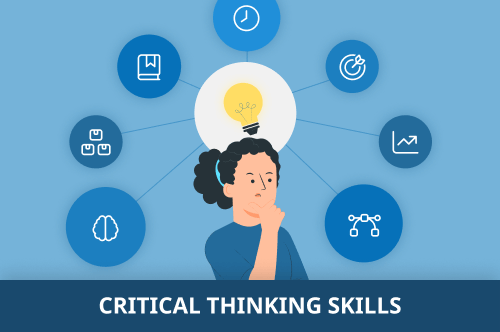
You sit down to analyze a complex problem at work, armed with strong opinions, a gut feeling, and a fierce desire to be right. You look at the data. You cherry-pick the metrics that validate your initial hunch, discard the anomalies that contradict your narrative, and write up a conclusion that feels airtight.
Then, reality hits. Your strategy fails.
You stare at the wreckage, cursing your luck or blaming the market conditions.
What went wrong? Why didn't my analysis hold up?
Let’s cut through the noise right out of the gate: your analytical failures are not a sign that you lack intelligence, and your poor reasoning is not proof that you were born without the capacity for logic. For decades, culture has treated critical thinking like a static personality trait—you are either born a rational mastermind, or you are destined to stumble through life driven by emotional biases and knee-jerk assumptions.
That view is dangerously backward.
Critical thinking is not a trait. It is a mechanical, highly structured capability that can be mapped, diagnosed, measured, and systematically trained just like any physical skill. If you want to stop sabotaging your decisions, you have to stop treating your mind like a mysterious black box and start treating it like a technical system that requires rigorous engineering. What are critical thinking skills, truly? Let's break down the foundational architecture required to stop reacting to cognitive bias and start executing with analytical precision.
The Anatomy of a Cognitive Shortcut
Think about how you learned physical mechanics. If you pick up a golf club for the first time, you don't just step onto the course and swing wildly, expecting to hit a straight drive. You break the movement down. You analyze your grip, your stance, your rotation, and your follow-through. When your shot slices into the woods, you don't scream at the universe; you look at the technical breakdown in your swing path.
Yet, when it comes to the mind, we abandon all logic.
We expect ourselves to evaluate complex geopolitical trends, corporate financial statements, or strategic business risks without a single structural framework, relying entirely on whatever intuition bubbles up from our emotional centers first. And when our reasoning inevitably collapses under scrutiny, we make excuses for our bad conclusions.
Critical thinking operates on exact neurological feedback loops. When you lack structural reasoning skills, your emotional brain (the amygdala) and your cognitive bias pathways hijack your rational function (the prefrontal cortex) the second a problem touches your ego, your beliefs, or your desire for certainty. You aren't stupid; you are simply unskilled at managing your internal processing under the weight of cognitive friction.
The Lesson of the Overconfident Strategist
I learned this reality years ago while working with a senior business strategist who was utterly convinced that his market expansions always failed because of bad execution by middle management. On paper, he was brilliant. He understood macroeconomic trends inside and out, possessed world-class technical knowledge, and could build financial models in his sleep. Yet, every single time his expansion models hit the real world, they imploded.
For years, he tried to fix this by demanding tighter operational control, rewriting execution playbooks, and berating his team for failing to hit his targets. He treated his strategic errors as a leadership failure.
When we finally sat down and mapped his mental execution, we discovered something entirely different. He wasn't failing because his team was incompetent. He was failing because his critical thinking was compromised by a severe confirmation bias loop. The moment he conceived a new expansion strategy, his brain fell entirely in love with the idea. Instead of searching for disconfirming evidence, his mind actively hunted down data points that proved he was right while dismissing every warning sign as a minor outlier. He wasn't thinking critically; he was building an elaborate intellectual defense mechanism to protect his ego from being wrong.
Once we built a structured protocol to spot his emotional attachment to his ideas, force a rigorous red-team analysis, and name the specific biases occurring in real-time, his entire decision-making profile changed. The market didn't get any softer, but his ability to evaluate risk objectively became completely mechanical. That is what true critical thinking looks like in action.
The Taxonomy of Critical Thinking Mechanics
To understand what critical thinking skills actually are, you have to look past vague definitions in textbooks and examine concrete behavioral mechanics. Here is how the core elements of reasoning compare across different operational approaches.
| Critical Thinking Dimension | The Unskilled Approach (Willpower-Dependent) | The Skilled Approach (Mechanically Engineered) | Corrective Technical Protocol |
| Bias Mitigation | Assuming you are objective while unconsciously cherry-picking supporting data. | Systematically hunting for data that disproves your primary hypothesis. | Red-team analysis, falsification drills, blind data reviews. |
| Evidence Evaluation | Accepting information that aligns with your emotional beliefs at face value. | Subjecting every claim to rigorous source auditing and stress-testing. | Epistemic audits, causal mapping, logic-chain verification. |
| Ambiguity Tolerance | Rushing to premature conclusions to eliminate uncomfortable uncertainty. | Sitting inside the gray area; treating lack of clarity as incomplete data. | Friction pauses, probability assignments, hypothesis branching. |
| Argument Deconstruction | Attacking anyone who challenges your core assumptions or arguments. | Treating counterarguments as valuable diagnostic data for stress-testing. | Ego separation, steel-manning, objective debriefs. |
Notice the structural divide? The unskilled approach relies entirely on hope and gut instinct. The skilled approach relies on mechanics. When stress spikes or uncertainty rises, the gut-instinct method collapses into emotional rationalization.
Core Skill 1: Epistemic Humility and Bias Detection
The foundation of all critical thinking is the mechanical recognition that your brain is fundamentally wired to protect your ego, not to discover objective truth. When you form an opinion, your perceptual filter tunes itself to notice everything that proves you right while rendering invisible everything that proves you wrong.
Most people believe bias is something bad people do. That is entirely false. Bias is an automated neural energy-saving mechanism. It takes massive metabolic effort to process nuance, so your brain defaults to shortcuts. Critical thinking requires you to actively override these shortcuts through systematic self-inspection.
How to Build It:
-
Track Your Certainty Spikes: Notice the physical sensation of absolute certainty. Whenever you find yourself thinking, "This is obvious, anyone can see it," treat that exact thought as a massive warning sign. Certainty is frequently a symptom of unexamined bias, not proof of objective truth.
-
Run Falsification Audits: Take your primary working assumption on any complex problem. Write down the exact piece of evidence that, if discovered, would prove your assumption completely false. Then, launch a deliberate search to find that specific piece of evidence.
Core Skill 2: Logical Deconstruction and Causal Mapping
People often throw around the phrase "logical thinking" as if logic were a mystical aura. In reality, logic is a structural chain of cause and effect. A critical thinker does not look at a complex argument as a single block of text; they break it down into individual propositions, premises, and conclusions to inspect where the joints meet.
When a bridge collapses, engineers do not guess which beam failed; they inspect the load-bearing joints. Critical thinking is structural engineering applied to ideas.
How to Build It:
-
Isolate Premises from Conclusions: When reading a report or evaluating a business proposal, strip away the rhetorical fluff, the emotional appeals, and the vocabulary. Isolate the core premises. Ask yourself: If Premise A is true, and Premise B is true, does Conclusion C actually follow as an absolute necessity, or is there a logical leap?
-
Map Second-Order Consequences: Unskilled thinkers look only at immediate outcomes (first-order effects). Critical thinkers systematically map out downstream consequences: If we implement this solution, what problems does it create three steps down the line?
Core Skill 3: Ambiguity Endurance and Friction Pacing
Human beings possess an intense, visceral hatred of uncertainty. When you face a complex, messy problem with no clear answer, your emotional brain panics slightly and pushes you to jump to a premature conclusion just to relieve the psychological tension of not knowing.
True critical thinking requires the capacity to sit inside unresolved complexity without panicking into false certainty.
How to Build It:
-
Implement the Ambiguity Pause: When you feel the urge to rush to a decision simply to stop the mental discomfort of confusion, force a hard operational pause. Say out loud: "I am rushing to a conclusion because I want comfort, not because I have sufficient data."
-
Maintain Hypothesis Branching: Instead of searching for the single "right" answer immediately, force yourself to generate at least three distinct, competing hypotheses that could explain the data. Treat them all neutrally until evidence eliminates them one by one.
Core Skill 4: Intellectual Steel-Manning
When someone challenges your perspective in a meeting or a debate, your amygdala often interprets it as a physical attack. Your pulse quickens, your jaw tightens, and your mind immediately shifts from analytical reasoning to defensive retaliation.
Critical thinkers possess the emotional regulation required to separate their identity from their arguments. They do not attack the person disagreeing with them, nor do they dismiss the dissent; they actively seek to strengthen the opposing view.
How to Build It:
-
Practice Steel-Manning: Before you respond to a critique of your logic, you must restate the critic's position so clearly and powerfully that they say, "Yes, that is exactly what I meant." Only after you have successfully built the strongest possible version of the counter-argument are you allowed to evaluate it.
-
Decouple Ego from Output: Remind yourself constantly that an error in your thinking is not an indictment of your character. It is simply a mechanical bug in your code that needs to be patched.
The Provocative Reality of Rationality
Let’s dismantle the ultimate comforting illusion: the belief that you are an objective, rational actor who only follows the pure data where it leads.
When people struggle with critical thinking, they love to blame education systems, media bias, or the irrationality of others. They cast themselves as innocent victims of a post-truth world. That is a cop-out. It is a psychological defense mechanism designed to protect you from the uncomfortable labor of taking absolute responsibility for your own mental laziness.
Critical thinking requires maintenance. It requires sweat, intellectual humility, and the brutal honesty of looking at your own flawed assumptions without making excuses. If your car engine starts sputtering, you don't stare at the dashboard and blame the asphalt. You pop the hood, look for the oil leak, and fix the mechanical failure.
It is time to pop the hood on your own reasoning machinery. Stop waiting for clarity to drop into your lap, stop hoping that your gut instincts will magically protect you from bad decisions, and stop treating cognitive biases as moral failures. Build the skills. Master the mechanics. Take absolute ownership of your analytical process, and watch how quickly your capacity for deep, precise critical thinking begins to transform.
- Arts
- Business
- Computers
- الألعاب
- Health
- الرئيسية
- Kids and Teens
- مال
- News
- Personal Development
- Recreation
- Regional
- Reference
- Science
- Shopping
- Society
- Sports
- Бизнес
- Деньги
- Дом
- Досуг
- Здоровье
- Игры
- Искусство
- Источники информации
- Компьютеры
- Личное развитие
- Наука
- Новости и СМИ
- Общество
- Покупки
- Спорт
- Страны и регионы
- World

 English
 Russian
 French
 Spanish
 Portuguese
 Deutsch
 Turkish
 Dutch
Dutch
 Italiano
 Romaian
 Portuguese (Brazil)
 Greek
Greek
