
The Invisible Journey Behind Every Purchase: How the Retail Supply Chain Actually Works
A customer walks into a store, picks up a sweater, taps a card, and leaves.
The transaction lasts seconds.
The journey behind that sweater may have taken months.
Before it reached a display rack, the product passed through a complex network of decisions, forecasts, factories, warehouses, transportation systems, software platforms, and human judgments. A retailer’s supply chain is not simply a path from manufacturer to customer. It is a living system that constantly balances uncertainty and demand.
Will customers want this color?
Will inventory arrive before the holiday rush?
Should the company produce more now or risk having excess stock later?
Every item on a shelf represents a series of bets.
The retail supply chain succeeds when those bets align. It fails when they do not.
I learned this lesson while visiting a retail operation where a seemingly small inventory mistake created a surprisingly large impact. A popular product had strong sales, but replenishment decisions lagged behind demand. The shelves emptied quickly, customers became frustrated, and the company lost revenue at precisely the moment when consumer interest was highest. The problem was not the product. The problem was the invisible system supporting it.
That experience changed the way I viewed retail. The shelf is not the beginning of the customer experience. It is the final stage of a much longer story.
What Is a Retail Supply Chain?
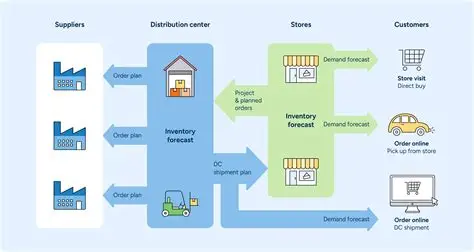
A retail supply chain is the interconnected system that moves products from raw materials to the final customer.
At its simplest, the process includes:
- Product design and planning
- Sourcing materials
- Manufacturing
- Transportation
- Warehousing
- Inventory management
- Distribution
- Retail sales
- Customer delivery or pickup
But simplicity disappears quickly when scale enters the picture.
A global retailer may work with thousands of suppliers across multiple countries, manage millions of products, and make inventory decisions based on constantly changing consumer behavior.
The challenge is not just moving products.
The challenge is moving the right products, to the right location, at the right time, while controlling cost.
The First Step: Predicting What Consumers Will Buy
Every supply chain begins with a question:
What will customers want?
Retailers use demand forecasting to estimate future sales. These forecasts influence purchasing decisions, production schedules, warehouse capacity, and transportation planning.
Forecasting is part science and part educated prediction.
Companies analyze:
- Historical sales data
- Seasonal trends
- Customer preferences
- Economic conditions
- Marketing campaigns
- Regional differences
- Competitor activity
A retailer selling winter coats faces a very different challenge from one selling fresh groceries. One product can sit in inventory for months. Another may lose value within days.
The cost of being wrong can be significant.
Too little inventory creates missed sales.
Too much inventory creates markdowns, storage costs, and wasted resources.
The Supply Chain’s Main Components
Although every retailer operates differently, most supply chains contain several fundamental stages.
Product Development and Sourcing
Before products exist physically, retailers decide what to create and where to produce it.
Sourcing teams evaluate suppliers based on:
- Manufacturing capability
- Cost structure
- Quality standards
- Delivery reliability
- Geographic location
A lower production cost may appear attractive, but a supplier located far away can introduce longer transportation times and greater uncertainty.
Retailers constantly weigh efficiency against flexibility.
Manufacturing: Turning Plans Into Products
Manufacturing transforms concepts into inventory.
This stage involves decisions about:
- Materials
- Production volume
- Quality control
- Labor
- Timing
Large retailers often work with multiple manufacturers because relying on a single source can create risk.
A factory delay, political disruption, or shortage of materials can affect the entire chain.
Transportation: Moving Products Across the World
Transportation connects every stage.
Products may travel through:
- Cargo ships
- Air freight
- Trucks
- Rail networks
- Local delivery vehicles
Transportation decisions involve trade-offs.
Air shipping is faster but expensive.
Ocean shipping is cheaper but slower.
Trucking offers flexibility but depends heavily on infrastructure and fuel costs.
A retailer’s transportation strategy directly influences pricing, availability, and customer experience.
A Retail Supply Chain Comparison
Different retail models require different supply chain approaches.
| Retail Model | Inventory Approach | Main Supply Chain Challenge | Speed Priority | Common Risk |
|---|---|---|---|---|
| Fast Fashion | Rapid turnover, frequent product changes | Matching trends quickly | Very high | Excess inventory after trends fade |
| Grocery Retail | Continuous replenishment | Maintaining freshness and availability | Extremely high | Waste from unsold products |
| Luxury Retail | Limited inventory, controlled distribution | Protecting exclusivity | Moderate | Overproduction reducing brand value |
| E-Commerce Retail | Large fulfillment networks | Fast and accurate delivery | Very high | Rising logistics costs |
| Wholesale Retail | Bulk purchasing | Managing volume efficiently | Moderate | Storage and inventory expenses |
The table reveals an important truth: there is no universal “best” supply chain.
The ideal system depends on what customers value.
Warehousing: The Middle of the Movement
Warehouses are often misunderstood as simple storage spaces.
Modern warehouses function as complex operational centers.
They manage:
- Inventory tracking
- Product sorting
- Order preparation
- Returns processing
- Quality checks
Technology has transformed warehouses into highly coordinated environments. Barcode systems, robotics, and inventory software help companies locate products quickly and reduce mistakes.
But technology does not eliminate the fundamental challenge.
A warehouse can only perform well when inventory decisions upstream are accurate.
Inventory Management: The Retail Balancing Act
Inventory is where many supply chain decisions become visible.
A customer does not see forecasting models or supplier contracts. They see whether the product is available.
Inventory management requires answering difficult questions:
“How much should we keep?”
“Where should we place it?”
“When should we reorder?”
Retailers measure inventory performance through metrics such as:
- Inventory turnover
- Stockout rates
- Carrying costs
- Order accuracy
- Forecast accuracy
A retailer with too much inventory ties up money.
A retailer with too little disappoints customers.
The goal is balance.
Technology’s Growing Role in Retail Supply Chains
Modern supply chains rely heavily on data.
Retailers use technology to improve:
- Demand forecasting
- Warehouse operations
- Delivery routing
- Supplier communication
- Customer fulfillment
Artificial intelligence and advanced analytics can identify patterns that humans may miss. For example, a system may detect that a specific region is likely to experience increased demand for a product before traditional sales reports reveal the trend.
However, technology does not replace judgment.
A forecast can identify patterns, but humans still decide how much risk to accept.
The Customer Is the Final Link in the Chain
Historically, supply chains focused primarily on efficiency.
Today, customer expectations have expanded the definition of success.
Consumers care about:
- Fast delivery
- Product availability
- Easy returns
- Transparency
- Sustainability
A retailer’s supply chain has become part of the brand experience.
A delayed delivery is not simply a logistics issue. It becomes a customer relationship issue.
An unavailable product is not just an inventory problem. It becomes a lost opportunity.
Sustainability and the Changing Supply Chain
Retail supply chains are also being reshaped by environmental concerns.
Companies are examining:
- Packaging waste
- Transportation emissions
- Supplier practices
- Product lifecycles
Sustainable supply chains require difficult decisions because environmental improvements often involve cost considerations.
The challenge is creating systems that are both responsible and economically viable.
Why Supply Chains Fail
Supply chain failures rarely come from one mistake.
They usually result from disconnected decisions.
A retailer may underestimate demand.
A supplier may experience delays.
Transportation costs may increase.
A warehouse may struggle with capacity.
Each problem creates pressure on the next stage.
The strongest supply chains are not those that eliminate uncertainty. They are those designed to respond effectively when uncertainty arrives.
Conclusion: The Shelf Is Only the Beginning
Retail supply chains remain invisible to most shoppers.
That invisibility is a sign of success.
When everything works correctly, customers rarely think about the journey behind a purchase. They simply find what they need, when they need it.
But behind every product is a network of decisions involving people, technology, forecasts, and relationships.
The future of retail will not be determined only by who creates the most attractive products. It will also belong to companies that understand how to move those products intelligently.
Because the real competition in retail does not happen only on the shelf.
It happens long before the customer arrives.
The supply chain is where strategy becomes reality.
- Arts
- Business
- Computers
- الألعاب
- Health
- الرئيسية
- Kids and Teens
- مال
- News
- Personal Development
- Recreation
- Regional
- Reference
- Science
- Shopping
- Society
- Sports
- Бизнес
- Деньги
- Дом
- Досуг
- Здоровье
- Игры
- Искусство
- Источники информации
- Компьютеры
- Личное развитие
- Наука
- Новости и СМИ
- Общество
- Покупки
- Спорт
- Страны и регионы
- World

 English
 Russian
 French
 Spanish
 Portuguese
 Deutsch
 Turkish
 Dutch
Dutch
 Italiano
 Romaian
 Portuguese (Brazil)
 Greek
Greek
