
What Is the Difference Between SaaS and Web Applications? The Distinction Most Businesses Get Wrong
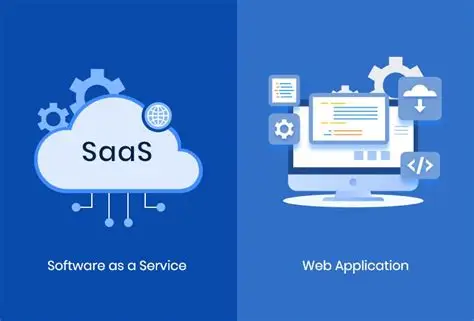
There is a fascinating pattern in technology conversations.
The more familiar a term becomes, the less precisely people tend to use it.
Consider how often people use the words “brand” and “logo” interchangeably, despite representing entirely different concepts. Or how “innovation” is frequently confused with “invention,” even though one concerns novelty and the other concerns value.
The same phenomenon appears in software.
Ask a room full of business leaders about SaaS and web applications, and chances are good that many will treat them as synonyms. After all, both are accessed through a browser. Both live online. Both allow users to accomplish tasks without installing traditional desktop software.
The similarities seem obvious.
The differences are less obvious.
And yet those differences matter because they influence how software is developed, monetized, scaled, maintained, and ultimately experienced by customers.
I was reminded of this during a product strategy workshop with a software startup. The founders proudly described their platform as a SaaS solution. A few minutes later, a prospective investor interrupted and asked a deceptively simple question:
“Is it actually SaaS, or is it just a web application?”
The room became surprisingly quiet.
Not because nobody knew the answer.
Because everyone realized the answer was more complicated than they initially thought.
That moment highlights a larger misunderstanding in the technology marketplace. SaaS and web applications overlap. Often extensively.
But they are not the same thing.
Understanding why requires looking beyond technology and examining the business model underneath it.
Why the Confusion Exists
At first glance, the misunderstanding seems reasonable.
Most SaaS products are web applications.
Users access them through browsers.
They run on remote servers.
They require internet connectivity.
They deliver functionality through web technologies.
From the customer's perspective, they often look identical.
But appearance can be misleading.
A web application describes how software is delivered and accessed.
SaaS describes how software is packaged, distributed, managed, and monetized.
One is primarily a technological concept.
The other is primarily a business model.
That distinction changes everything.
Defining a Web Application
A web application is any software program that operates through a web browser.
Rather than running locally on a device, the application processes requests through web technologies and servers.
Examples are everywhere:
- Online banking portals
- Travel booking systems
- University student portals
- Government service websites
- Internal employee dashboards
- E-commerce management tools
The defining characteristic is not ownership.
It is not pricing.
It is not licensing.
The defining characteristic is access through the web.
A web application may be free.
It may be private.
It may be publicly available.
It may serve a single company.
It may serve millions of users.
The term simply describes the application's architecture and delivery mechanism.
Defining SaaS
Software-as-a-Service, or SaaS, is a software distribution model in which customers subscribe to software hosted and managed by a provider.
Instead of purchasing software outright, users pay for ongoing access.
The provider handles:
- Infrastructure
- Maintenance
- Updates
- Security patches
- Performance optimization
- Feature enhancements
Customers consume the service rather than owning the software.
This distinction is crucial.
A SaaS product is not merely software accessed through a browser.
It is software delivered as an ongoing service.
The word “service” carries enormous weight here.
Because the provider's responsibility does not end after deployment.
In many ways, it is just beginning.
The Rectangle-and-Square Problem
One of the easiest ways to understand the relationship is through a simple analogy.
Every square is a rectangle.
Not every rectangle is a square.
Similarly:
Every SaaS product is typically a web application.
Not every web application is SaaS.
The distinction sounds subtle.
Yet it determines how companies generate revenue, support customers, and create long-term value.
A corporate intranet might be a web application.
A government tax filing portal might be a web application.
An internal inventory management system might be a web application.
None of these are necessarily SaaS products.
They may have no subscriptions.
No recurring payments.
No external customers.
No commercial software service model.
They are simply applications delivered through the web.
SaaS vs. Web Applications: Side-by-Side Comparison
| Feature | SaaS | Web Application |
|---|---|---|
| Primary Definition | Software delivery and business model | Software architecture and access method |
| Access Method | Usually browser-based | Browser-based |
| Subscription Revenue | Common | Not required |
| Multi-Tenant Architecture | Often used | Optional |
| Continuous Updates | Expected | Depends on owner |
| Customer Support | Typically included | Not always included |
| Commercial Product | Usually | Optional |
| User Base | Multiple customers | Internal or external users |
| Scalability Focus | High | Varies |
| Ownership Model | Vendor-owned and managed | Can be organization-owned |
| Monetization | Subscription or recurring fees | May be free or internal-use only |
| Service Responsibility | Vendor-managed | Depends on deployment |
The table reveals something important.
The differences are less about functionality and more about operational structure.
What users see on the surface often looks remarkably similar.
What happens behind the scenes is entirely different.
Why Business Models Matter More Than Technology
Technology leaders often focus on features.
Executives often focus on outcomes.
Customers focus on convenience.
Yet sustainable software businesses depend on economics.
This is where SaaS separates itself from a generic web application.
A SaaS company is not simply building software.
It is building an ongoing relationship.
Revenue arrives monthly or annually.
Customer retention becomes critical.
Product improvements never stop.
Support becomes part of the offering.
Success depends not only on acquiring users but on keeping them.
That creates different incentives.
A web application can succeed simply by functioning.
A SaaS platform must continue delivering value long after the initial sign-up.
The difference resembles the contrast between selling a product and operating a membership program.
The interaction never truly ends.
The Hidden Importance of Multi-Tenancy
Another distinction frequently overlooked involves architecture.
Many SaaS products rely on multi-tenant environments.
Multiple customers share the same underlying infrastructure while maintaining separate and secure data environments.
This creates significant efficiencies.
Updates occur centrally.
Features roll out universally.
Maintenance becomes streamlined.
Not every web application operates this way.
An organization may build a web application solely for internal use.
A university may create a student portal.
A healthcare provider may develop a patient management platform.
These applications may serve specific audiences without supporting multiple paying customers.
Technically sophisticated?
Absolutely.
SaaS?
Not necessarily.
My Lesson Learned: The Product Was Excellent, the Business Wasn't
Several years ago, I advised a software company preparing for expansion.
The leadership team proudly emphasized the sophistication of its web application.
The product worked beautifully.
Users loved it.
Performance was strong.
Yet growth stalled.
The reason became apparent during customer interviews.
The company had focused almost entirely on application functionality while largely ignoring the service experience surrounding it.
Onboarding was inconsistent.
Support response times varied.
Feature releases were infrequent.
Customer success initiatives were minimal.
The application was impressive.
The SaaS experience was not.
That distinction proved costly.
Eventually, leadership reoriented the business around customer lifecycle management rather than software development alone.
Retention improved dramatically.
So did revenue.
The lesson was simple.
A great web application can be a component of a successful SaaS business.
It is not sufficient by itself.
When a Web Application Is Not SaaS
Understanding what falls outside the SaaS category helps clarify the difference.
Examples include:
Internal Enterprise Systems
Many companies build custom web applications exclusively for employees.
These applications support operations but are not sold commercially.
Government Portals
Tax filing systems, licensing portals, and public service websites often function as web applications without operating as subscription software businesses.
Educational Platforms
Universities frequently develop student-facing systems for registration, grades, and communications.
These may be sophisticated web applications without fitting the SaaS model.
Single-Organization Applications
Custom software developed for one company's specific needs remains a web application even if it uses modern cloud technologies.
The common thread is straightforward.
The application exists.
The service model does not.
When a Web Application Becomes SaaS
A web application evolves into SaaS when additional business and operational layers emerge.
These typically include:
Subscription-Based Access
Users pay recurring fees rather than purchasing software outright.
Vendor-Managed Operations
The provider maintains infrastructure, updates, and security.
Ongoing Product Development
Features improve continuously rather than remaining static.
Scalable Customer Delivery
The same platform serves multiple customers efficiently.
Customer Success and Support
The relationship extends beyond software access.
At this point, the organization is no longer simply distributing an application.
It is delivering a service.
And that shift fundamentally changes the business.
Why the Distinction Matters for Buyers
Many software buyers focus exclusively on functionality.
Can the application perform the required task?
That question matters.
But it is incomplete.
Organizations should also evaluate:
- Who manages updates?
- Who handles security?
- How is support delivered?
- What happens when requirements change?
- How frequently does innovation occur?
These considerations often determine long-term satisfaction more than individual features.
Because software rarely fails due to a lack of functionality.
More often, it fails because the surrounding experience falls short.
That experience is where SaaS providers differentiate themselves.
The Future: Increasing Overlap, Persistent Differences
The line between SaaS and web applications will continue to blur.
Modern software increasingly relies on browser-based experiences.
Cloud infrastructure has become ubiquitous.
Subscription models remain popular.
As a result, many applications will possess characteristics associated with both categories.
Yet the fundamental distinction will remain.
A web application describes technology.
SaaS describes a business model.
One explains how software works.
The other explains how software creates value.
Those are different questions.
And the companies that understand both tend to outperform those that focus on only one.
Conclusion: The Difference Is Not Where the Software Lives
The most common mistake in this debate is assuming the distinction revolves around browsers, servers, or internet connectivity.
It does not.
The real difference lies in the relationship between provider and user.
A web application is software accessed through the web.
A SaaS product is software delivered as an ongoing service.
One can exist without the other.
One frequently exists within the other.
But they are not interchangeable concepts.
And that distinction becomes increasingly important as software markets mature.
Because the future of technology is not merely about building applications.
It is about creating experiences, maintaining relationships, and delivering continuous value.
The companies that recognize that shift stop asking whether they have a web application.
They start asking whether they are delivering a service.
That question is far more revealing.
- Arts
- Business
- Computers
- Spiele
- Health
- Startseite
- Kids and Teens
- Geld
- News
- Personal Development
- Recreation
- Regional
- Reference
- Science
- Shopping
- Society
- Sports
- Бизнес
- Деньги
- Дом
- Досуг
- Здоровье
- Игры
- Искусство
- Источники информации
- Компьютеры
- Личное развитие
- Наука
- Новости и СМИ
- Общество
- Покупки
- Спорт
- Страны и регионы
- World

 English
 Russian
 French
 Spanish
 Portuguese
 Turkish
 Dutch
Dutch
 Italiano
 Arabic
 Romaian
 Portuguese (Brazil)
 Greek
Greek
