
Can a country have a comparative advantage in everything?
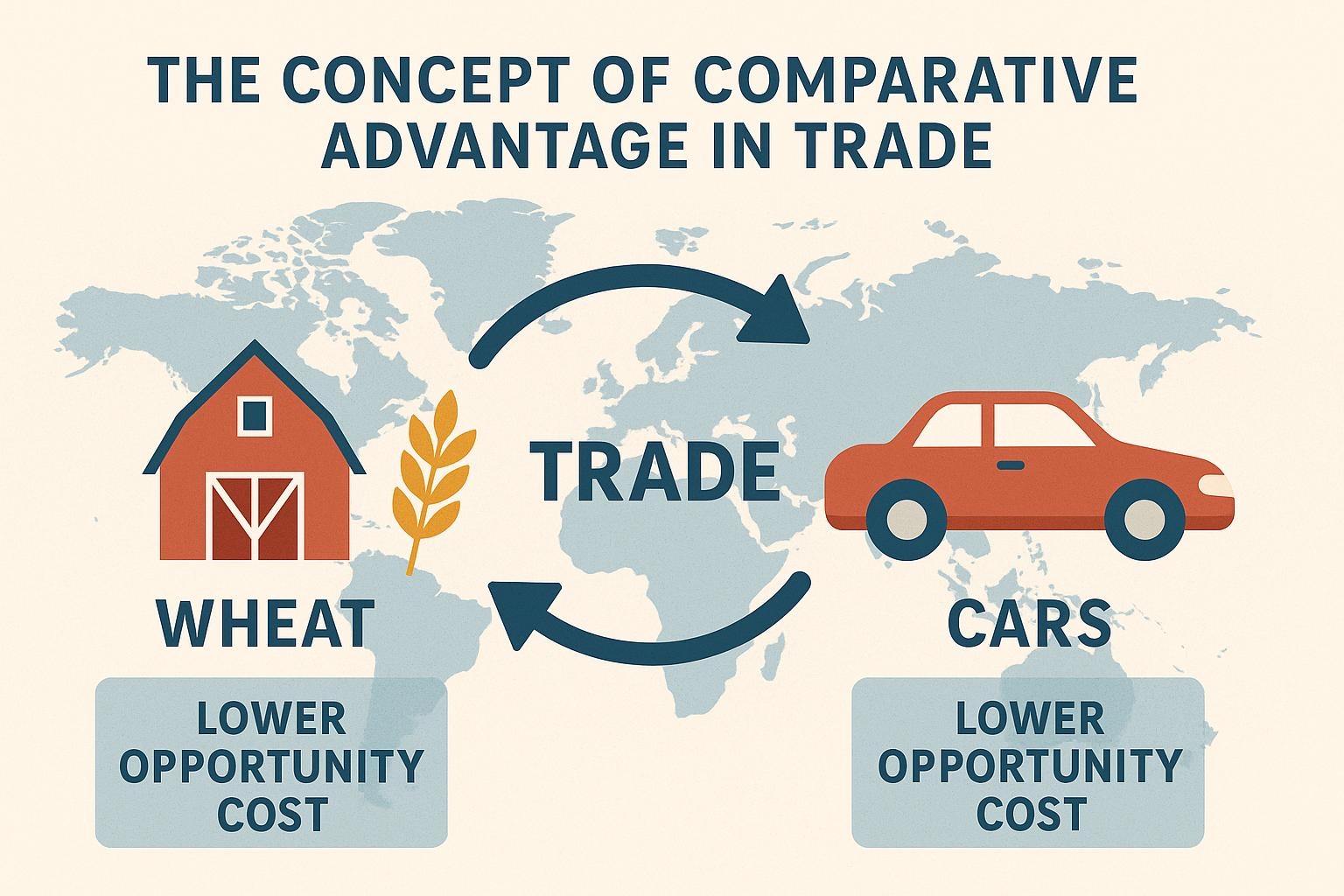
Can a Country Have a Comparative Advantage in Everything?
Comparative advantage is one of the most important ideas in international economics. It explains why countries can benefit from specializing in certain goods and services and trading with one another, even when one country is more productive in producing everything. A common question, however, is whether a country can have a comparative advantage in everything.
The short answer is no. A country can have an absolute advantage in everything, but it cannot have a comparative advantage in everything when there are only two countries and two goods. Comparative advantage is based on relative opportunity costs, and those costs necessarily create a trade-off between goods.
Absolute Advantage vs. Comparative Advantage
To understand why, it is important to distinguish between absolute and comparative advantage.
A country has an absolute advantage in producing a good if it can produce that good using fewer resources or produce more of it with the same resources than another country. For example, suppose Country A can produce both computers and wheat more efficiently than Country B. Country A therefore has an absolute advantage in both goods.
Comparative advantage is different. A country has a comparative advantage in producing a good when it can produce that good at a lower opportunity cost than another country.
Opportunity cost is what must be given up to produce something else. If producing one additional computer requires Country A to give up two tons of wheat, while Country B must give up four tons of wheat to produce one computer, Country A has the comparative advantage in computers.
This means comparative advantage depends not on who is best at producing a product in absolute terms, but on who gives up less to produce it.
Why One Country Cannot Have Comparative Advantage in Everything
Consider a simple example involving two countries, Country A and Country B, and two products: wheat and computers.
Suppose Country A is more productive in producing both goods. It can produce:
-
100 units of wheat or 50 computers
-
Country B can produce 60 units of wheat or 20 computers
Country A has an absolute advantage in both wheat and computers.
However, its comparative advantage must be determined by opportunity costs.
For Country A, producing 1 computer costs 2 units of wheat:
100 ÷ 50 = 2 units of wheat
For Country B, producing 1 computer costs 3 units of wheat:
60 ÷ 20 = 3 units of wheat
Therefore, Country A has the comparative advantage in computers.
Now consider wheat. Producing 1 unit of wheat costs Country A 0.5 computers, while it costs Country B about 0.33 computers.
Thus, Country B has the comparative advantage in wheat.
Country A is more productive at producing both goods, but it has a comparative advantage in only one of them. Country B has the comparative advantage in the other.
This illustrates a fundamental principle: absolute productivity differences do not determine comparative advantage; relative opportunity costs do.
The Role of Opportunity Cost
The reason a country cannot normally have comparative advantage in everything is mathematical.
With two goods, the opportunity cost of producing one good is the reciprocal of the opportunity cost of producing the other. If Country A has a lower opportunity cost for producing computers than Country B, it must have a higher opportunity cost for producing wheat.
Suppose:
-
Country A gives up 2 units of wheat for one computer.
-
Country B gives up 4 units of wheat for one computer.
Country A has the lower opportunity cost for computers and therefore has the comparative advantage in computers.
But in terms of wheat:
-
Country A gives up 0.5 computers for one unit of wheat.
-
Country B gives up 0.25 computers for one unit of wheat.
Country B therefore has the comparative advantage in wheat.
The comparative advantage in one good automatically implies a comparative disadvantage in the other.
What If a Country Is Much More Productive?
A common misunderstanding is that a highly productive country might be so efficient that it has a comparative advantage in every product.
It can certainly have an absolute advantage in every product. For example, a technologically advanced economy may produce cars, computers, pharmaceuticals, and agricultural goods more efficiently than another country.
However, productivity alone does not determine comparative advantage.
Imagine Country A is twice as productive as Country B in agriculture but ten times as productive in manufacturing. Country A has an absolute advantage in both sectors. Nevertheless, its relative efficiency is much greater in manufacturing. Therefore, it has a comparative advantage in manufacturing, while Country B has a comparative advantage in agriculture.
This distinction is particularly important in international trade. A less productive country can still benefit from trade if it specializes in activities where its relative disadvantage is smallest.
Can a Country Have Comparative Advantage in Many Goods?
Although a country cannot have a comparative advantage in everything in a simple two-country, two-good model, it can have comparative advantages in many goods and services when the economy includes numerous products and trading partners.
For example, a country might have comparative advantages in:
-
Financial services
-
Software development
-
Pharmaceuticals
-
Engineering
-
Certain agricultural products
At the same time, other countries may have comparative advantages in other products.
Comparative advantage is also relative to a particular trading partner. A country could have a comparative advantage in producing a product compared with one country but not compared with another.
With many countries and thousands of products, the pattern of comparative advantage can therefore be much more complicated than the simple two-good model suggests.
A Country Can Have Absolute Advantage Everywhere
It is perfectly possible for one country to be better at producing every good.
This idea was central to economist David Ricardo's theory of comparative advantage. Ricardo showed that international trade can benefit countries even when one country is more efficient in producing every product.
Suppose Country A can produce both wine and cloth more efficiently than Country B. If Country A is especially efficient at producing wine relative to cloth, while Country B is relatively less inefficient at producing cloth, both countries can gain by specializing and trading.
Country A specializes more heavily in wine, while Country B specializes more heavily in cloth. Through trade, both can obtain combinations of goods that would be difficult or impossible to achieve without specialization.
Thus, the existence of an absolute advantage does not eliminate the benefits of international trade.
What About More Than Two Countries?
When there are many countries, the statement becomes more nuanced.
Comparative advantage is always a relative concept. A country may be relatively efficient in several industries compared with some countries but not others. It may also trade with different countries based on different opportunity costs.
For example, Country A could have a comparative advantage in electronics relative to Country B, while Country C may have an even greater comparative advantage in electronics relative to Country A.
Therefore, saying that a country has a comparative advantage "in everything" is generally too broad. Comparative advantage depends on the countries being compared, the goods being considered, and the relevant opportunity costs.
Why Comparative Advantage Matters for Trade
The principle of comparative advantage provides the economic foundation for specialization and international trade.
If countries specialize according to their comparative advantages, resources can be allocated more efficiently. Production can increase, and countries can exchange goods and services to achieve higher levels of consumption.
Importantly, this does not mean every country must be the world's most efficient producer of something. Even a country with lower productivity across the board can have a comparative advantage in an industry because its opportunity cost is relatively low.
This is one reason international trade can be mutually beneficial even when countries differ significantly in productivity, technology, wages, and resources.
Conclusion
A country cannot have a comparative advantage in everything in the standard two-country, two-good framework. It can, however, have an absolute advantage in everything.
The key distinction is opportunity cost. Comparative advantage is determined by which country sacrifices less of another good when producing a particular product. If one country has the lower opportunity cost for one good, the other country necessarily has the lower opportunity cost for the other good.
In real-world economies with many countries and products, comparative advantage can exist across numerous industries and relationships, making the pattern more complex. Nevertheless, the central principle remains the same: comparative advantage is about relative opportunity costs, not overall productivity.
Understanding this distinction helps explain why international trade can benefit countries even when one country is more productive than its trading partners in virtually every area.
- Arts
- Business
- Computers
- Игры
- Health
- Главная
- Kids and Teens
- Деньги
- News
- Personal Development
- Recreation
- Regional
- Reference
- Science
- Shopping
- Society
- Sports
- Бизнес
- Деньги
- Дом
- Досуг
- Здоровье
- Игры
- Искусство
- Источники информации
- Компьютеры
- Личное развитие
- Наука
- Новости и СМИ
- Общество
- Покупки
- Спорт
- Страны и регионы
- World

 English
 French
 Spanish
 Portuguese
 Deutsch
 Turkish
 Dutch
Dutch
 Italiano
 Arabic
 Romaian
 Portuguese (Brazil)
 Greek
Greek