
What is a customs union?
What Is a Customs Union?
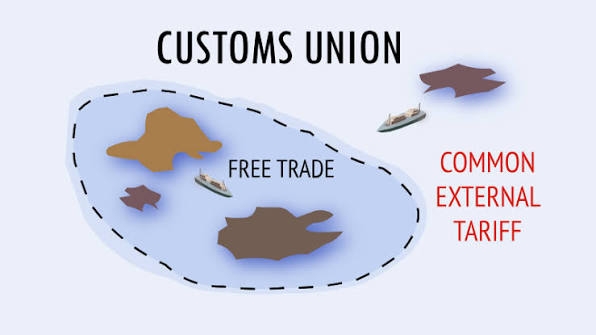
A customs union is a form of economic integration in which two or more countries agree to remove or reduce customs duties and other trade barriers on goods traded among themselves while applying a common external tariff to goods imported from countries outside the union. It is a step beyond a free trade area because member countries not only promote trade among themselves but also adopt a common approach to imports from non-member countries.
Customs unions are designed to make trade between participating countries easier, reduce administrative barriers, and strengthen economic cooperation. One of the best-known examples is the European Union, which operates as a customs union among its member states.
How Does a Customs Union Work?
A customs union has two main characteristics.
First, member countries eliminate customs duties and similar restrictions on most goods traded between them. For example, if Countries A, B, and C form a customs union, goods produced in Country A can generally be exported to Countries B and C without being subject to import tariffs.
Second, the members establish a common external tariff (CET). This means that goods imported from a country outside the union are generally subject to the same tariff regardless of which member country they enter through.
For instance, suppose Countries A, B, and C belong to a customs union and agree on a 10% tariff on imported automobiles from non-member countries. An automobile imported from Country X would normally face a 10% tariff whether it entered through A, B, or C. This prevents businesses from simply importing goods through the member country with the lowest external tariff.
Customs Union vs. Free Trade Area
A customs union is closely related to a free trade area, but there is an important difference.
In a free trade area, members remove trade barriers among themselves but maintain their own tariffs on imports from non-member countries. This means each country can have a different trade policy toward the rest of the world.
A customs union goes further by requiring members to use a common external tariff.
For example, imagine Countries A and B have a free trade agreement. Country A might impose a 5% tariff on imported electronics, while Country B imposes a 15% tariff. Because the countries have different external tariffs, they need rules of origin to determine whether products entering one country from the other were genuinely produced there or merely imported from a third country and re-exported.
In a customs union, the common external tariff reduces this problem because members generally apply the same tariff to goods coming from outside the union.
Main Objectives of a Customs Union
Customs unions are established for several economic and political reasons.
1. Increasing Trade Among Members
Removing tariffs between member countries makes goods cheaper and can encourage businesses to trade more across borders. Consumers may gain access to a wider range of products at competitive prices.
2. Reducing Trade Barriers
A common customs policy can simplify international trade procedures. Businesses operating across member countries may face fewer customs-related obstacles than they would under separate national systems.
3. Creating a Larger Market
A customs union combines the markets of its member countries. Companies can potentially serve a larger customer base, allowing them to expand production and benefit from economies of scale.
4. Strengthening Bargaining Power
A group of countries negotiating trade policy together may have greater bargaining power than individual countries. The combined market can make the customs union an important trading partner for countries outside the union.
5. Promoting Economic Cooperation
Customs unions can encourage closer economic and political relationships among participating countries. Trade integration may create incentives for governments to cooperate on other economic issues.
Advantages of a Customs Union
One major advantage is trade creation. When tariffs between members are removed, consumers and businesses may purchase goods from more efficient producers within the union. This can increase economic efficiency.
Another benefit is greater market access. Businesses can potentially sell products to a larger integrated market without facing tariffs at every internal border.
Customs unions can also reduce uncertainty for companies. A common external tariff provides businesses with a more predictable framework for importing goods from outside the union.
In addition, member countries may benefit from increased competition. Domestic companies that previously operated behind high trade barriers may face competition from firms in other member states. This can encourage businesses to improve productivity, reduce costs, and develop better products.
Customs unions may also attract foreign investment. International companies may establish production facilities within the union so they can gain access to its wider market.
Disadvantages and Challenges
Despite their benefits, customs unions also have disadvantages.
One important issue is loss of independent trade policy. Once a country joins a customs union, it generally cannot freely set its own tariffs on goods from non-member countries. Decisions about the common external tariff must be coordinated with the other members.
This can create disagreements. Different countries may have different economic priorities. A country with a large automobile industry, for example, may want high tariffs on imported cars to protect domestic producers, while another member may prefer lower tariffs because its consumers benefit from cheaper imported vehicles.
Another potential problem is trade diversion. This occurs when a country begins importing goods from a less efficient producer within the customs union because imports from a more efficient non-member producer are made relatively more expensive by the common external tariff.
For example, if Country A can efficiently produce a product but faces the common external tariff when exporting to the union, businesses in member countries might instead buy the same product from a less efficient member country. Although internal trade increases, overall economic efficiency may decline.
Customs unions can also require substantial coordination between governments. Members need common rules concerning tariffs, customs procedures, and the treatment of goods from outside the union.
Examples of Customs Unions
The European Union (EU) is one of the most prominent examples. EU member states form a customs union in which goods generally move between member countries without internal customs duties, while a common external tariff is applied to imports from outside the EU.
Another example is MERCOSUR, a South American regional integration bloc involving countries such as Argentina, Brazil, Paraguay, and Uruguay. MERCOSUR has developed a customs union framework, although its implementation has included exceptions and special arrangements.
The East African Community (EAC) also operates a customs union among its participating members, with the aim of promoting trade and economic integration in East Africa.
Customs Union and Economic Integration
A customs union represents an intermediate stage of economic integration. Economic integration can take several forms, ranging from relatively limited cooperation to much deeper integration.
A simplified progression is:
Preferential trade agreement → Free trade area → Customs union → Common market → Economic union → Political union
A free trade area removes many internal trade barriers but allows members to maintain separate external tariffs. A customs union adds a common external tariff. A common market goes further by allowing greater freedom of movement for goods, services, capital, and labor. An economic union involves even closer coordination of economic policies.
Thus, a customs union can serve as a foundation for deeper regional integration.
Conclusion
A customs union is an agreement between countries to remove trade barriers among themselves while applying a common external tariff to imports from non-member countries. It aims to increase trade, expand markets, improve economic efficiency, and strengthen cooperation among its members.
The key difference between a customs union and a free trade area is the common external tariff. While customs unions can create significant economic opportunities, they also require members to surrender some control over their independent trade policies and can produce challenges such as trade diversion.
Overall, customs unions are an important form of regional economic integration. When effectively managed, they can encourage trade and investment, create larger markets, and strengthen the economic position of participating countries in the global economy.
- Arts
- Business
- Computers
- Juegos
- Health
- Home
- Kids and Teens
- Money
- News
- Personal Development
- Recreation
- Regional
- Reference
- Science
- Shopping
- Society
- Sports
- Бизнес
- Деньги
- Дом
- Досуг
- Здоровье
- Игры
- Искусство
- Источники информации
- Компьютеры
- Личное развитие
- Наука
- Новости и СМИ
- Общество
- Покупки
- Спорт
- Страны и регионы
- World

 English
 Russian
 French
 Portuguese
 Deutsch
 Turkish
 Dutch
Dutch
 Italiano
 Arabic
 Romaian
 Portuguese (Brazil)
 Greek
Greek