
What is economic integration?
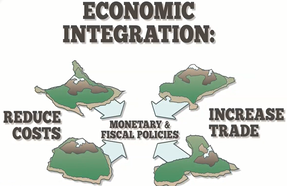
What Is Economic Integration?
Economic integration is the process by which countries reduce or remove barriers to trade, investment, and economic cooperation in order to create closer economic relationships. These barriers can include tariffs, import quotas, restrictions on investment, and other regulations that make it more difficult for goods, services, capital, and sometimes workers to move between countries.
Economic integration can take different forms, ranging from simple trade agreements to highly coordinated economic and monetary unions. Its main goal is to increase economic efficiency, encourage trade and investment, and improve economic opportunities for participating countries.
How Economic Integration Works
Countries normally have separate economic systems, with their own trade policies, taxes, regulations, currencies, and markets. When countries decide to integrate their economies, they agree to reduce some of these differences and cooperate more closely.
For example, two countries might agree to eliminate tariffs on goods traded between them. This makes imported products cheaper and encourages businesses in both countries to trade more. At a deeper level of integration, countries may also allow the free movement of services, capital, and workers or coordinate economic policies.
Economic integration therefore involves progressively reducing economic barriers. The deeper the integration, the greater the level of cooperation and policy coordination required.
Levels of Economic Integration
There are several major stages of economic integration.
1. Preferential Trade Area
A preferential trade area is one of the simplest forms of integration. Participating countries give each other lower tariffs or other trade advantages than they provide to countries outside the agreement.
This arrangement encourages trade between members but does not necessarily eliminate all trade barriers.
2. Free Trade Area
In a free trade area, member countries eliminate or significantly reduce tariffs and other trade barriers among themselves. However, each country generally maintains its own trade policies toward non-member countries.
A well-known example is the United States-Mexico-Canada Agreement (USMCA), which supports trade among the United States, Mexico, and Canada.
3. Customs Union
A customs union goes further by eliminating internal tariffs while also establishing a common external tariff on many goods imported from countries outside the union.
This means members coordinate an important part of their external trade policy. The European Union developed from earlier stages of economic cooperation that included a customs union.
4. Common Market
A common market includes the features of a customs union while allowing greater freedom of movement for factors of production, particularly labor and capital.
Workers may have greater opportunities to work in other member countries, while businesses and investors can move capital more easily across borders.
5. Economic Union
An economic union represents a deeper level of integration. Member countries coordinate significant economic policies, including areas such as taxation, regulation, and government spending.
The objective is to make participating economies operate more closely as a single economic area.
6. Monetary Union
A monetary union occurs when countries adopt a common currency or coordinate their monetary policies closely. The euro area is a major example, where participating European countries use the euro as their currency.
A common currency can make cross-border trade and investment easier because businesses do not have to deal with exchange-rate fluctuations between participating countries.
Examples of Economic Integration
The European Union is one of the most advanced examples of economic integration. Its members have developed extensive cooperation in trade, investment, movement of people, and economic regulation. Many EU members also share the euro.
Other examples include the Association of Southeast Asian Nations (ASEAN), which promotes economic cooperation among Southeast Asian countries, and the African Continental Free Trade Area (AfCFTA), which aims to increase trade among African economies by reducing trade barriers.
Regional trade agreements are also important forms of integration. They can allow countries to specialize in industries where they are relatively efficient and obtain other goods and services through international trade.
Advantages of Economic Integration
Economic integration can provide several important benefits.
Increased trade: Removing tariffs and other barriers makes it easier and cheaper for businesses to sell products across borders. This can increase the volume of international trade.
Larger markets: Businesses gain access to larger markets when several national economies become more closely connected. A larger market can allow companies to expand production and benefit from economies of scale.
Greater competition: Integration exposes domestic companies to competitors from other member countries. This can encourage businesses to improve productivity, reduce costs, and develop new products.
More foreign investment: Investors may be more willing to invest in an integrated economic region because they can access a larger market with fewer restrictions.
Lower prices and greater choice: Consumers can benefit from increased competition and access to a wider range of products and services.
Economic growth: Increased trade, investment, and productivity can contribute to economic growth and create new employment opportunities.
Stronger cooperation: Economic integration can encourage countries to cooperate politically as well as economically. Shared economic interests may help reduce tensions and strengthen regional relationships.
Disadvantages and Challenges
Despite its potential benefits, economic integration also creates challenges.
One concern is that some domestic industries may struggle to compete with more efficient foreign producers. When trade barriers are removed, companies that were previously protected by tariffs may lose market share or close, potentially causing unemployment in particular industries or regions.
Economic integration can also reduce a government's freedom to make independent economic policies. In deeper forms of integration, countries may have to follow common rules or coordinate their monetary, fiscal, and trade policies.
Another challenge is that economic problems can spread more easily between closely connected economies. A financial crisis in one member country may affect its trading and investment partners.
There can also be disagreements over how the benefits of integration should be distributed. Larger or more competitive economies may gain more from certain arrangements, while smaller economies may worry about losing economic independence.
Economic Integration and Globalization
Economic integration is closely connected to globalization. Globalization involves the increasing interconnectedness of economies, societies, and markets around the world. Economic integration contributes to this process by making it easier for countries to trade, invest, and cooperate.
However, economic integration is often more organized and deliberate than globalization. Countries voluntarily create agreements and institutions to manage their economic relationships. Globalization can occur through broader forces such as technological development, international business expansion, and improved transportation and communication.
Conclusion
Economic integration is an important feature of the modern global economy. By reducing trade barriers and encouraging cooperation, it allows countries to build closer economic relationships and create larger markets.
The process can range from preferential trade agreements to free trade areas, customs unions, common markets, economic unions, and monetary unions. Each level requires different degrees of cooperation and can produce both benefits and costs.
When managed effectively, economic integration can increase trade, investment, competition, productivity, and economic growth. At the same time, governments must address challenges such as job losses in less competitive industries, unequal distribution of benefits, and reduced national policy independence.
Ultimately, economic integration reflects the idea that countries can achieve economic advantages by cooperating rather than operating entirely as separate markets. As international trade and investment continue to expand, economic integration will remain an important part of how countries participate in the global economy.
- Arts
- Business
- Computers
- Spellen
- Health
- Home
- Kids and Teens
- Money
- News
- Personal Development
- Recreation
- Regional
- Reference
- Science
- Shopping
- Society
- Sports
- Бизнес
- Деньги
- Дом
- Досуг
- Здоровье
- Игры
- Искусство
- Источники информации
- Компьютеры
- Личное развитие
- Наука
- Новости и СМИ
- Общество
- Покупки
- Спорт
- Страны и регионы
- World

 English
 Russian
 French
 Spanish
 Portuguese
 Deutsch
 Turkish
 Italiano
 Arabic
 Romaian
 Portuguese (Brazil)
 Greek
Greek