
What Is SaaS Governance?
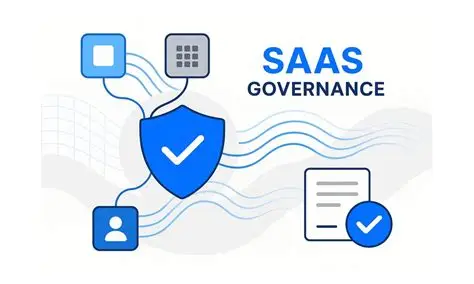
The easiest way to lose control of software is to give people exactly what they want.
Need a project-management tool? Sign up.
Need a survey platform? Try one.
Need a better way to share files with a client? There is an app for that.
Need it today?
Even better.
This is the promise of SaaS. Software becomes faster to acquire, easier to deploy, and remarkably difficult to keep track of.
Then the bill arrives.
Not one bill, necessarily. Hundreds.
Somewhere inside the organization are applications nobody remembers approving, accounts belonging to former employees, duplicate tools doing nearly identical jobs, contracts approaching renewal, and integrations quietly moving data between systems.
The software is working.
The governance is not.
That is where SaaS governance comes in.
SaaS governance is the framework an organization uses to control how cloud-based software is selected, approved, purchased, accessed, secured, monitored, and retired.
It sounds bureaucratic.
Done properly, it is almost the opposite.
Good governance allows companies to move faster because employees know what they can use, how they can obtain it, and what happens when they need something new.
The goal is not to stop software adoption.
The goal is to make software adoption intentional.
SaaS Governance, Defined
At its simplest, SaaS governance answers seven questions:
- What applications do we have?
- Who owns them?
- Who can access them?
- What data do they contain?
- How much do they cost?
- What risks do they create?
- When should we renew, replace, or remove them?
That sounds like inventory management.
It is much broader.
A mature governance program connects IT, security, finance, procurement, legal, compliance, and business teams.
Each group sees a different part of the problem.
Finance cares about spend.
Security cares about exposure.
IT cares about architecture and access.
Legal cares about contracts and obligations.
Business teams care about getting work done.
SaaS governance is the mechanism that makes those interests work together rather than compete independently.
Why SaaS Created a Governance Problem
Traditional enterprise software was difficult to acquire.
That was inconvenient.
It was also a form of governance.
Buying a major software system might require hardware, installation, implementation consultants, licensing agreements, IT approval, and a substantial budget.
Cloud software removed much of that friction.
That was transformative for employees.
It also changed the balance of power inside organizations.
A department can now discover a product in the morning, create an account at lunch, and begin using it before IT knows the application exists.
This phenomenon is often described as shadow IT.
But there is a more useful way to understand it.
Shadow IT is frequently a symptom of demand outrunning governance.
If the official process takes six weeks and the business needs a solution tomorrow, employees will look for another route.
The lesson is important:
A governance system that makes legitimate work painfully slow eventually teaches employees to bypass it.
The answer is not necessarily more restrictions.
Sometimes the answer is better design.
The Five Pillars of SaaS Governance
While organizations structure their programs differently, five areas consistently matter.
1. Visibility
You cannot govern applications you do not know exist.
A SaaS inventory should capture applications, owners, users, vendors, contracts, costs, integrations, and relevant risk information.
The inventory must also stay current.
A spreadsheet updated once a year is not governance.
It is historical documentation.
2. Access
Employees should have appropriate access to the applications they need—and inappropriate access should disappear when they no longer need it.
This makes identity management central to SaaS governance.
Single sign-on, automated provisioning, role-based access controls, and employee offboarding processes can reduce the number of forgotten accounts and unnecessary privileges.
3. Security
Every SaaS application potentially introduces data and access risk.
Governance therefore asks questions such as:
- What information does the vendor receive?
- Where is that information stored?
- Does the application connect to other systems?
- What permissions does it require?
- Does the vendor meet the organization's security standards?
- What happens if the vendor suffers a breach?
Security review should happen before—not after—the software becomes deeply embedded in the business.
4. Financial Control
SaaS creates recurring expenditure.
Governance gives organizations a way to understand that expenditure.
The objective is not to eliminate every application that is underused.
It is to determine whether the organization is receiving sufficient value for what it pays.
That distinction matters.
5. Lifecycle Management
Every application has a lifecycle:
Request → evaluate → approve → purchase → deploy → monitor → renew → retire.
Weak governance focuses heavily on the first step.
Mature governance pays equal attention to the last one.
Software that no longer serves a business purpose should not remain indefinitely because nobody knows who owns it.
What SaaS Governance Looks Like in Practice
Imagine an employee wants to purchase a new analytics platform.
In an unmanaged environment, the employee submits a corporate-card request—or simply pays for it—and begins uploading company information.
In a governed environment, the request triggers a workflow.
The organization might evaluate:
- Business purpose
- Existing software overlap
- Security requirements
- Data classification
- Vendor risk
- Contract terms
- Pricing
- Legal requirements
- Integration needs
- Ownership
The process does not have to take weeks.
Automation can route low-risk applications through an expedited path while sending high-risk requests to security or legal teams.
This is an important principle:
Governance should be proportional to risk.
A lightweight productivity application should not require the same scrutiny as a system handling regulated customer information.
A Governance Framework by Risk Level
| SaaS Category | Example Use | Typical Risk | Governance Level | Primary Owner |
|---|---|---|---|---|
| Low-risk productivity | Notes, basic task management | Low | Lightweight review | IT/business |
| Collaboration | Messaging, file sharing | Moderate | Security + access review | IT |
| Customer-facing | CRM, support platforms | High | Security + legal + procurement | Business/IT |
| Financial | Accounting, payments | Very high | Extensive controls | Finance/IT |
| Regulated data | Healthcare, sensitive personal data | Very high | Formal risk/compliance review | Security/compliance |
| Privileged infrastructure | Identity, administration | Critical | Strict technical governance | Security/IT |
The point is not the labels themselves.
The point is creating a predictable decision process.
Employees should understand what happens when they request software.
Security should understand which requests require deeper review.
Procurement should know when it enters the process.
Leadership should know where the company's greatest exposure lies.
The Lesson Hidden in the Application List
One of the most useful lessons I have learned from examining software environments is that the application inventory tells a story about the organization itself.
If three departments independently purchase three different project-management tools, the problem may not be “too many apps.”
It may indicate that the organization has decentralized purchasing.
If employees repeatedly adopt unsanctioned collaboration tools, perhaps the approved platform is failing them.
If security discovers dozens of applications connected to sensitive systems, perhaps access governance is too weak.
The list of applications is therefore diagnostic.
It can reveal organizational friction that would otherwise remain invisible.
That is why simply deleting applications rarely solves the underlying problem.
The organization has to understand why they appeared in the first place.
Governance vs. SaaS Management
The terms are often used interchangeably.
They should not be.
SaaS management focuses heavily on operational visibility and optimization.
Governance is broader.
| Area | SaaS Management | SaaS Governance |
|---|---|---|
| Application discovery | Core function | Core function |
| License optimization | Core function | Important |
| Spend analysis | Core function | Important |
| Access control | Important | Core function |
| Security policy | Supporting | Core function |
| Vendor risk | Supporting | Core function |
| Compliance | Supporting | Core function |
| Approval processes | Important | Core function |
| Lifecycle policy | Important | Core function |
| Organizational accountability | Moderate | Core function |
Think of SaaS management as answering:
“What is happening?”
Governance asks:
“What should be allowed to happen—and under what conditions?”
That distinction becomes increasingly important as software ecosystems grow.
The Role of Procurement
Procurement has traditionally focused on negotiating favorable commercial terms.
SaaS governance expands that role.
A good procurement process can identify duplicate applications, consolidate vendors, standardize contract terms, and prevent automatic renewals from becoming invisible expenses.
But procurement should not operate independently.
The cheapest contract can still be a bad decision if the software creates unacceptable security risk.
Likewise, the most secure application may be economically irrational if the company already has an equivalent capability elsewhere.
Governance creates the conversation between those competing priorities.
The Role of Security
Security teams once focused primarily on infrastructure controlled by the organization.
SaaS changes the perimeter.
Corporate data may now live across dozens or hundreds of third-party environments.
That makes vendor relationships part of the security architecture.
A governance program can establish minimum requirements for authentication, encryption, access control, incident response, data retention, and vendor risk.
But there is another issue that receives less attention:
third-party integrations.
An application may be low risk by itself but become high risk once it receives permission to read from a CRM, access cloud storage, or act on behalf of employees.
Governance must therefore evaluate not just applications, but connections between applications.
AI Is Making SaaS Governance Harder
Generative AI introduces a new layer of complexity.
Employees can now add AI assistants to workflows with remarkable speed.
They may connect an AI application to documents, email, calendars, customer data, or internal knowledge bases.
The productivity upside can be enormous.
So can the governance questions.
What information can the AI access?
Where does that information go?
Who controls retention?
What happens when an employee leaves?
Can the AI act on behalf of the user?
What permissions does it have?
The old SaaS governance model treated an application primarily as a destination for data.
AI applications can behave more like participants in workflows.
That changes the risk model.
Governance therefore has to evolve from controlling software access to controlling software behavior.
What Good SaaS Governance Looks Like
The mature organization does not try to approve every mouse click.
Instead, it creates guardrails.
Employees receive a clear software catalog.
Low-risk applications move through fast approval paths.
High-risk applications receive deeper review.
Identity systems automatically provision and revoke access.
Security tools monitor application connections.
Procurement tracks contracts and renewals.
Business owners periodically certify that applications remain necessary.
Finance sees aggregate spending.
Leadership sees risk.
And nobody has to maintain the entire system manually.
That last point matters.
At enterprise scale, governance that depends on heroic administrative effort will eventually fail.
Automation is not a luxury.
It is part of the architecture.
The Provocative Question
There is a temptation to think SaaS governance is primarily about controlling employees.
I think that framing misses the larger opportunity.
The real objective is to create an organization where software can spread without becoming invisible.
That is harder.
It requires trust rather than blanket restriction.
It requires data rather than assumptions.
It requires accountability without creating bureaucratic paralysis.
And it requires accepting an uncomfortable fact about modern companies:
Software is no longer something IT simply installs. It is something the entire organization continuously creates, purchases, connects, and abandons.
Governance must therefore become continuous as well.
Conclusion: The Goal Isn't Fewer Apps
A company with 500 SaaS applications is not necessarily poorly governed.
A company with 50 applications is not necessarily well governed.
The meaningful question is whether the organization understands its software environment well enough to make deliberate decisions.
Who owns each application?
Who can access it?
What data does it touch?
What does it cost?
What does it connect to?
What happens when the vendor changes its terms?
And perhaps the most important question:
What happens when nobody is paying attention?
That is where governance earns its keep.
The future of SaaS governance will not be defined by the size of the application inventory. It will be defined by the organization's ability to make software adoption fast without making it reckless, decentralized without making it invisible, and automated without making it unaccountable.
The best governance system may ultimately be the one employees barely notice.
They request what they need.
The organization understands the risk.
Access appears when appropriate.
It disappears when necessary.
Contracts are reviewed before they renew.
Data goes where it should.
And software that has outlived its purpose quietly leaves.
That is not bureaucracy.
That is an organization learning how to control the complexity it deliberately created.
- Arts
- Business
- Computers
- Jogos
- Health
- Início
- Kids and Teens
- Money
- News
- Personal Development
- Recreation
- Regional
- Reference
- Science
- Shopping
- Society
- Sports
- Бизнес
- Деньги
- Дом
- Досуг
- Здоровье
- Игры
- Искусство
- Источники информации
- Компьютеры
- Личное развитие
- Наука
- Новости и СМИ
- Общество
- Покупки
- Спорт
- Страны и регионы
- World

 English
 Russian
 French
 Spanish
 Portuguese
 Deutsch
 Turkish
 Dutch
Dutch
 Italiano
 Arabic
 Romaian
 Greek
Greek