
What Is the Difference Between Sponsorship and a Donation?
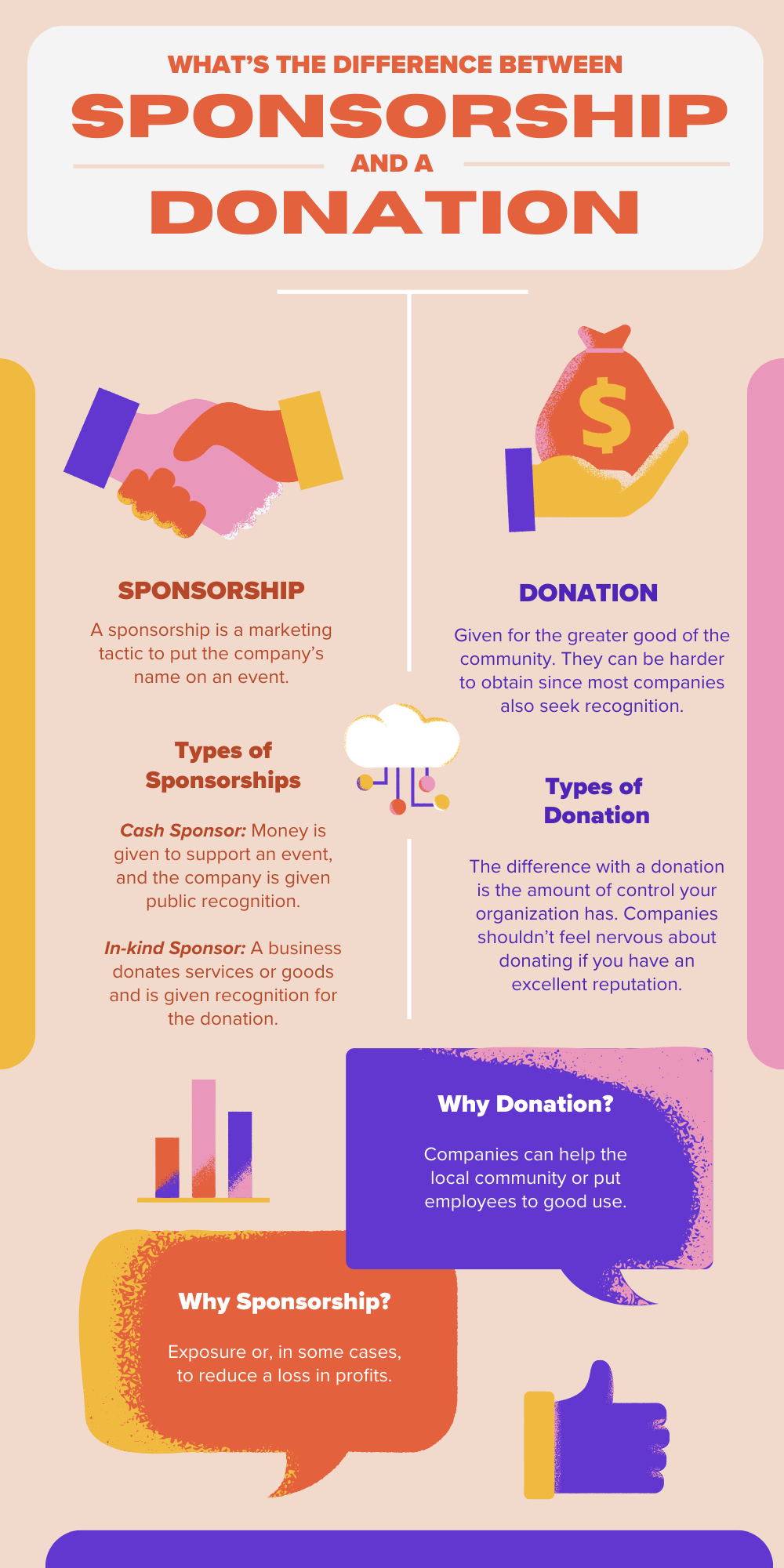
A company gives $50,000 to a youth soccer organization.
At first glance, the transaction seems straightforward. Money moves from a business to a community organization. The organization benefits. The children benefit. Everyone shakes hands.
But suppose the company’s logo appears on every jersey. Its executives receive tickets to the organization’s annual gala. The company gets a booth at tournament events, mentions in promotional materials, and permission to use the team’s name in its own marketing.
Now it is no longer simply a gift.
It is a sponsorship.
That distinction matters because sponsorship and donation may involve the same check, the same recipient, and even the same charitable cause. Yet they represent fundamentally different exchanges.
A donation is primarily an act of giving.
A sponsorship is primarily an exchange of value.
The difference becomes particularly important for companies deciding where to allocate community-investment dollars. A donation can express generosity and support a mission. A sponsorship can do that while simultaneously pursuing visibility, customer engagement, employee participation, or brand association.
Neither is inherently more virtuous.
They simply answer different questions.
A donation asks: What can we give?
A sponsorship asks: What can we build together?
The Fundamental Difference: Gift Versus Exchange
The easiest way to distinguish the two is to examine what the organization gives the company in return.
With a donation, the central expectation is generally that the money will support the recipient’s mission. There may be recognition—a donor's name on a wall, a thank-you letter, an annual report listing, or an invitation to an event—but that recognition is not necessarily the economic centerpiece of the transaction.
With sponsorship, benefits are usually specified.
The sponsor might receive advertising inventory, signage, naming rights, event access, content opportunities, category exclusivity, hospitality, tickets, speaking opportunities, product placement, or the right to associate its name with the sponsored property.
That is a commercial relationship.
The organization is not merely saying, “Thank you for helping us.”
It is saying, “Here are the assets and benefits you receive as part of this partnership.”
This is why the terminology matters.
Calling a sponsorship a donation can obscure the sponsor’s objectives. Calling a donation a sponsorship can distort the donor's intentions and create expectations that were never part of the gift.
Sponsorship vs. Donation at a Glance
| Dimension | Sponsorship | Donation |
|---|---|---|
| Basic nature | Exchange of value | Gift or charitable contribution |
| Primary objective | Mutual benefit | Support a mission or cause |
| Business benefits | Usually explicit | Usually secondary or absent |
| Brand exposure | Commonly negotiated | May occur through recognition |
| Contract | Typically formalized | Often simpler |
| Rights | Defined and deliverable | Generally limited |
| Marketing use | Often central | Usually incidental |
| Logo placement | Frequently negotiated | May be offered as recognition |
| Exclusivity | Can be included | Usually not a central feature |
| Hospitality | Common in larger agreements | Less typical |
| Audience access | Often part of the package | Not usually the purpose |
| Activation | Frequently expected | Generally unnecessary |
| Measurement | Exposure, engagement, leads, sales, brand impact | Mission impact and stewardship |
| Relationship | Strategic partnership | Philanthropic support |
| Renewal decision | Often tied to business performance | Often tied to mission, budget, and relationship |
| Typical internal owner | Marketing, partnerships, communications | Corporate philanthropy, foundation, CSR, leadership |
| Core question | “What value does this partnership create?” | “What impact will this gift make?” |
The distinction is not always perfectly clean.
Real-world arrangements occupy a spectrum.
That is precisely why organizations should define the relationship before the money changes hands.
When a Donation Starts Looking Like a Sponsorship
Here is where things get interesting.
Imagine a company contributes $25,000 to a nonprofit. In exchange, the nonprofit places the company's logo on event materials and thanks the company publicly.
Is that a sponsorship?
Maybe.
Now add a speaking slot for the CEO.
Add a branded activation area.
Add a customer hospitality package.
Add social-media content featuring the company's products.
Add category exclusivity preventing competing companies from participating.
At that point, calling the transaction a simple donation becomes difficult to defend strategically.
The company has purchased a bundle of rights.
The nonprofit has agreed to deliver them.
The relationship has moved from philanthropy toward sponsorship.
This doesn't make the arrangement less charitable. It simply changes its economic character.
That distinction is one of the most useful lessons for marketers and nonprofit leaders: intent matters, but deliverables matter too.
Why Companies Sponsor Instead of Donate
Companies rarely have unlimited community-investment budgets.
Every dollar has an opportunity cost.
A marketing executive evaluating a $100,000 sponsorship may ask questions a philanthropist evaluating a $100,000 donation does not:
- How many people will we reach?
- Does this audience overlap with our customers?
- Will the association strengthen our brand?
- Can employees participate?
- Can we create content around the partnership?
- Will customers have an experience they remember?
- Can the sponsorship generate leads?
- Does the property give us credibility in a market where we are trying to grow?
These questions do not make the sponsorship cynical.
They make it strategic.
A company may genuinely care about youth sports while also recognizing that a youth-sports partnership can help it build relationships in a local market.
Those motivations can coexist.
The mistake is pretending they are the same motivation.
Why Companies Donate Instead
Donation decisions often begin somewhere else.
A company might support a food bank because the organization is addressing hunger in its community. It might contribute to disaster relief because immediate assistance is needed. It might fund scholarships because education is central to its philanthropic priorities.
There may be no marketing campaign attached.
No expectation of customer acquisition.
No branded activation.
No demand for exclusivity.
The value is the impact created by the money.
That distinction can be liberating.
Not every corporate contribution needs to generate impressions.
Not every act of generosity needs to become content.
Sometimes the strongest philanthropic decision is the one that does not require a logo to be photographed.
The First-Person Lesson: Don't Confuse Visibility With Impact
One lesson I would emphasize when evaluating these arrangements is deceptively simple: visibility is not the same thing as value.
It is tempting to look at a sponsorship package and count logos, banners, social posts, mentions, and event appearances.
Those are measurable.
They are also incomplete.
A nonprofit may receive a substantial donation that produces almost no public visibility but funds a program serving hundreds of people.
Another organization may receive a smaller sponsorship that generates enormous exposure for the company but relatively modest mission funding.
Neither outcome should automatically be judged as better.
The right evaluation depends on the objective.
If the company is trying to strengthen a brand association, sponsorship may be appropriate.
If the company is trying to provide unrestricted funding for a critical program, a donation may be more valuable.
I have found that this is where many otherwise sophisticated conversations become muddled. People start comparing transactions by dollar amount rather than by purpose.
That is a category error.
The relevant question is not simply, “How much money changed hands?”
It is, “What was each side trying to accomplish?”
Sponsorship Can Require More Than Writing a Check
A donation is relatively simple operationally.
The company gives money.
The nonprofit uses it according to the agreed purpose.
A sponsorship often requires work from both parties.
The nonprofit may need to deliver signage, hospitality, content, event access, social posts, tickets, reporting, or other contractual benefits.
The sponsor, meanwhile, may need to activate those rights.
That last point is frequently underestimated.
A company can spend $200,000 on sponsorship rights and fail to extract meaningful value because it never creates anything around the partnership.
The sponsorship sits there.
The logo appears.
The opportunity evaporates.
Activation turns rights into experiences.
A company sponsoring a cultural festival might create an employee volunteer program, customer experience, educational installation, or digital campaign around the event. A company sponsoring a nonprofit gala might invite strategic customers and employees rather than simply collecting its table allotment.
Sponsorship is therefore not passive.
It asks the company to participate.
The Nonprofit's Perspective Matters, Too
Nonprofits sometimes approach sponsorship as if every corporate dollar should be treated as unrestricted philanthropy.
That can create problems.
Sponsors have legitimate expectations when they have purchased rights. If a company pays for category exclusivity, for example, the nonprofit cannot casually offer the same category to a competitor.
Likewise, if a sponsor expects a certain number of social-media mentions or hospitality seats, those deliverables need to be managed.
The relationship becomes more professional—and more sustainable—when both parties understand the exchange.
But nonprofits should also be cautious about selling too much.
A sponsorship package overloaded with logos, announcements, banners, and promotional obligations can diminish the very audience experience that made the property attractive to the sponsor.
The strongest partnerships protect the nonprofit's mission and the sponsor's commercial objectives simultaneously.
The Tax and Legal Distinction Deserves Attention
There is another reason terminology matters: tax and legal treatment can differ depending on the jurisdiction and structure of the transaction.
A straightforward charitable contribution may be treated differently from a payment made in exchange for substantial promotional or commercial benefits.
That does not mean every sponsorship is automatically taxable advertising, nor does it mean every donation is automatically deductible in a particular way.
The details matter.
Organizations should therefore avoid relying on casual labels such as “donation” or “sponsorship” when documenting transactions. The actual agreement, benefits, purpose, and applicable tax rules should determine the treatment.
For substantial arrangements, professional legal or tax advice is appropriate.
The check's memo line is not a legal theory.
Which One Should a Company Choose?
Start with the objective.
Choose donation when the primary goal is philanthropic impact and the company does not require a commercial return.
Choose sponsorship when the company wants a structured relationship that combines financial support with defined marketing, engagement, access, or brand benefits.
And consider a hybrid strategy when both objectives matter.
A company might make a charitable contribution to a nonprofit's general fund while separately sponsoring one of its public events.
That separation can actually improve clarity.
The donation supports the mission.
The sponsorship supports the partnership.
Everyone understands what each dollar is intended to accomplish.
The More Important Question Is Not “Donation or Sponsorship?”
The distinction between sponsorship and donation ultimately comes down to a deceptively uncomfortable idea:
Giving money does not automatically make a transaction philanthropic.
And seeking business value does not automatically make a transaction less meaningful.
A sponsorship can fund valuable community work while strengthening a company's reputation. A donation can be completely altruistic while producing enormous goodwill. There is no moral hierarchy embedded in the vocabulary.
But there is a strategic hierarchy embedded in clarity.
If a company wants exposure, negotiate exposure.
If it wants customer access, negotiate access.
If it wants to support a mission without strings attached, make a donation.
If a nonprofit needs unrestricted funding, say so.
If it is selling sponsorship rights, define those rights precisely.
The worst arrangement is not necessarily the one with the smallest check.
It is the one in which neither side can clearly explain what the money was supposed to accomplish.
That is the provocative truth about sponsorship and donation: the difference is not who receives the money. It is what the money is buying—or, more precisely, whether it is buying anything at all.
A donation says, We believe your work deserves support.
A sponsorship says, We believe your work—and our relationship to it—can create value together.
Both can matter.
But they should never be confused.
- Arts
- Business
- Computers
- Giochi
- Health
- Home
- Kids and Teens
- Money
- News
- Personal Development
- Recreation
- Regional
- Reference
- Science
- Shopping
- Society
- Sports
- Бизнес
- Деньги
- Дом
- Досуг
- Здоровье
- Игры
- Искусство
- Источники информации
- Компьютеры
- Личное развитие
- Наука
- Новости и СМИ
- Общество
- Покупки
- Спорт
- Страны и регионы
- World

 English
 Russian
 French
 Spanish
 Portuguese
 Deutsch
 Turkish
 Dutch
Dutch
 Arabic
 Romaian
 Portuguese (Brazil)
 Greek
Greek