
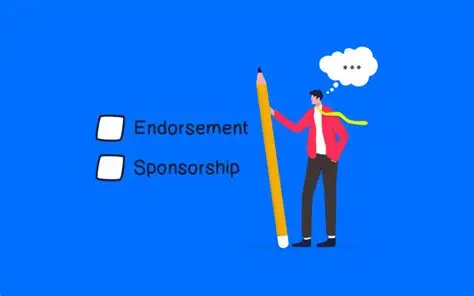
What Is the Difference Between Sponsorship and Endorsement?
A famous athlete wears a company's shoes.
A celebrity appears in a commercial holding its product.
A technology company puts its name on a major conference.
All three can look like endorsement.
All three can look like sponsorship.
They are not the same thing.
The confusion is understandable because modern marketing routinely blends the two. A sponsored athlete may endorse a product. A celebrity endorsement may appear inside a larger sponsorship program. A company may sponsor an event and then pay a celebrity to promote its brand at that event.
The money changes hands. The logo appears. The audience notices.
But the underlying exchange is different.
Sponsorship is primarily about a relationship between a brand and a property. Endorsement is primarily about a relationship between a brand and a person—or, sometimes, another identifiable entity whose credibility is being used to influence an audience.
That distinction changes everything from contract structure to creative control, measurement, risk, and return on investment.
And it leads to a useful strategic question:
Are you trying to own an association, or borrow someone's credibility?
Sponsorship and Endorsement Solve Different Problems
Let's begin with the simplest possible distinction.
A sponsorship gives a brand rights associated with a property.
An endorsement gives a brand an advocate or spokesperson who publicly supports the brand, product, or service.
The property in a sponsorship could be a sports team, league, tournament, concert, festival, nonprofit event, venue, media program, creator platform, or cultural institution.
The endorser could be an athlete, actor, musician, expert, creator, celebrity, or other influential individual.
This creates two fundamentally different strategic mechanisms.
A sponsor wants to become associated with something people already care about.
An endorser wants to transfer some measure of credibility, relevance, expertise, popularity, or personality to the brand.
That is why a stadium can be sponsored without endorsing a product.
And an athlete can endorse a product without the brand sponsoring the athlete's team.
Once that distinction is clear, much of the terminology becomes easier.
Sponsorship vs. Endorsement: The Strategic Comparison
| Dimension | Sponsorship | Endorsement |
|---|---|---|
| Primary asset | Relationship with a property | Relationship with a person or spokesperson |
| Core objective | Build association and access | Transfer credibility or influence |
| Typical partner | Team, league, event, venue, organization, creator property | Athlete, celebrity, expert, creator, public figure |
| Main consumer signal | “This brand belongs here” | “This person recommends or uses this brand” |
| Message control | Shared with property | Often negotiated with endorser |
| Brand association | Property-driven | Personality-driven |
| Typical rights | Signage, naming, tickets, hospitality, content, exclusivity | Image, name, likeness, statements, appearances, content |
| Audience relationship | Often community-based | Often personality-based |
| Activation | Frequently required | Usually integrated into advertising/content |
| Reputation risk | Property and partner risk | Individual reputation risk |
| Exclusivity | Often category-based | Often competitor/category-based |
| Measurement | Reach, exposure, engagement, brand lift, attendance, hospitality | Awareness, credibility, engagement, consideration, conversion, brand lift |
| Duration | Often multi-year | Can range from campaign to multi-year contract |
| Emotional mechanism | Association with an existing property | Identification with or trust in an individual |
| Best suited to | Community, lifestyle, cultural, or institutional positioning | Product preference, credibility, personality, influence |
| Central question | “What should our brand be associated with?” | “Whom do we want consumers to believe?” |
The table reveals an important point: sponsorship is broader than endorsement.
A sponsorship can include endorsements as part of its activation strategy.
An endorsement, by contrast, can stand entirely on its own.
What Exactly Is Sponsorship?
Sponsorship is fundamentally an exchange.
The sponsor provides money, products, services, or other resources. In return, the sponsored property provides agreed rights and benefits.
Those benefits might include:
- Brand visibility
- Naming rights
- Signage
- Event presence
- Tickets
- Hospitality
- Product integration
- Content opportunities
- Social-media exposure
- Category exclusivity
- Customer experiences
- Access to participants or audiences
- Rights to use the property's name and intellectual property
Consider a company sponsoring a professional basketball team.
The sponsor isn't necessarily saying that a particular player recommends its product.
It is saying something subtler:
We want our brand connected to this team, its fans, its culture, and what the team represents.
The association can operate at a surprisingly deep level.
Fans may see the sponsor repeatedly. They may encounter the company at games. They may receive promotional offers. Employees may attend matches. Customers may participate in hospitality programs.
The brand becomes part of the environment surrounding something the audience already values.
That is sponsorship's distinctive power.
What Exactly Is an Endorsement?
Endorsement works through the individual.
A person lends their name, reputation, expertise, image, or public credibility to a brand or product.
The critical psychological mechanism is not simply exposure.
It is source credibility.
If a respected athlete says a product is useful, consumers may process that claim differently than if the same sentence appears in a standard advertisement.
Why?
Because the messenger matters.
The consumer is not merely evaluating a product claim. The consumer is evaluating who is making it.
This is especially important when the endorser has an obvious connection to the product.
A professional runner endorsing running shoes makes intuitive sense.
A chef endorsing cookware makes intuitive sense.
A cybersecurity expert discussing security software can carry a different kind of authority.
But credibility is fragile.
If the connection feels artificial, the endorsement can become an expensive piece of theater.
Sponsorship Says “We Belong.” Endorsement Says “Trust Me.”
This is the distinction I would put at the center of any strategic discussion.
Sponsorship is contextual. Endorsement is personal.
A sponsorship places the brand inside a context.
An endorsement places a person between the brand and the audience.
That difference affects creative execution.
A sponsor might have its logo displayed during an event without saying anything substantive about the product.
An endorser generally needs to do more than appear.
The person's involvement is itself part of the message.
That does not mean an endorsement must be verbal. A recognizable athlete wearing a branded product in an advertisement can communicate endorsement through behavior and association.
But the audience needs to understand the relationship.
Otherwise, the marketer has paid for celebrity visibility without receiving much endorsement value.
The Most Powerful Strategy May Combine Both
Here's where the distinction becomes commercially interesting.
Imagine a sportswear company sponsoring a marathon.
The sponsorship gives the company access to the event, runners, spectators, content, branding, hospitality, and community.
Now add a prominent marathon runner as a brand ambassador.
The company has created two layers of association.
The event provides context.
The athlete provides credibility and personality.
The brand can now tell stories around both.
The runner can appear in advertisements.
The event can provide live experiences.
The athlete can create content.
The sponsorship can generate access.
The endorsement can sharpen the product message.
One asset establishes the stage.
The other supplies the voice.
This is why marketers sometimes struggle to classify major campaigns. The distinction between sponsorship and endorsement is conceptually clear, but sophisticated programs often combine them.
Endorsement Risk Is Personal
There is a particular danger in endorsement that deserves more attention than it usually receives.
People change.
A celebrity can make an offensive statement. An athlete can become embroiled in controversy. An influencer can lose credibility with followers. An expert can make a public mistake.
When the brand's message depends on that person's credibility, the risk is not abstract.
It is attached to a human being.
That means endorsement contracts often need detailed provisions addressing conduct, morality, exclusivity, intellectual property, appearances, content approvals, and termination.
The sponsor faces reputational risk too, of course.
But sponsorship risk can sometimes be distributed across a larger property.
Endorsement risk is concentrated.
The face of the campaign can become the story.
And when that happens, the brand may find itself paying for an association it never intended to purchase.
Sponsorship Risk Is Contextual
Sponsorship carries a different problem.
The property itself can change.
A sports team can suffer a scandal. An event can be poorly managed. A nonprofit can experience governance problems. A festival can become associated with an issue that conflicts with the sponsor's values.
The sponsor's logo does not disappear simply because the circumstances changed.
That is the uncomfortable feature of association-based marketing.
You don't completely control what happens around the property.
This is why sponsorship due diligence matters.
The sponsor should understand not only the audience size but also the property’s reputation, governance, audience composition, competitive relationships, contractual protections, and potential controversies.
A million impressions attached to the wrong context are not necessarily a bargain.
Measurement: Exposure Is the Easy Part
Both sponsorship and endorsement suffer when marketers reduce success to visibility.
Counting appearances is easy.
Understanding influence is harder.
For sponsorship, useful metrics can include:
- Reach and frequency
- Media exposure
- Brand awareness
- Brand association
- Event attendance
- Engagement
- Customer acquisition
- Hospitality outcomes
- Lead generation
- Sales
- Renewal rates
- Employee participation
For endorsement, measurement might emphasize:
- Awareness
- Perceived credibility
- Brand consideration
- Purchase intent
- Content engagement
- Search behavior
- Conversion
- Incremental sales
- Brand lift
- Audience sentiment
The deeper lesson is that the metric should follow the mechanism.
If sponsorship is supposed to strengthen a brand's connection with a community, measure that connection.
If endorsement is supposed to increase product credibility, measure credibility.
A campaign shouldn't be declared successful simply because a famous person appeared in it.
Fame is an input.
It is not an outcome.
The First-Person Lesson: The Logo Is Rarely the Point
One lesson that repeatedly emerges when analyzing partnerships is that marketers can become overly focused on the visible asset.
The logo is easy to photograph.
The banner is easy to count.
The celebrity appearance is easy to report.
But those are surface indicators.
The strategic question sits underneath them.
Why does this person matter to the audience?
Why does this property matter?
Why should the consumer care that the brand is connected to either one?
If those questions have weak answers, more exposure rarely solves the fundamental problem.
This is perhaps the most useful discipline a marketer can impose on a sponsorship or endorsement proposal: remove the logo mentally and ask whether the relationship still makes sense.
If the answer is no, the brand may be buying inventory rather than building an asset.
So, Which Is Better?
Again, there is no universal winner.
Choose sponsorship when the strategic goal is to build an association with a community, event, property, lifestyle, or cultural platform.
Choose endorsement when the strategic goal is to leverage an individual's credibility, expertise, popularity, or personality.
Choose both when the two relationships reinforce each other.
But don't combine them simply because a package makes them available.
A famous person does not automatically improve a sponsorship.
A large event does not automatically make an endorsement more credible.
The connection must make sense to the audience.
That is the real test.
The Provocative Conclusion: Don't Rent Fame When You Need Meaning
Sponsorship and endorsement are often discussed as if they were interchangeable ways of buying attention.
They aren't.
Sponsorship buys a relationship with a property. Endorsement buys access to a person's credibility and identity.
One gives a brand a place.
The other gives it a voice.
That distinction becomes increasingly important as brands search for ways to mean something beyond their product descriptions.
A company can put its logo on a stage.
It can put a celebrity in an advertisement.
Neither guarantees relevance.
The real value comes from the connection between the brand, the property or person, and the audience.
That is where the economics become interesting—and where marketing judgment matters most.
A sponsorship should not exist merely because an audience is large.
An endorsement should not exist merely because a person is famous.
The sharper question is more uncomfortable:
What does this relationship allow the brand to mean that it could not credibly mean on its own?
If the answer is compelling, sponsorship can become much more than signage.
Endorsement can become much more than celebrity advertising.
If there is no answer, the brand may simply be renting someone else's attention.
And attention, by itself, is a surprisingly poor substitute for meaning.
- Arts
- Business
- Computers
- Spellen
- Health
- Home
- Kids and Teens
- Money
- News
- Personal Development
- Recreation
- Regional
- Reference
- Science
- Shopping
- Society
- Sports
- Бизнес
- Деньги
- Дом
- Досуг
- Здоровье
- Игры
- Искусство
- Источники информации
- Компьютеры
- Личное развитие
- Наука
- Новости и СМИ
- Общество
- Покупки
- Спорт
- Страны и регионы
- World

 English
 Russian
 French
 Spanish
 Portuguese
 Deutsch
 Turkish
 Italiano
 Arabic
 Romaian
 Portuguese (Brazil)
 Greek
Greek