
What Should a Sponsorship Proposal Include?
A sponsorship proposal should do one thing exceptionally well:
Make it easy for the right sponsor to say, “Tell me more.”
That sounds simple.
It isn't.
A weak proposal can contain twenty pages of information and still leave a potential sponsor wondering what, exactly, you are asking for—and why they should care.
A strong proposal may be considerably shorter.
It identifies the opportunity. It explains the audience. It establishes credibility. It spells out the benefits. It makes the investment understandable. And it gives the sponsor a clear next step.
That is the difference.
A sponsorship proposal is not your autobiography. It is not a brochure stuffed with logos. And it should never read like an apology for asking for money.
It is a business case for a partnership.
Whether you are seeking sponsors for a school event, nonprofit program, conference, sports team, community initiative, personal project, or individual career, the underlying questions are remarkably similar:
Who are you?
Who can you reach?
Why does that audience matter?
What does the sponsor receive?
What will the partnership accomplish?
How much does it cost?
Why should the sponsor trust you to deliver?
Answer those questions clearly, and your proposal has a foundation.
Miss them, and beautiful formatting will not save it.
Start With the Opportunity, Not the Need
This is one of the most important distinctions in sponsorship.
You may desperately need $10,000.
That does not mean a company should give you $10,000.
The sponsor needs a reason to invest.
Perhaps you offer access to an audience the company wants to reach. Perhaps your event creates meaningful community visibility. Perhaps your content reaches a highly specialized market. Perhaps your organization gives the sponsor an opportunity to demonstrate its commitment to education, health, youth development, or another cause.
Your proposal should connect those dots.
Instead of:
“We need financial support to make our event possible.”
Think:
“We are creating an opportunity for local businesses to connect with 1,200 families while supporting educational programming for students.”
The need still exists.
But now there is an opportunity on the table.
That is a much stronger starting point.
The 10 Essential Elements of a Sponsorship Proposal
A comprehensive sponsorship proposal should generally include ten core elements.
Not every proposal needs to be enormous.
In fact, many shouldn't be.
But each of these elements answers a question a potential sponsor is likely to have.
1. Executive Summary
The executive summary is your opening argument.
Keep it concise.
Explain:
- Who you are
- What you are organizing or accomplishing
- Who it reaches
- Why it matters
- What kind of sponsorship you are seeking
Think of this section as the answer to:
“Why am I reading this?”
Do not spend three pages getting there.
A busy decision-maker should understand the basic opportunity quickly.
Example
“The annual Youth Innovation Summit brings together approximately 750 students, educators, parents, and local business leaders for a day of workshops, demonstrations, and career exploration. We are seeking corporate partners to help expand the program while providing sponsors with meaningful opportunities to connect with families and emerging talent.”
That is much more useful than:
“We are excited to announce our biggest event yet!”
Excitement is fine.
Context is better.
2. Your Organization, Event, or Personal Story
Now explain who is behind the opportunity.
Give the sponsor enough background to understand your credibility.
You might include:
- When the organization began
- What you do
- Who you serve
- Major accomplishments
- Previous events
- Awards
- Relevant experience
- Mission and values
If you are an individual seeking sponsorship, explain your professional background, achievements, audience, and project.
But resist the temptation to write your entire life story.
The sponsor does not need every detail.
They need the details that establish relevance and credibility.
3. Audience Information
This may be one of the most valuable sections in the entire proposal.
Sponsors want to know who they can reach.
Provide actual information whenever possible.
Include:
- Expected attendance
- Previous attendance
- Geographic reach
- Audience demographics
- Professional characteristics
- Interests
- Social media following
- Email subscribers
- Website traffic
- Media reach
Avoid empty claims such as “large audience” or “extensive exposure.”
Numbers are more useful.
Even better, explain why those numbers matter.
For example:
“Approximately 70% of attendees live within 25 miles of the event and are parents of school-age children.”
That tells a potential sponsor much more than:
“Our event attracts a great local audience.”
4. The Sponsorship Opportunity
Now explain what you are offering.
This section should make the partnership tangible.
Potential benefits might include:
- Logo placement
- Event signage
- Speaking opportunities
- Booth space
- Product demonstrations
- Social media promotion
- Newsletter inclusion
- Website recognition
- Content collaborations
- Media exposure
- Event tickets
- VIP access
- Employee volunteer opportunities
But don't simply list benefits.
Connect them to outcomes.
For example:
“Sponsors receive a branded activation area where attendees can interact directly with company representatives.”
That is more compelling than:
“Sponsors receive booth space.”
The first describes an experience.
The second describes furniture.
5. Sponsorship Levels
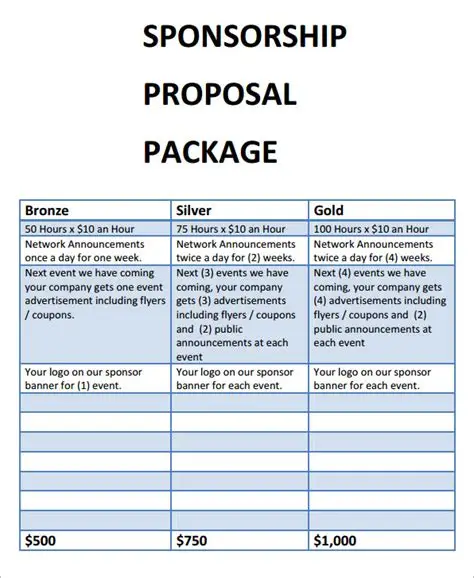
Most proposals benefit from offering several levels.
This gives companies options.
A simple structure might look like this:
| Sponsorship Level | Sample Investment | Key Benefits | Primary Value |
|---|---|---|---|
| Presenting Partner | $10,000+ | Naming recognition, premium branding, speaking opportunity, major activation | High visibility and association |
| Gold Partner | $5,000 | Prominent branding, activation space, digital promotion | Audience engagement |
| Silver Partner | $2,500 | Logo placement, event recognition, social promotion | Brand awareness |
| Community Partner | $500–$1,000 | Program and website recognition | Local goodwill |
| In-Kind Partner | Variable | Recognition based on contribution | Product/service visibility |
These numbers are examples, not universal pricing.
Your levels should reflect the actual size, audience, reach, and value of your opportunity.
And don't create ten sponsorship tiers simply because you can.
Three to five well-defined options are often easier to understand.
Make the Packages Flexible
Here's something worth remembering:
A sponsorship package should start a conversation, not end one.
A company may love your event but have no interest in your standard Gold package.
Maybe it wants to sponsor a particular activity.
Maybe it wants to provide products rather than cash.
Maybe it wants an employee volunteer component.
Allow room for customized partnerships.
That flexibility can uncover opportunities you would never have predicted.
6. A Clear Explanation of Sponsor Benefits
This deserves its own section because vague benefits are among the most common problems in sponsorship proposals.
“Exposure” is not a benefit until you explain what it means.
Ask:
- Exposure to whom?
- Through what channel?
- How often?
- In what format?
- With what expected reach?
- Can it be measured?
Instead of:
“Your company will receive extensive social media exposure.”
Write:
“The sponsor will receive four dedicated social media mentions across our pre-event and event-week campaigns, reaching an audience of approximately 15,000 followers.”
Now the sponsor has something concrete to evaluate.
Specificity builds confidence.
7. Activation Opportunities
A sponsor should not necessarily be limited to having its logo displayed.
Give it opportunities to participate.
Consider:
Product Activation
Allow the sponsor to demonstrate, sample, or showcase a product.
Educational Activation
A sponsor might provide a workshop, presentation, or resource.
Experiential Activation
Create an interactive activity that puts the sponsor directly into the event experience.
Content Activation
Develop videos, interviews, articles, photographs, or social media content around the partnership.
Community Activation
Give employees opportunities to volunteer or participate in the cause.
These approaches can turn sponsorship from passive recognition into active engagement.
And active engagement often creates a richer experience for everyone involved.
8. Proof and Past Results
A sponsor is taking a risk.
Your proposal should reduce that risk.
Include evidence that you can execute.
That could be:
- Previous attendance figures
- Photographs
- Testimonials
- Media coverage
- Audience analytics
- Past sponsor results
- Case studies
- Awards
- Partnerships
- Examples of previous campaigns
If you have sponsored relationships already, show what happened.
For example:
“Last year's event generated 3,400 registrations, 2,700 attendees, and 18,000 social media engagements.”
That is evidence.
If this is your first event, don't pretend otherwise.
Instead, emphasize the strengths you do have.
Perhaps you have a strong community organization behind you. Perhaps you have experienced event professionals. Perhaps you already have access to a highly relevant audience.
Credibility does not require pretending to have a history you don't have.
9. Investment and Budget
Eventually, you have to talk about money.
Be clear.
Explain:
- Sponsorship levels
- What each level costs
- What the sponsor receives
- Payment timing, if relevant
- Whether customized options are available
You can also briefly explain how sponsorship funds will be used.
For example:
“Sponsorship revenue will support venue expenses, educational materials, student programming, and event production.”
Transparency matters.
A sponsor does not necessarily need a 42-line expense report.
But it should understand what its investment makes possible.
10. Measurement and Next Steps
Finish with accountability.
Explain how you will report results.
Depending on the sponsorship, you might track:
- Attendance
- Impressions
- Engagement
- Leads
- Clicks
- Registrations
- Media mentions
- Product interactions
- Content views
Then tell the sponsor what happens next.
Would you like to schedule a call?
Is there a sponsorship deadline?
Do you need a signed agreement?
Who should they contact?
Don't make the reader figure it out.
A Lesson Learned: Your Proposal Should Answer the Sponsor's Questions Before They Ask
One of the most useful lessons I've learned about sponsorship proposals is that organizers often write from the inside out.
They know their event so well that they assume everyone else understands it.
They know why the event matters.
They know how difficult it was to create.
They know how much effort went into it.
But the sponsor wasn't there for any of that.
The sponsor is coming in cold.
That means the proposal has to provide context.
I learned to look at proposals differently by asking a simple question:
“If I knew nothing about this organization, what would I need to know before I could confidently recommend this sponsorship to my boss?”
That question changes the document.
Suddenly, vague claims become specific.
Unexplained statistics get context.
Benefits become deliverables.
And the proposal starts sounding less like a request and more like a business case.
That is the shift you want.
What You Should Leave Out
Knowing what to exclude can be just as important as knowing what to include.
Avoid:
- Excessively long biographies
- Unverified statistics
- Generic sponsor language
- Unrealistic attendance projections
- Promises you cannot control
- Excessive jargon
- Twelve nearly identical sponsorship tiers
- Unexplained pricing
- Poor-quality photographs
- Huge blocks of text
- Benefits that sound impressive but cannot be measured
And don't promise the moon.
If you cannot deliver it, don't put it in the proposal.
A smaller promise delivered exceptionally well is more valuable than a spectacular promise that disappears after the contract is signed.
Make It Look Professional—But Don't Hide Behind Design
Good design matters.
It helps the reader navigate the document.
Use clear headings, consistent formatting, quality images, charts where appropriate, and plenty of white space.
But remember:
Design is packaging. Strategy is the product.
A gorgeous proposal sent to an irrelevant company is still a poor proposal.
Research matters more than decorative elements.
Relevance matters more than clever graphics.
Evidence matters more than adjectives.
If you have to choose between spending another three hours redesigning page seven and spending three hours researching ten better sponsor prospects, the prospect research may produce the greater return.
The Ideal Length
There is no magic number of pages.
A simple local sponsorship might require only a few pages.
A major corporate partnership may justify a much more detailed document.
The test is not length.
The test is usefulness.
Every page should help the sponsor understand one of these things:
Who you are.
Who you reach.
What you offer.
Why it matters.
What it costs.
How success will be measured.
What happens next.
If a page does none of those things, question whether it belongs.
The Provocative Conclusion: Your Proposal Is Not Supposed to Close the Deal
This may sound strange.
But a sponsorship proposal does not always need to close the sponsorship.
Its first job is to earn the next conversation.
That distinction takes pressure off the document—and makes it better.
You are not trying to cram every possible argument into 20 pages.
You are trying to create enough clarity, credibility, relevance, and value that the sponsor wants to explore the opportunity.
That means the best sponsorship proposal is not necessarily the longest.
It is not the most expensive-looking.
It is not the one with the most logos.
It is the one that makes the sponsor's decision easier.
And that requires a subtle change in perspective.
Don't ask:
“What do I want to tell the sponsor?”
Ask:
“What does the sponsor need to know to make an informed decision?”
That is the question that should shape every page.
Your story matters.
Your mission matters.
Your accomplishments matter.
But the proposal becomes persuasive when those things connect to the sponsor's world.
Audience.
Business objectives.
Brand alignment.
Community relationships.
Customer engagement.
Measurable results.
Trust.
That is what turns a sponsorship proposal into a partnership proposal.
And there is one final test worth applying before you send it.
Hand the proposal to someone who knows nothing about your project.
Give them two minutes.
Then ask:
“What exactly are we offering a sponsor, and why would a company want it?”
If they can answer clearly, you are probably close.
If they cannot, don't add another page.
Rewrite the confusing parts.
Because the purpose of a sponsorship proposal isn't to prove how much work you've done.
It is to make the value of working with you impossible to misunderstand.
- Arts
- Business
- Computers
- Spiele
- Health
- Startseite
- Kids and Teens
- Geld
- News
- Personal Development
- Recreation
- Regional
- Reference
- Science
- Shopping
- Society
- Sports
- Бизнес
- Деньги
- Дом
- Досуг
- Здоровье
- Игры
- Искусство
- Источники информации
- Компьютеры
- Личное развитие
- Наука
- Новости и СМИ
- Общество
- Покупки
- Спорт
- Страны и регионы
- World

 English
 Russian
 French
 Spanish
 Portuguese
 Turkish
 Dutch
Dutch
 Italiano
 Arabic
 Romaian
 Portuguese (Brazil)
 Greek
Greek