
How Much Should I Charge for Sponsorship?
There's a number sitting on your sponsorship proposal.
You know you have to put something there.
The problem is figuring out what that something should be.
$1,000?
$5,000?
$25,000?
$100,000?
Most sponsorship sellers worry about charging too much.
Experienced sponsorship sellers also worry about charging too little.
And that second concern deserves far more attention.
Because once you've sold a valuable sponsorship for less than it's worth, you can't easily get the difference back.
You gave away the asset.
The sponsor got the deal.
Now you're stuck explaining why the same opportunity costs twice as much next year.
So, how much should you charge for sponsorship?
Charge based on the value of the opportunity—not simply what feels comfortable, and not what another organization happens to charge.
That's the foundation.
Everything else follows from it.
There Is No Universal Sponsorship Price
The first thing to understand is that sponsorship doesn't have a standard retail price.
A small community event might reasonably charge $500 for a local sponsorship.
A regional conference could charge $10,000 or $25,000.
A major national event could command $100,000, $500,000, or more.
All of those prices can be appropriate.
The difference is the asset.
Consider two hypothetical events:
Event A: 10,000 attendees, broad consumer audience, limited sponsor engagement.
Event B: 750 senior executives, highly targeted industry audience, exclusive sponsor categories, VIP networking, speaking opportunities, and lead-generation activation.
Event A has more attendees.
Event B may have substantially greater sponsorship value for the right company.
That's why the question isn't:
“How many people will attend?”
It's:
“How valuable are the people this sponsor will reach?”
Start With Your Audience
Your audience is the heart of your sponsorship valuation.
Before setting a price, document exactly who you're offering access to.
Look at:
- Number of attendees
- Job titles
- Industries
- Seniority
- Geographic distribution
- Demographics
- Purchasing authority
- Household income, where relevant
- Customer interests
- Professional influence
- Engagement levels
Don't stop at raw attendance.
A sponsor doesn't necessarily want 10,000 people.
They may want 200 specific people.
If those 200 people are difficult to reach through conventional marketing, your sponsorship becomes much more valuable.
Audience Quality Can Outweigh Audience Size
Imagine you're selling enterprise software.
Would you rather reach 50,000 general consumers or 500 qualified technology executives who influence purchasing decisions?
The answer is obvious.
Your sponsorship pricing should reflect that difference.
This is why “We expect 5,000 attendees” is weak sponsorship data by itself.
“More than 60% of attendees are senior-level professionals in the target industry” is much more useful.
The first tells the sponsor about quantity.
The second tells them about opportunity.
Five Questions to Ask Before Setting Your Price
Before you choose a number, answer five questions.
1. Who Is the Audience?
Be specific.
2. How Much Access Does the Sponsor Receive?
Are they simply visible?
Can they interact?
Can they host?
Can they speak?
Can they meet prospects?
3. How Much Visibility Do They Receive?
Consider all channels:
- Website
- Social media
- On-site signage
- Program materials
- Press
- Video
- Livestreams
- Podcasts
- Post-event content
4. What Is Exclusive?
Category exclusivity can be extremely valuable.
One insurance sponsor may value being the only insurance company associated with the event far more than another 20 logo placements.
5. What Can the Sponsor Measure?
The easier it is to connect sponsorship activity to business outcomes, the stronger your pricing conversation becomes.
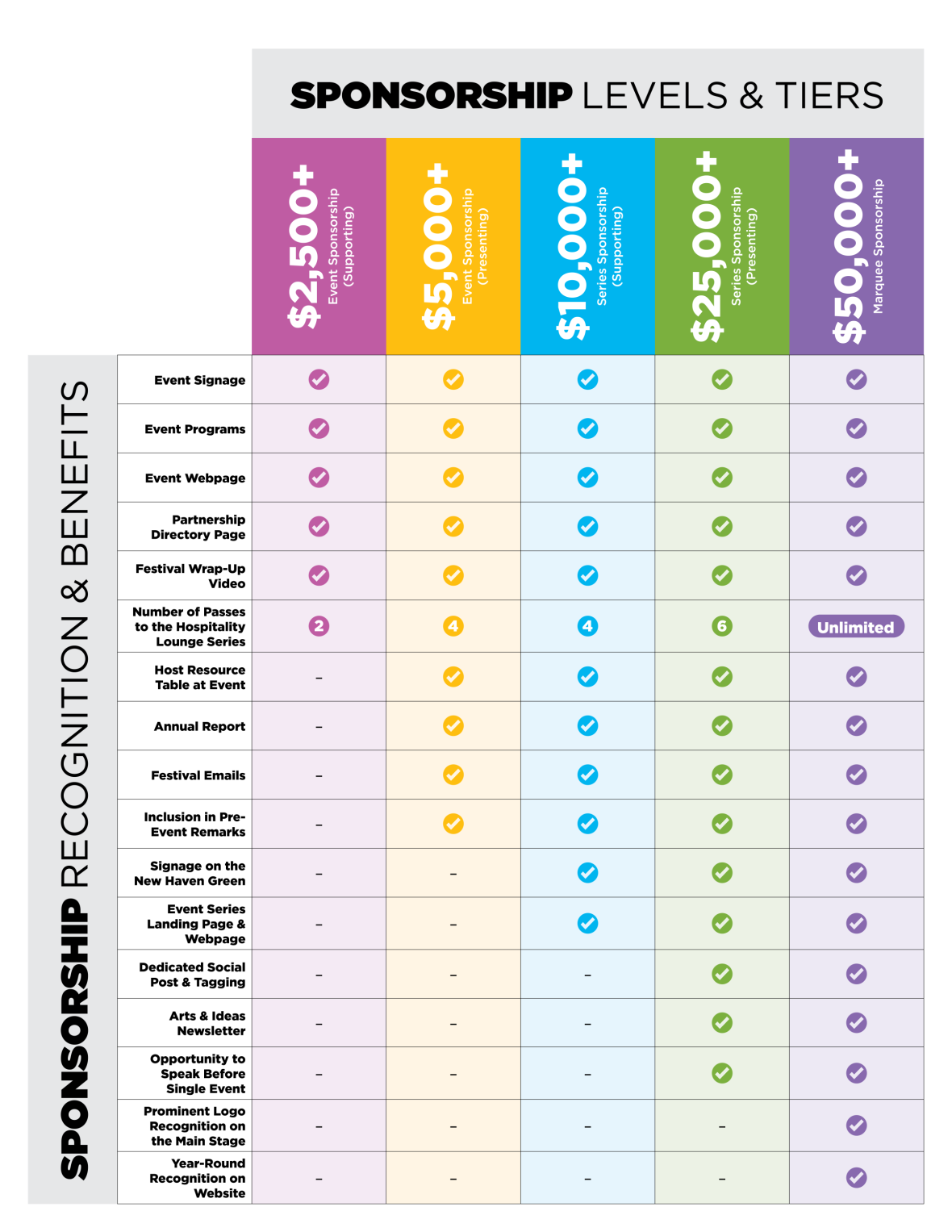
A Practical Sponsorship Pricing Table
Here's an illustrative framework for a mid-sized event:
| Sponsorship Level | Suggested Range | Typical Visibility | Access | Activation | Exclusivity |
|---|---|---|---|---|---|
| Community | $500–$2,500 | Basic | General | Limited | None |
| Bronze | $2,500–$5,000 | Standard | Event access | Basic | None |
| Silver | $5,000–$15,000 | Strong | Networking | Moderate | Possible |
| Gold | $15,000–$30,000 | Premium | VIP | Extensive | Possible |
| Presenting | $30,000–$100,000+ | Very high | Executive | Major | Often included |
| Title | $50,000–$250,000+ | Maximum | Highest | Custom | Typically exclusive |
These figures are illustrative rather than universal market rates.
A nonprofit fundraiser in a small community may sit below them.
A nationally recognized property with a highly desirable audience may sit far above them.
Use the framework to think about relative value—not as a fixed rate card.
Price the Assets, Not the Logo
This is one of the most important distinctions in sponsorship.
Suppose you offer:
Logo on event website: $2,000
What exactly is the sponsor buying?
If your website receives 500 visits, that's one thing.
If it receives 500,000 highly relevant visits, that's another.
Even then, the logo isn't necessarily the most valuable part of the package.
Maybe the real asset is the audience.
Maybe it's the association with your brand.
Maybe it's the opportunity to host customers.
Maybe it's category exclusivity.
Maybe it's the speaking opportunity.
Your logo is simply a delivery mechanism.
Don't confuse the mechanism with the value.
Build a Sponsorship Value Matrix
One way to establish a defensible price is to assign an internal value to each benefit.
For example:
| Sponsorship Asset | Illustrative Internal Value |
|---|---|
| Basic logo recognition | $500–$1,500 |
| Premium logo placement | $1,500–$4,000 |
| Dedicated email promotion | $1,000–$7,500 |
| Social media campaign | $1,000–$5,000 |
| Event tickets | $250–$1,000+ per package |
| VIP hospitality | $2,500–$15,000+ |
| Exhibitor space | $1,500–$10,000 |
| Speaking opportunity | $3,000–$15,000+ |
| Lead-generation activation | $5,000–$25,000+ |
| Category exclusivity | $5,000–$50,000+ |
| Presenting rights | $15,000–$100,000+ |
| Naming rights | $25,000–$250,000+ |
These are planning estimates, not claims about universal market prices.
The point is to understand your inventory.
If you know internally that you're giving away $30,000 worth of strategic benefits, you won't accidentally sell them for $10,000 simply because a prospect asks for a discount.
Don't Use Cost as Your Only Pricing Formula
Here's another common mistake.
An organizer calculates:
Event expenses = $75,000
Then decides:
Sponsorship target = $100,000
That's useful for budgeting.
It isn't enough for pricing.
Your event may cost $75,000 to produce while creating $250,000 worth of sponsorship value.
Or it may cost $250,000 while offering relatively little that sponsors want.
Your expenses tell you what you need to operate.
Your audience and assets tell you what you can potentially charge.
Those are different calculations.
What Should a Gold Sponsorship Cost?
A Gold sponsorship should be priced according to the value of its benefits.
For a smaller regional event, that might mean $5,000.
For a significant conference, $20,000.
For a major property, considerably more.
Don't pick a number simply because Gold “sounds like” a certain amount.
Instead, define what Gold means.
For example:
- Premium branding
- 10 tickets
- VIP access
- Speaking opportunity
- Exhibitor space
- Social promotion
- Dedicated email exposure
- Lead-generation activation
- Category protection
Then determine what those assets are worth to the target sponsor.
The label comes last.
The value comes first.
What About Presenting Sponsorship?
Presenting sponsorships are premium inventory.
If the sponsor receives “Presented by” recognition, category exclusivity, major visibility, speaking opportunities, hospitality, and strategic activation, the price should reflect the combined value.
A presenting position might be worth $25,000 at one event and $150,000 at another.
Again, the event's scale isn't the only consideration.
Scarcity matters.
If there is one presenting sponsor available, you have a scarce asset.
Don't price scarce assets like ordinary inventory.
How Much Should I Charge a Small Business?
This is where customization helps.
A local business may not have the budget of a national corporation.
That doesn't mean you should exclude them.
You might create entry-level sponsorships at:
- $500
- $1,000
- $2,500
- $5,000
The benefits should scale accordingly.
A $1,000 sponsor doesn't need the same package as a $25,000 sponsor.
But the smaller sponsor should still receive something meaningful.
Community recognition.
Tickets.
Local visibility.
Networking.
A small activation.
The goal is accessibility without destroying the value of your premium inventory.
What If You Don't Have Sponsorship History?
This is a common challenge.
You have a good audience.
You believe the opportunity is valuable.
But you don't have a long list of sponsor results.
Start conservatively—but don't give everything away.
Create an introductory rate for the first year.
In exchange, offer a clear renewal structure.
For example:
Year One: $7,500
Year Two: $10,000
Year Three: $12,500
Those numbers are merely illustrative.
The principle is what matters.
You are acknowledging that the first partnership carries more uncertainty while protecting future value.
A Lesson I Learned About Setting the Price
One of the most important lessons I've learned is that the number you put on the proposal affects how the sponsor perceives the opportunity.
Price too low and the sponsor may wonder why.
Is the audience weak?
Is the event struggling?
Are other companies unwilling to participate?
Is there little demand?
Price too high without explaining the value and the sponsor will reach a different conclusion:
“This isn't worth it.”
The answer isn't to find some magical number in the middle.
It's to create a strong relationship between price and proof.
When you can show audience data, past results, engagement, media exposure, testimonials, renewal rates, and concrete activation opportunities, the price has context.
I learned to stop asking, “Will they think this is expensive?”
The better question is:
“Have I given them enough evidence to understand why this investment is reasonable?”
That changed how I approached sponsorship proposals.
Should You Offer Discounts?
Be careful.
If a sponsor says:
“Can you do $10,000 instead of $15,000?”
Don't automatically say yes.
Ask what is driving the request.
Maybe their budget is $10,000.
Maybe they don't value three of the benefits.
Maybe they want a different activation.
Maybe they're comparing you with another opportunity.
Instead of reducing the price immediately, consider reducing or changing the benefits.
For example:
$15,000: Gold sponsorship + VIP hospitality + lead-generation activation
$10,000: Silver sponsorship + standard tickets + branding
Now the sponsor isn't simply getting the same package for less.
The value exchange remains intact.
Use Scarcity to Protect Your Pricing
Scarcity isn't a marketing trick when it's real.
If you have:
- One presenting sponsor
- One financial-services sponsor
- One healthcare sponsor
- One automotive sponsor
- One keynote sponsor
say so.
Limited inventory creates a legitimate reason for sponsors to make decisions.
But don't manufacture scarcity.
If you have 20 sponsorship slots, don't pretend there are two.
Sponsors appreciate transparency.
Review Your Pricing Every Year
Your sponsorship price shouldn't be frozen forever.
Review:
- Attendance
- Audience quality
- Sponsor demand
- Renewal rate
- Media reach
- Engagement
- Activation results
- New inventory
- Competitor activity
- Economic conditions
If the event has grown significantly, your sponsorship pricing should probably evolve with it.
And if sponsors repeatedly buy out every package months before the event, that's useful information.
You may be underpriced.
The Bottom Line
So, how much should you charge for sponsorship?
Enough to reflect the real value you're providing—but not so much that your price becomes disconnected from the sponsor's expected benefits.
Start with the audience.
Understand its quality.
Inventory your assets.
Identify what is scarce.
Build meaningful activation.
Create clear sponsorship tiers.
Assign internal values to benefits.
Then establish your price.
And don't be afraid of a number simply because it looks large.
A $25,000 sponsorship can be a bargain if it gives the right company access to an audience worth far more than $25,000.
A $2,500 sponsorship can be wildly overpriced if it delivers little relevant value.
Here's the provocative truth:
The biggest sponsorship pricing mistake isn't charging too much. It's charging an arbitrary amount for an opportunity you haven't learned how to value.
That's when negotiations become uncomfortable.
That's when discounts become automatic.
That's when valuable inventory gets given away.
And that's when organizers start wondering why sponsorship revenue never seems to match the effort required to secure it.
Don't guess.
Measure.
Package.
Position.
Prove.
Then charge accordingly.
Because sponsors aren't buying a number on a proposal.
They're deciding whether the opportunity in front of them is valuable enough to invest in.
Your job is to make that value impossible to misunderstand.
- Arts
- Business
- Computers
- الألعاب
- Health
- الرئيسية
- Kids and Teens
- مال
- News
- Personal Development
- Recreation
- Regional
- Reference
- Science
- Shopping
- Society
- Sports
- Бизнес
- Деньги
- Дом
- Досуг
- Здоровье
- Игры
- Искусство
- Источники информации
- Компьютеры
- Личное развитие
- Наука
- Новости и СМИ
- Общество
- Покупки
- Спорт
- Страны и регионы
- World

 English
 Russian
 French
 Spanish
 Portuguese
 Deutsch
 Turkish
 Dutch
Dutch
 Italiano
 Romaian
 Portuguese (Brazil)
 Greek
Greek