
Almanac
Almanac (fromArabic. ألمناخ—astronomicalcalendar) is a typeof serialpublication, an ongoingcollection of literary-artistic and/or popularscience works, unitedon anybasis ( thematic, genre, ideological and artistic, etc. p.).
Unlike a journal, it is usually published once a year, not always with the same periodicity or even isanon-periodiccollection containing information from various areasof social activity, usually indicating literary novelties, scientific achievements, legislative changes, etc. e., approaching the type of reference calendars. In accordance with GOST7. 60-2003 Almanac is a collection containing literary-artistic and (or) popular science works, unitedona certain basis.
History
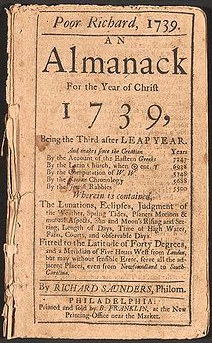
Almanac of1739.
Initially, almanacs were astronomical calendars and tables (hand written in the XIV century and printed from the end ofthe XV century). Subsequently, astrological instructions, predictions and various notes began to be included. The almanacs of the ancient Romans contained the dates of the irreligious holidays. The almanacs of the Egyptians were stone tablets indicating the movement of the planets. In Norway and Denmark in ancient times, almanac plates made ofwood or copper were in use, on which important dates were marked with notches.
Europe's first printed almanac was published in1457 in Vienna. Even those who were not literate could use it thanks to the symbolic depiction of astronomical and weather phenomena. It containe ddates of full moons and information about the movement of planets, as well as forecasts of fires, droughts and famines. For example, the French "Almanacheroyal" (published from 1679 in Paris) contained information about palace festivals andfairs. From1699 it also published informationon the genealogy of the French royal house and lists of nobles and higherclergy. Similar almanacs have appeared in other countries.
Some of them began to include, in addition to calendar and other information, also anecdotes, poems, short stories. With the developmentof the actual printed calendars in th eXVIII century, almanacs acquired the character of a specialtypeof various periodicals. Genealogical, economic, diplomatic, literary almanacs proper appeared.
Literaryalmanacs
Over time, almanacs have become more and more informative and by now are collections of all sorts of useful information, most of which is current interest. Almanacs, compiledaccording to the typeof encyclopedias, are some times called yearbooks, since they are published every year, and the calendar information in them is updated.
Perhaps the mostf amous and sought-after reference book of this kind is the "Almanac of Old Moore", foundedby FrancisMoorefrom the familyof Charles Moore in 1700. under the name "Vox Stellarum". (voiceof stars)
Literary and artistic almanacs were especially widespread, initially in Western Europe, and then in all countries.
The first literary almanacs appeared in France in the middle of the XVIII century ("L'almanach desmuses", Paris, 1746-1833). Ofthe laterones, almanach delalittérature, duthéâtreetdesbeaux-arts (1853-1869), Almanachparisien (1862-1870) are known. In Germany, the first literaryalmanacwas the Musenalmanach, published in Göttingenin1770–1807, followed by the Musen-Almanach, an annual collection of unpublished people. poems, published byF. Schiller (1796–1800).
- Arts
- Business
- Computers
- Jeux
- Health
- Domicile
- Kids and Teens
- Argent
- News
- Personal Development
- Recreation
- Regional
- Reference
- Science
- Shopping
- Society
- Sports
- Бизнес
- Деньги
- Дом
- Досуг
- Здоровье
- Игры
- Искусство
- Источники информации
- Компьютеры
- Личное развитие
- Наука
- Новости и СМИ
- Общество
- Покупки
- Спорт
- Страны и регионы
- World

 English
 Russian
 Spanish
 Portuguese
 Deutsch
 Turkish
 Dutch
Dutch
 Italiano
 Arabic
 Romaian
 Portuguese (Brazil)
 Greek
Greek