
How does a credit card work?
How does a credit card work?
Credit cards are one of the most widely used financial tools in the world. They allow people to make purchases conveniently, manage cash flow, and even build credit history. But how exactly do they work? Let’s break it down.
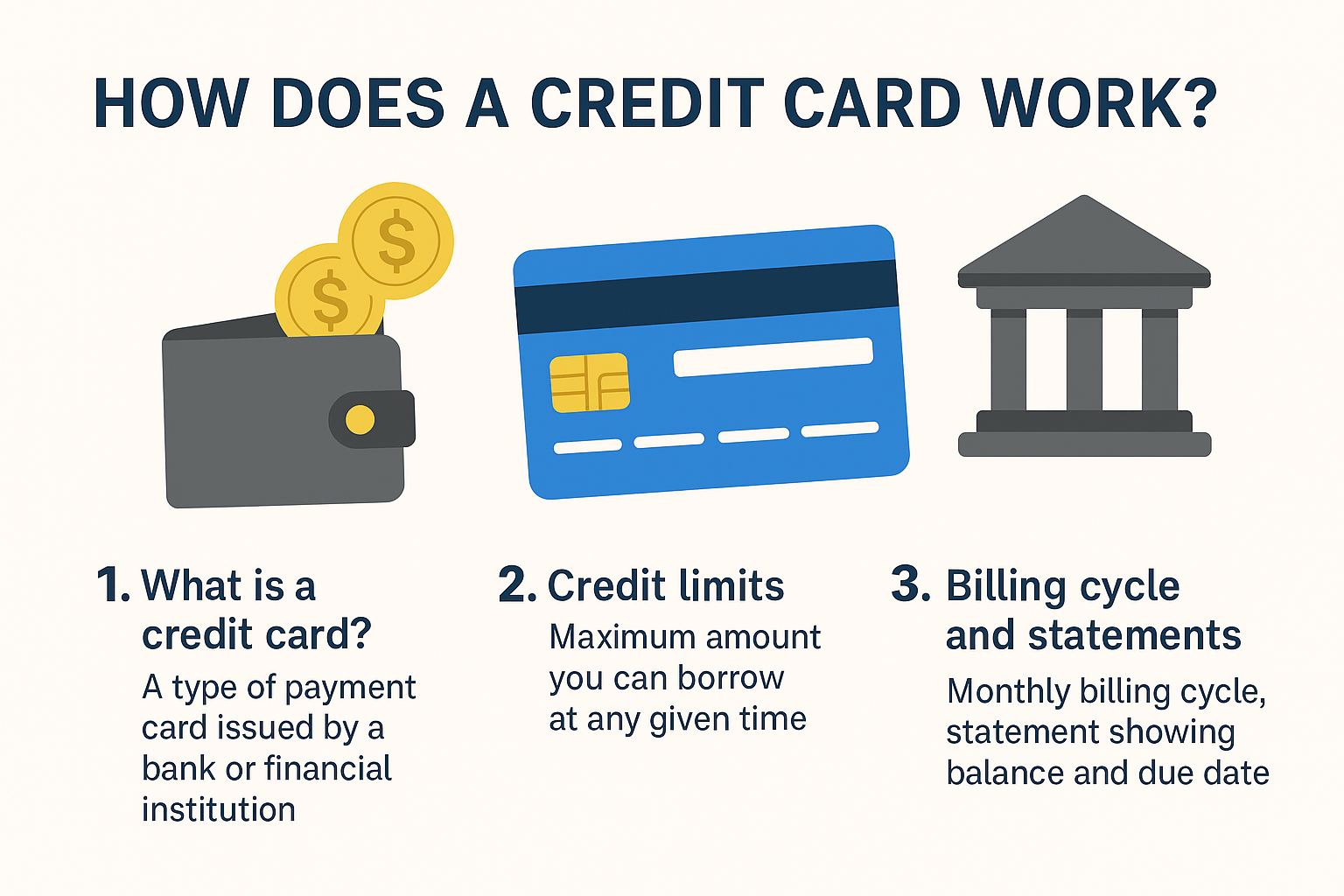
1. What is a credit card?
A credit card is a type of payment card issued by a bank or financial institution. Unlike a debit card, which draws money directly from your bank account, a credit card lets you borrow money from the issuer up to a certain limit. You then repay the borrowed amount, usually at the end of each billing cycle.
2. Credit limits
When you are approved for a credit card, the issuer assigns a credit limit. This is the maximum amount you can borrow at any given time. The limit depends on factors like your income, credit score, and borrowing history. If you try to spend beyond your limit, your transaction may be declined, or you may face fees.
3. Billing cycle and statements
Credit cards work on a monthly billing cycle, usually lasting 28–31 days. At the end of each cycle, the issuer sends you a statement showing:
-
Your total balance (the amount you’ve borrowed)
-
The minimum payment due
-
The due date
If you pay your balance in full by the due date, you avoid interest charges. If you only pay part of it, interest accrues on the remaining balance.
4. Interest and fees
Credit card interest rates are called Annual Percentage Rates (APR). They are typically higher than other types of loans. Interest is charged when you carry a balance past the due date. In addition, credit cards may come with fees, such as:
-
Annual fees
-
Late payment fees
-
Over-limit fees
-
Foreign transaction fees
Using your card responsibly helps you avoid most of these costs.
5. Rewards and benefits
Many credit cards offer perks, such as:
-
Cashback on purchases
-
Travel rewards or airline miles
-
Purchase protection and extended warranties
-
Fraud protection and zero-liability policies
These benefits can make credit cards more valuable, as long as you use them wisely.
6. Credit score impact
Using a credit card responsibly—paying on time and keeping balances low—can improve your credit score. A strong credit score helps you qualify for better loans, mortgages, and even job opportunities. However, missed payments or high balances can hurt your score.
7. Key takeaways
-
A credit card lets you borrow money up to a set limit.
-
Paying your full balance on time avoids interest charges.
-
Responsible use builds your credit history and may earn rewards.
-
Misuse can lead to debt and a damaged credit score.
Final thoughts
Credit cards are powerful tools for managing finances when used carefully. They provide flexibility, security, and rewards, but they also carry risks if not handled responsibly. The key is to borrow only what you can repay and to stay on top of your payments.
Would you like me to make this more beginner-friendly (like a simple guide for someone new to credit), or more in-depth (with technical details about how transactions are processed between banks and networks)?
- Arts
- Business
- Computers
- Jogos
- Health
- Início
- Kids and Teens
- Money
- News
- Personal Development
- Recreation
- Regional
- Reference
- Science
- Shopping
- Society
- Sports
- Бизнес
- Деньги
- Дом
- Досуг
- Здоровье
- Игры
- Искусство
- Источники информации
- Компьютеры
- Личное развитие
- Наука
- Новости и СМИ
- Общество
- Покупки
- Спорт
- Страны и регионы
- World

 English
 Russian
 French
 Spanish
 Portuguese
 Deutsch
 Turkish
 Dutch
Dutch
 Italiano
 Arabic
 Romaian
 Greek
Greek