
How can inflation be controlled?
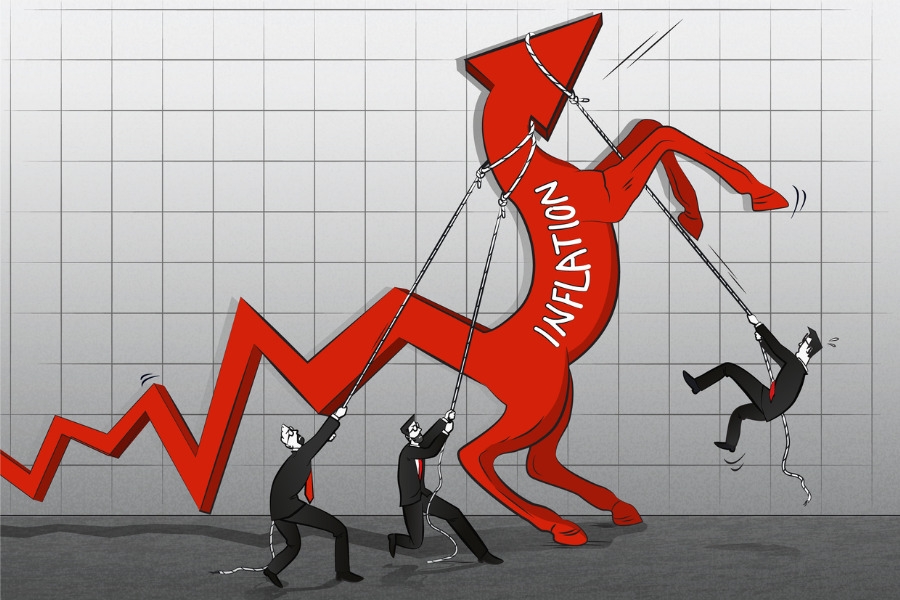
How Can Inflation Be Controlled?
There is a peculiar ritual repeated in every collapsing fiat society. Prices rise. Politicians express concern. Central bankers appear before cameras wearing the facial expression of undertakers. Economists publish charts full of arrows and colored gradients. And then, as if participating in some ancient liturgy, the public is informed that inflation is caused by everything except the thing that actually causes inflation.
Greedy corporations. Supply chains. Wars. Consumer psychology. Weather. Oil traders. Speculators. Foreigners. Farmers. Truckers. Restaurant owners. Anyone, really, except the institution with the legal monopoly on producing money.
This is not an accident. It is the central intellectual fraud of modern macroeconomics.
Inflation is not the rise in prices. Prices merely reveal inflation the way smoke reveals fire. Inflation is the expansion of the money supply beyond the production of real goods and services. The rise in prices is simply the market’s method of informing society that the currency has been diluted.
Once one understands this distinction, the question “How can inflation be controlled?” becomes astonishingly simple.
Control the money.
Everything else is theater.
The Ancient Temptation of the Printing Press
Throughout history, rulers have discovered the same irresistible temptation: create more money than there is wealth.
The Roman emperors clipped coins. Medieval monarchs debased silver. Modern governments use keyboards.
The technology changes; the incentive structure does not.
A state that can finance itself honestly through taxation faces resistance immediately. Citizens complain. Businesses relocate. Productivity declines. Political costs appear instantly. But inflation taxation—the silent confiscation achieved through monetary expansion—operates differently. It disperses pain gradually and unevenly. Few understand its mechanism. Fewer still can identify its perpetrators.
That opacity is precisely why governments prefer it.
Consider the twentieth century. Before the abandonment of the gold standard, long-term price stability was the historical norm. Prices fluctuated, certainly, but currencies anchored to scarce commodities imposed discipline upon governments. After gold convertibility disappeared, the purchasing power of nearly every fiat currency began a long, uninterrupted decline.
The numbers are almost comical.
A dollar in 1971—the year the United States severed the final link between the dollar and gold—now purchases only a fraction of what it once did. Savings accumulated over decades evaporated invisibly. The middle class did not collapse in a dramatic instant; it dissolved through a thousand small erosions.
This is inflation’s true violence. It destroys not merely wealth, but time.
A worker who saves for twenty years discovers his labor stored in currency has quietly decayed. His future has been consumed before he arrives there.
Inflation Cannot Be Controlled Politically
The first lesson any serious student of monetary history learns is brutally straightforward: politicians cannot be trusted with unlimited monetary authority.
Not because they are uniquely evil.
Because incentives matter more than virtue.
An elected official operating under democratic time horizons has every incentive to favor short-term stimulus over long-term stability. Printing money creates immediate benefits and delayed consequences. Elections occur before consequences fully emerge. Therefore, inflationary policy becomes structurally inevitable.
Modern central banking merely institutionalizes this process behind technical language.
“Quantitative easing” sounds cleaner than “currency debasement.” “Liquidity injections” sounds more respectable than “creating trillions from nothing.” But vocabulary does not alter reality.
If a bakery doubled the number of claims on its bread without increasing bread production, chaos would follow immediately. Yet economists routinely advocate precisely this logic for money itself.
And then they appear surprised when housing, healthcare, education, and food become unaffordable.
The Three Genuine Methods of Controlling Inflation
There are only three durable mechanisms capable of controlling inflation over long periods.
Everything else is temporary cosmetics.
1. Restrict Money Supply Growth
This is the fundamental solution.
If money grows faster than productive output, prices eventually rise. The mathematics are not mysterious. More currency units chase the same quantity of goods. Each unit buys less.
Central banks therefore attempt to reduce inflation by increasing interest rates, shrinking balance sheets, and reducing credit expansion.
Higher interest rates matter because they increase the cost of borrowing newly created money. Cheap credit fuels speculative excess. Expensive credit restrains it.
When rates rise, weak businesses fail. Asset bubbles deflate. Consumption slows. Debt-fueled expansion contracts.
Painful? Certainly.
Necessary? Usually.
Modern societies became addicted to artificially low interest rates because low rates disguise economic weakness. They permit governments, corporations, and households to sustain debt levels that would otherwise be impossible.
But suppressed interest rates are not prosperity. They are anesthesia.
Eventually the patient wakes up.
2. Anchor Currency to Scarcity
Historically, gold performed this role because it possessed properties difficult to manipulate:
-
Scarcity
-
Durability
-
Divisibility
-
Resistance to sudden supply increases
Gold restrained governments because mining additional gold required real economic effort. A politician could not simply announce the existence of more gold reserves through legislation.
Fiat currencies removed that constraint.
The result was predictable.
Under a hard monetary standard, governments must finance wars, welfare programs, and deficits honestly. Under fiat systems, they can postpone consequences through monetary expansion.
That postponement creates the illusion of prosperity while silently consuming capital formation underneath.
I learned this lesson personally years ago while living in an economy experiencing severe currency instability. Friends around me obsessed over nominal salary increases while ignoring purchasing power destruction. A man would celebrate a 20% raise while food prices rose 35%. Another would boast about record housing prices while mortgages consumed entire lifetimes of future income.
People measured wealth in currency units rather than in what those units could purchase.
That confusion is inflation’s greatest ally.
3. Allow Recessions to Cleanse Malinvestment
No politician likes recessions. No central banker welcomes them publicly. Yet recessions perform an indispensable economic function.
They liquidate unsustainable investments.
When cheap money floods markets, capital allocation deteriorates. Businesses that should fail survive artificially. Speculative ventures multiply. Productivity declines beneath layers of debt-financed illusion.
Recessions expose reality.
Inflation control therefore requires accepting economic pain rather than endlessly postponing it through additional monetary expansion.
This is the part modern societies find intolerable.
Citizens demand low inflation, permanent asset appreciation, endless government spending, rising wages, cheap mortgages, soaring stock markets, generous entitlements, and near-zero interest rates simultaneously. These desires are mutually contradictory.
Economics is ultimately the study of scarcity. One cannot consume future productivity indefinitely without consequences.
The False Solutions Governments Prefer
Because genuine inflation control imposes short-term pain, governments usually pursue substitutes instead.
These substitutes fail repeatedly.
Price Controls
Price controls are among humanity’s oldest economic mistakes.
When prices rise, politicians often conclude that prices themselves are the problem. So they cap them.
But prices are information. Suppressing information does not eliminate underlying scarcity.
If beef prices are capped below market equilibrium, producers reduce supply. Shortages emerge. Black markets appear. Quality deteriorates.
This happened in ancient Rome. It happened in the Soviet Union. It happened in Venezuela. The consistency is almost admirable.
Yet each generation rediscovers the error independently.
Corporate Blame Campaigns
Another fashionable tactic involves accusing corporations of “greed.”
Corporations were greedy during periods of stable prices too. Human nature did not suddenly mutate in 2021.
Greed cannot explain why all prices rise broadly across sectors simultaneously over sustained periods. Monetary expansion can.
Blaming businesses for inflation resembles blaming thermometers for fever.
Statistical Manipulation
Governments also attempt to redefine inflation itself.
Asset inflation is ignored. Housing costs are selectively adjusted. Consumption baskets are modified continuously. Hedonic adjustments appear. Numbers become increasingly detached from lived reality.
Citizens notice this instinctively.
When official inflation reads 4% while rent rises 15%, public trust deteriorates rapidly.
And rightly so.
A Historical Comparison of Inflation Control Strategies
| Strategy | Short-Term Political Popularity | Long-Term Effectiveness | Historical Result |
|---|---|---|---|
| Interest Rate Increases | Extremely unpopular | High when sustained | Successful in the early 1980s under Paul Volcker |
| Money Printing | Highly popular initially | Catastrophic long-term | Persistent currency debasement |
| Price Controls | Politically attractive | Extremely low | Shortages and black markets |
| Gold Standard | Politically restrictive | Historically stable | Long-term purchasing power preservation |
| Fiscal Austerity | Deeply unpopular | Moderately effective | Stabilizes debt trajectories |
| Currency Pegs | Initially stabilizing | Fragile without discipline | Frequent collapses under stress |
| Central Bank Independence | Mixed | Effective only with credibility | Often eroded politically |
Why Modern Inflation Is Harder to Defeat
Inflation today possesses structural advantages absent in earlier eras.
Modern economies are debt-saturated.
Governments carry enormous sovereign debts. Corporations rely on perpetual refinancing. Consumers finance lifestyles through credit expansion. Entire financial systems now depend on continuously expanding liquidity.
This creates a trap.
If central banks raise rates aggressively enough to truly crush inflation, debt servicing costs explode. Asset prices collapse. Governments face fiscal crises. Banking systems destabilize.
But if they refuse to tighten sufficiently, inflation persists.
In other words, decades of easy money transformed inflation control from a technical challenge into a systemic threat.
The architects of cheap money constructed an economy incapable of tolerating monetary normalization.
That is the real crisis.
The Forgotten Moral Dimension
Inflation discussions are often framed purely in technical terms. Interest rates. CPI baskets. Treasury yields.
But inflation is fundamentally moral.
Sound money rewards prudence, savings, delayed gratification, and long-term thinking. Inflated money rewards leverage, speculation, political proximity, and consumption.
Under inflationary systems, the careful saver subsidizes the reckless borrower. Future generations inherit obligations they never approved. Productive labor loses purchasing power while financial engineering prospers disproportionately.
A civilization organized around continuously depreciating money gradually begins to depreciate everything else as well.
Time preference rises.
People save less. Consume more. Speculate constantly. Think quarterly instead of generationally.
Monetary policy shapes culture far more profoundly than most economists admit.
The Uncomfortable Conclusion
Inflation can be controlled.
History proves this repeatedly.
But controlling inflation requires something modern political systems rarely possess: the willingness to endure short-term pain for long-term stability.
It requires restricting monetary expansion even when markets panic. It requires allowing unproductive institutions to fail. It requires abandoning the fantasy that prosperity can be printed into existence.
Most importantly, it requires recognizing that money is not wealth.
A society does not become richer because zeros multiply inside bank accounts. Wealth consists of productive capacity, accumulated capital, technological advancement, energy production, skilled labor, and functioning institutions.
Printing currency creates none of these things.
It merely redistributes claims upon them.
And eventually, inevitably, reality reasserts itself.
Always.
- Arts
- Business
- Computers
- Jeux
- Health
- Domicile
- Kids and Teens
- Argent
- News
- Personal Development
- Recreation
- Regional
- Reference
- Science
- Shopping
- Society
- Sports
- Бизнес
- Деньги
- Дом
- Досуг
- Здоровье
- Игры
- Искусство
- Источники информации
- Компьютеры
- Личное развитие
- Наука
- Новости и СМИ
- Общество
- Покупки
- Спорт
- Страны и регионы
- World

 English
 Russian
 Spanish
 Portuguese
 Deutsch
 Turkish
 Dutch
Dutch
 Italiano
 Arabic
 Romaian
 Portuguese (Brazil)
 Greek
Greek