
What Is the Difference Between B2B and B2C? One Sells to Organizational Logic. The Other Sells to Human Emotion Under Time Pressure.
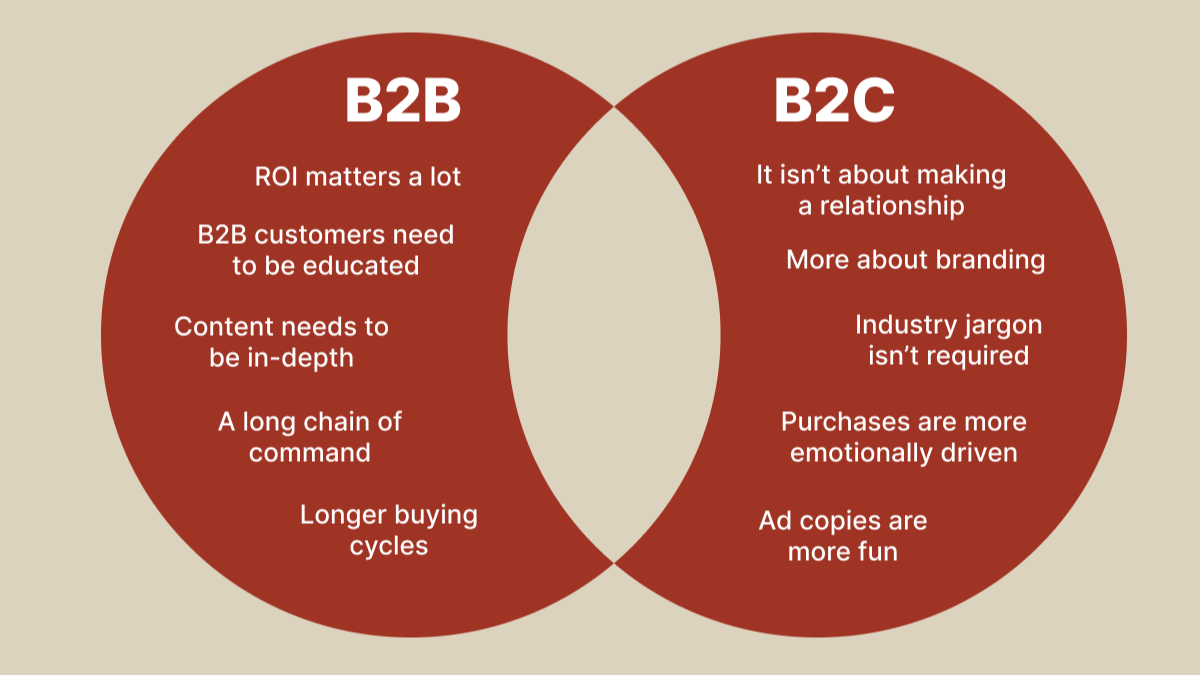
A man buying toothpaste at a pharmacy and a procurement director approving a $250,000 software contract are both technically making purchasing decisions.
But psychologically, the situations barely resemble each other.
One decision may take:
- fourteen seconds
- partial attention
- mild brand familiarity
The other may require:
- six months
- internal approvals
- legal review
- budget negotiation
- stakeholder alignment
- operational risk assessment
That distinction captures the real difference between B2B and B2C.
Not merely who buys.
But how people think while buying.
Because businesses often discuss B2B (business-to-business) and B2C (business-to-consumer) as though they are simply two sales categories.
They are not.
They are fundamentally different emotional environments.
B2B operates inside:
- organizational pressure
- professional risk
- long-term operational consequences
B2C operates inside:
- identity
- convenience
- emotion
- impulse
- attention scarcity
And companies misunderstanding those psychological differences often apply the wrong strategies entirely.
They market enterprise software like sneakers.
Or consumer products like procurement solutions.
Neither works particularly well for long.
What Is B2B?
B2B stands for business-to-business.
It describes companies selling products or services to other businesses rather than individual consumers.
Examples include:
- CRM software providers
- logistics platforms
- cybersecurity companies
- accounting services
- industrial equipment manufacturers
In B2B, purchases usually support:
- operations
- efficiency
- scalability
- compliance
- revenue generation
Which means buying decisions carry organizational consequences.
A failed enterprise purchase can:
- waste significant budget
- disrupt workflows
- damage careers internally
- create implementation chaos
That risk changes buyer behavior dramatically.
What Is B2C?
B2C means business-to-consumer.
This model involves companies selling directly to individual customers for personal use.
Examples include:
- clothing retailers
- streaming services
- cosmetics brands
- restaurants
- fitness apps
- electronics companies
B2C decisions generally happen faster because consequences feel smaller.
Consumers often purchase based on:
- convenience
- emotional desire
- habit
- social influence
- identity alignment
The emotional dimension becomes much stronger and more immediate.
Someone buying a pair of sneakers may unconsciously ask:
“Does this feel like me?”
An enterprise buyer purchasing software asks:
“Will this disrupt operations if implementation goes badly?”
Those are completely different psychological calculations.
The Core Difference: Risk vs. Emotion
This is where the distinction becomes most useful.
B2B buyers prioritize risk reduction.
B2C buyers prioritize emotional satisfaction.
That does not mean B2B lacks emotion or B2C lacks logic.
Both contain both.
But the weighting differs significantly.
B2B buyers worry about:
- operational reliability
- stakeholder approval
- implementation risk
- ROI justification
- professional accountability
B2C buyers often prioritize:
- convenience
- aspiration
- pleasure
- trust familiarity
- immediate gratification
Understanding this changes everything about:
- messaging
- branding
- sales
- customer retention
- pricing strategy
A Detailed Comparison: B2B vs. B2C
| B2B | B2C |
|---|---|
| Sells to businesses | Sells to individuals |
| Longer sales cycles | Faster purchasing decisions |
| Multiple stakeholders involved | Usually one decision-maker |
| Higher transaction values | Lower average transaction values |
| ROI-focused messaging | Emotion-focused messaging |
| Relationship-driven sales | Convenience-driven purchases |
| Professional risk influences decisions | Personal identity influences decisions |
| Detailed onboarding processes | Simpler customer experiences |
| Customer retention highly strategic | Brand loyalty more emotionally driven |
| Complex implementation common | Immediate usability expected |
The differences extend far beyond transaction structure alone.
They influence how trust forms entirely.
Why B2B Sales Take Longer
Enterprise purchasing creates organizational exposure.
If a company adopts:
- the wrong software
- the wrong vendor
- the wrong operational system
the consequences ripple outward:
- budget loss
- workflow disruption
- employee frustration
- leadership scrutiny
Which means B2B buyers become cautious.
One enterprise deal may require approval from:
- finance
- procurement
- legal
- operations
- executive leadership
Consensus-building slows everything.
I once worked with a SaaS company frustrated by “slow-moving prospects.”
Leadership initially blamed weak sales execution.
But after observing enterprise buying processes closely, the issue became obvious:
customers were not hesitating because the product lacked value.
They were hesitating because implementation affected multiple departments simultaneously.
The company eventually improved close rates by reducing operational uncertainty instead of increasing sales pressure.
That lesson mattered enormously.
Large B2B deals rarely stall because buyers lack interest.
They stall because buyers fear avoidable disruption.
Why B2C Depends Heavily on Branding
Consumers rarely analyze purchases with enterprise-level scrutiny.
Instead, they rely heavily on:
- perception
- familiarity
- emotional resonance
- social proof
A consumer choosing between two skincare brands may unconsciously evaluate:
- packaging aesthetics
- influencer associations
- emotional tone
- identity alignment
Functionality matters.
But feeling matters too.
That’s why branding becomes extraordinarily powerful in B2C environments.
Brands communicate emotional shorthand:
- luxury
- trust
- rebellion
- wellness
- simplicity
- sophistication
Consumers buy products partly to reinforce personal identity.
B2B buyers usually buy to reduce organizational friction.
Attention Works Differently in B2B and B2C
Consumer attention spans are shorter because:
- choices are abundant
- switching costs are low
- emotional impulses shift rapidly
B2C companies compete aggressively for immediate visibility.
Meanwhile B2B companies often compete for sustained credibility over time.
A consumer might buy:
- shoes
- coffee
- headphones
within minutes.
An enterprise buyer may spend months researching:
- integrations
- security
- implementation support
- pricing structures
The pacing changes how businesses communicate entirely.
My Most Useful Lesson About B2B vs. B2C Came From Watching Messaging Fail Completely
Years ago, I worked with a company attempting to expand from consumer markets into enterprise sales.
Leadership assumed their successful B2C messaging would transfer naturally.
It didn’t.
The marketing emphasized:
- excitement
- innovation
- lifestyle positioning
Enterprise buyers responded with confusion.
They wanted:
- operational clarity
- implementation details
- measurable outcomes
- support expectations
The company eventually rebuilt its enterprise communication almost from scratch.
And the shift worked because they finally understood:
B2B buyers do not primarily purchase aspiration.
They purchase confidence.
That experience permanently changed how I think about commercial psychology.
The same product can require entirely different emotional framing depending on who buys it.
Customer Relationships Look Different Too
B2B relationships often become long-term operational partnerships.
The vendor may support:
- integrations
- onboarding
- training
- account management
- strategic planning
This creates deeper but slower-moving customer relationships.
B2C relationships usually prioritize:
- convenience
- speed
- repeat purchasing
- emotional familiarity
Consumers may interact with brands frequently but briefly.
B2B customers interact less impulsively but often more structurally.
Technology Changed Both Models — But Not Human Psychology
Automation transformed:
- advertising
- personalization
- lead generation
- customer targeting
across both B2B and B2C.
Yet human decision-making patterns remain surprisingly recognizable underneath.
B2B buyers still fear:
- professional embarrassment
- operational disruption
- wasted investment
B2C buyers still seek:
- emotional reward
- convenience
- social belonging
- identity reinforcement
Technology accelerated communication.
It did not erase psychology.
And businesses forgetting that often optimize processes while weakening emotional relevance.
Why Some Companies Struggle Switching Between B2B and B2C
This transition looks easier than it actually is.
Because success in one model does not guarantee success in the other.
A strong B2C brand may struggle in B2B if:
- messaging feels too emotional
- implementation clarity feels weak
- operational support lacks depth
Meanwhile B2B companies entering consumer markets often struggle because:
- branding feels cold
- communication feels overly technical
- customer experiences feel friction-heavy
Different buyer psychology requires different trust-building strategies.
That distinction matters enormously.
Conclusion: B2B and B2C Are Really Different Versions of Human Trust
At surface level, the difference appears simple:
businesses selling to companies versus businesses selling to consumers.
But underneath, the distinction is psychological.
B2B operates through:
- caution
- risk management
- professional accountability
- operational trust
B2C operates through:
- identity
- convenience
- emotional resonance
- immediate perception
Both require credibility.
Both require trust.
But the mechanisms creating that trust differ profoundly.
Enterprise buyers ask:
“Will this decision create problems for my organization?”
Consumers ask:
“Does this feel right for me?”
And companies succeeding in either environment understand those emotional dynamics deeply.
Because ultimately, purchasing decisions are never purely rational.
Even enterprise buyers experience emotion:
fear,
uncertainty,
career pressure,
confidence.
And even consumers apply logic occasionally:
budget awareness,
quality evaluation,
comparisons.
But the balance shifts dramatically depending on context.
That’s why businesses treating B2B and B2C as interchangeable categories often struggle.
They fail to recognize they are not merely selling to different buyers.
They are selling to entirely different forms of human decision-making.
- Arts
- Business
- Computers
- Jogos
- Health
- Início
- Kids and Teens
- Money
- News
- Personal Development
- Recreation
- Regional
- Reference
- Science
- Shopping
- Society
- Sports
- Бизнес
- Деньги
- Дом
- Досуг
- Здоровье
- Игры
- Искусство
- Источники информации
- Компьютеры
- Личное развитие
- Наука
- Новости и СМИ
- Общество
- Покупки
- Спорт
- Страны и регионы
- World

 English
 Russian
 French
 Spanish
 Portuguese
 Deutsch
 Turkish
 Dutch
Dutch
 Italiano
 Arabic
 Romaian
 Greek
Greek
