
Why Do Some Countries Grow Faster Economically?
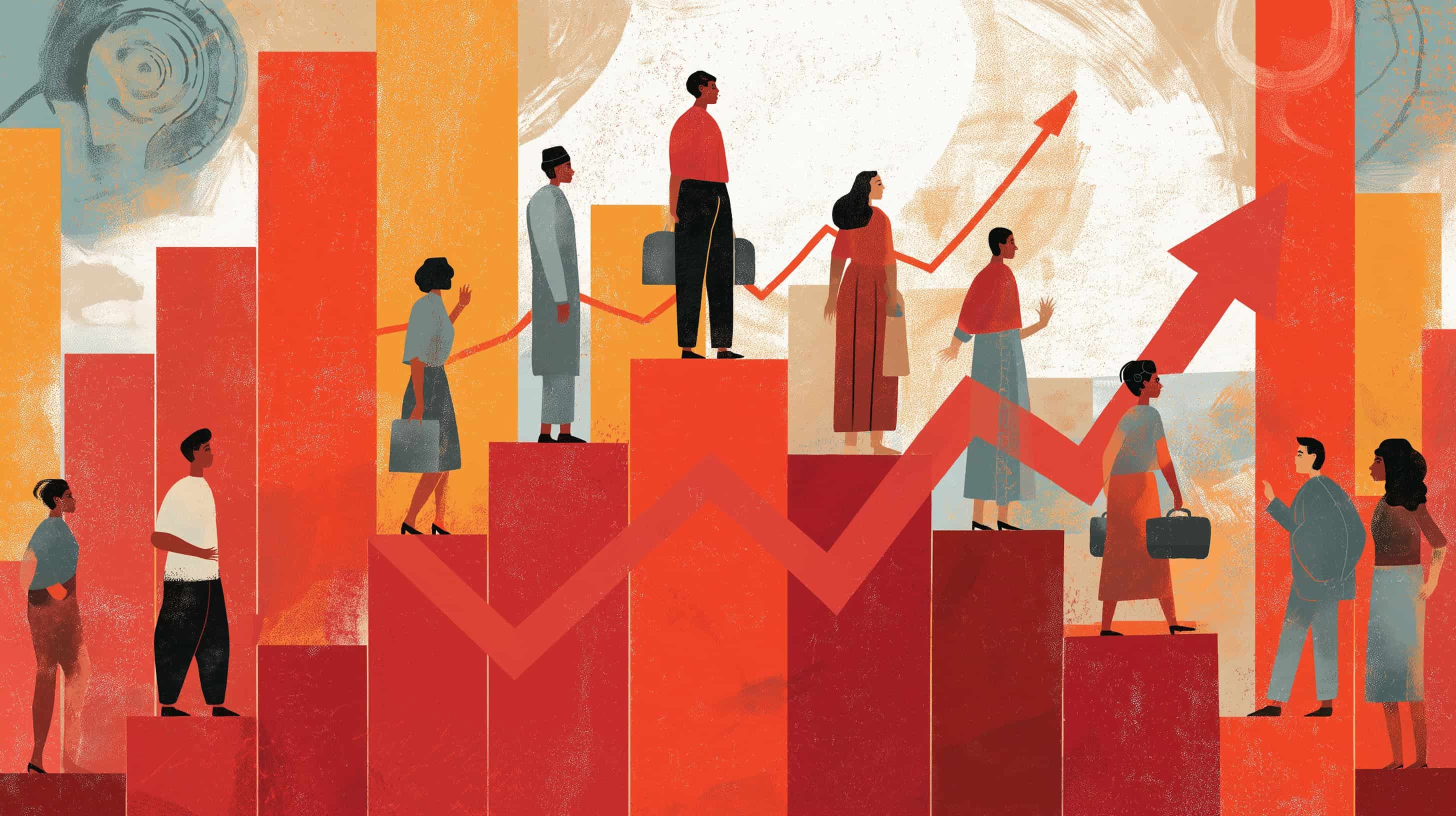
Why Do Some Countries Grow Faster Economically?
Walk through the streets of two different countries on opposite sides of the world and you may notice something striking. In one place, construction cranes dominate the skyline, businesses open every week, and young people talk about opportunity. In the other, storefronts sit empty, infrastructure deteriorates, and talented workers quietly search for exits.
The contrast raises one of the most important questions in economics:
Why do some countries grow faster economically than others?
I've spent decades listening to entrepreneurs, executives, investors, and policymakers debate this issue. What fascinates me is how often the conversation drifts toward simple answers. Some insist growth is about natural resources. Others point to education. Others blame or praise government policy.
The reality is more complicated—and more interesting.
Economic growth is rarely the result of one factor. It emerges from a network of institutions, incentives, cultural attitudes, investment decisions, and policy choices that interact over decades. Countries that grow rapidly tend to create environments where productive activity is rewarded. Countries that stagnate often undermine the very forces that generate prosperity.
The difference sounds subtle. In practice, it changes everything.
The Great Misunderstanding About Growth
Many people assume wealth creates growth.
In fact, growth often creates wealth.
That distinction matters.
A nation can discover oil and temporarily become richer. It can receive foreign aid and enjoy a short-term boost. It can borrow heavily and create the appearance of expansion.
But sustainable economic growth is different. It occurs when an economy becomes more productive—when workers, businesses, and institutions generate more value per hour, per dollar, and per unit of capital.
Productivity is the engine. Everything else is fuel.
When productivity rises, incomes rise. Living standards improve. Tax revenues increase without higher tax rates. Investment accelerates. Innovation compounds.
Without productivity growth, prosperity eventually hits a wall.
Institutions: The Invisible Infrastructure
Economists often talk about roads, ports, airports, and power grids.
Those matter.
But the most important infrastructure is invisible.
Property rights.
Contract enforcement.
Reliable courts.
Predictable regulations.
Protection against arbitrary government action.
These institutions determine whether people feel confident investing for the future.
Imagine two entrepreneurs.
Both have a promising business idea.
In the first country, they know contracts will be honored, corruption is limited, and success will not trigger political retaliation.
In the second country, officials can seize assets, regulations change unpredictably, and bribery influences outcomes.
The entrepreneur in the first country expands.
The entrepreneur in the second country hesitates.
Multiply that decision by millions of people and you begin to understand why growth rates diverge.
Capital Matters, But Only Up to a Point
Economic growth requires investment.
Factories must be built.
Machines must be purchased.
Technology must be deployed.
Infrastructure must be maintained.
Countries that save and invest more often grow faster because they increase their productive capacity.
Yet capital alone is not enough.
History is filled with examples of governments pouring money into massive projects that generated little economic value. Empty airports. Underused industrial parks. Prestige developments.
The lesson is straightforward.
Investment creates growth only when capital flows toward productive uses.
Money is powerful.
Misallocated money is expensive.
Human Capital: The Ultimate Competitive Advantage
Every modern economy competes through people.
Natural resources help.
Geography helps.
Talent helps more.
Countries that invest in education, workforce skills, technical training, and knowledge creation tend to outperform those that neglect human capital.
But here is an important nuance.
The best-performing countries do not simply produce graduates.
They produce capable problem-solvers.
There is a difference.
An economy needs engineers, technicians, software developers, scientists, entrepreneurs, managers, and skilled tradespeople. It needs workers who can adapt as technology changes.
The countries growing fastest today are often those creating systems that allow people to continuously acquire new skills rather than relying on what they learned years earlier.
Innovation Changes the Entire Equation
At some point, every economy faces a choice.
It can copy existing ideas.
Or it can create new ones.
Developing countries often grow rapidly by adopting technologies already proven elsewhere. This process can generate extraordinary gains because the country is catching up.
Advanced economies face a harder challenge.
They must innovate.
Innovation allows businesses to produce more with fewer resources. It creates entirely new industries. It transforms productivity.
Consider the impact of electricity, automobiles, semiconductors, the internet, and artificial intelligence.
Each innovation reshaped economic activity far beyond its original sector.
The countries that encourage experimentation tend to create more opportunities for breakthrough growth.
Those that discourage risk-taking often fall behind.
The Power of Economic Freedom
One lesson appears repeatedly across history.
People respond to incentives.
When individuals can start businesses, invest capital, hire workers, compete openly, and retain a meaningful portion of the rewards from success, economic activity tends to increase.
That does not mean governments have no role.
Far from it.
Effective governments establish rules, maintain order, enforce contracts, invest in essential public goods, and create stable conditions for growth.
The challenge is balance.
Too little government can create instability.
Too much government can suppress initiative.
The fastest-growing economies often find a workable middle ground where markets function dynamically while institutions remain strong.
A Comparison of Growth Drivers
| Factor | Fast-Growing Economies | Slow-Growing Economies |
|---|---|---|
| Property Rights | Strong protection | Weak enforcement |
| Education | Skill-focused and adaptive | Outdated and rigid |
| Investment Climate | Predictable and attractive | Uncertain and restrictive |
| Innovation | Encouraged and rewarded | Discouraged by barriers |
| Regulation | Clear and consistent | Complex and unpredictable |
| Corruption | Relatively low | Relatively high |
| Infrastructure | Expanding and maintained | Underdeveloped or deteriorating |
| Labor Markets | Flexible and responsive | Highly constrained |
| Entrepreneurship | Accessible and celebrated | Burdened by obstacles |
| Government Stability | Generally predictable | Frequently unstable |
The table simplifies a complex reality, but the pattern appears repeatedly across regions and decades.
Countries that perform well in multiple categories tend to experience stronger long-term growth.
Culture and Expectations Matter More Than People Admit
Economists sometimes avoid discussing culture because it is difficult to measure.
That is understandable.
It is also a mistake.
Growth often reflects societal attitudes toward work, achievement, education, entrepreneurship, and risk.
When people believe effort can improve their circumstances, they invest more in themselves.
When they believe advancement depends primarily on political connections or luck, incentives weaken.
Culture alone cannot create prosperity.
But culture can amplify—or undermine—the institutions and policies that support growth.
The interaction between culture and economics is one of the most underrated forces in development.
A Lesson I Learned From Business
Years ago, I had a conversation with a business owner who was deciding where to expand operations.
He wasn't discussing tax rates.
He wasn't talking about subsidies.
He wasn't asking about grants.
His primary concern was predictability.
He wanted to know whether the rules would remain consistent.
That conversation stayed with me because it captured something policymakers frequently overlook.
Businesses can adapt to challenges.
What they struggle with is uncertainty.
Investors commit capital for years. Sometimes decades.
When they trust the environment, they invest aggressively.
When they don't, they wait.
Economic growth often depends on how many people choose action instead of hesitation.
That lesson applies to countries just as much as it applies to companies.
Geography Helps—But It Doesn't Decide the Outcome
Some nations enjoy extraordinary advantages.
Access to oceans.
Navigable rivers.
Mild climates.
Strategic trade routes.
Others face daunting obstacles.
Landlocked locations.
Harsh terrain.
Limited natural resources.
Geography influences growth, but it does not determine destiny.
Countries such as Singapore transformed themselves despite severe resource limitations.
Meanwhile, numerous resource-rich nations have struggled to convert natural wealth into broad-based prosperity.
Geography sets the stage.
Institutions and policies shape the performance.
The Danger of Success
One of the paradoxes of economic growth is that success can create complacency.
Fast-growing countries sometimes assume momentum will continue automatically.
It won't.
The factors that generate growth require constant maintenance.
Educational systems must evolve.
Infrastructure must be upgraded.
Regulations must adapt.
Competition must remain vigorous.
The countries that continue growing are usually those that keep reforming even when things appear to be working.
The countries that stop improving often discover that yesterday's strengths become tomorrow's weaknesses.
Why Growth Ultimately Comes Down to Trust
After examining countless studies, historical examples, and business experiences, I keep returning to one word.
Trust.
Investors must trust institutions.
Workers must trust that effort will be rewarded.
Entrepreneurs must trust that success will not be punished.
Consumers must trust markets.
Citizens must trust that rules apply fairly.
Trust reduces friction.
And economies, much like machines, perform better when friction declines.
When trust breaks down, capital flees, innovation slows, and growth weakens.
When trust strengthens, investment accelerates and opportunity expands.
The Real Answer
So why do some countries grow faster economically?
Not because they are luckier.
Not because they are smarter.
Not because they possess a secret formula.
They grow faster because they build systems that encourage productive behavior.
They protect property.
They reward innovation.
They attract investment.
They educate people effectively.
They create confidence in the future.
Economic growth is not magic. It is the cumulative result of millions of decisions made by workers, entrepreneurs, investors, and consumers every day.
The countries that understand this truth gain an extraordinary advantage.
The ones that ignore it eventually discover a hard reality: prosperity is not a permanent condition. It is a process.
And the nations that grow fastest are usually the ones that never stop improving that process.
- Arts
- Business
- Computers
- Oyunlar
- Health
- Home
- Kids and Teens
- Money
- News
- Personal Development
- Recreation
- Regional
- Reference
- Science
- Shopping
- Society
- Sports
- Бизнес
- Деньги
- Дом
- Досуг
- Здоровье
- Игры
- Искусство
- Источники информации
- Компьютеры
- Личное развитие
- Наука
- Новости и СМИ
- Общество
- Покупки
- Спорт
- Страны и регионы
- World

 English
 Russian
 French
 Spanish
 Portuguese
 Deutsch
 Dutch
Dutch
 Italiano
 Arabic
 Romaian
 Portuguese (Brazil)
 Greek
Greek
