
What is loss aversion in finance?
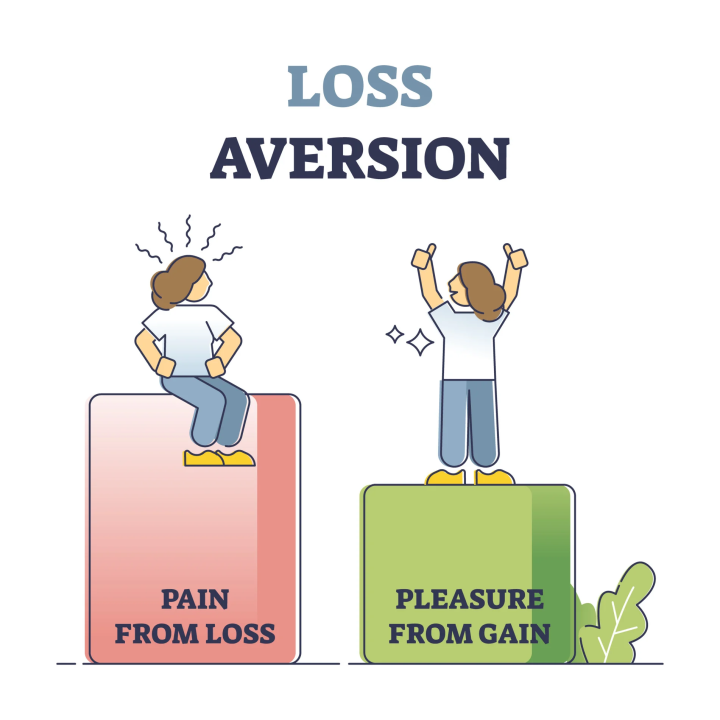
What Is Loss Aversion in Finance?
The Investor Who Couldn't Sell
An investor purchases a stock at $100 per share.
Months later, the stock trades at $70.
The company's prospects have deteriorated. New information suggests the investment thesis is no longer valid. Rational analysis points toward selling and reallocating the capital elsewhere.
Yet the investor hesitates.
Days pass.
Weeks pass.
The stock falls further.
Still, the position remains untouched.
The explanation often sounds reasonable.
"I'll sell when it gets back to my purchase price."
The statement appears logical.
It is also one of the most revealing phrases in finance.
The market does not know what the investor paid. Future returns are unaffected by the original purchase price. The investment should be evaluated based on current prospects, not historical costs.
Yet countless investors behave this way.
Professionals do it.
Beginners do it.
Intelligent people do it.
The reason is neither ignorance nor lack of discipline.
The reason is loss aversion.
Loss aversion is one of the most powerful concepts in behavioral finance. It explains why investors hold losing positions too long, sell winners too early, avoid necessary risks, panic during market downturns, and make decisions that conflict with their long-term goals.
The principle sounds simple.
Losses hurt more than equivalent gains feel good.
Yet this seemingly modest observation transformed economics, challenged traditional theories of decision-making, and revealed something profound about human psychology.
To understand finance, one must understand risk.
To understand risk, one must understand loss.
And to understand loss, one must understand why the human mind responds to it so intensely.
Defining Loss Aversion
Loss aversion refers to the tendency for individuals to experience the pain of losses more strongly than the pleasure of equivalent gains.
The concept emerged from the groundbreaking work of Daniel Kahneman and Amos Tversky through their development of the scientific_concept reference of Prospect Theory.
Their research revealed something surprising.
People do not evaluate outcomes based solely on final wealth.
Instead, they evaluate gains and losses relative to a reference point.
And losses carry greater emotional weight than gains.
In many experimental settings, losing $100 feels approximately twice as painful as gaining $100 feels pleasurable.
The exact ratio varies.
The asymmetry remains remarkably consistent.
This imbalance influences countless financial decisions.
Often without awareness.
Why Traditional Finance Struggled to Explain Investor Behavior
Classical finance assumes investors make rational choices.
Under this framework:
-
Risks are evaluated objectively.
-
Probabilities are processed accurately.
-
Decisions maximize expected utility.
-
Emotional reactions play a limited role.
The model is elegant.
Reality is less cooperative.
Investors frequently violate these assumptions.
They sell winning stocks too quickly.
They cling to losing investments.
They panic during downturns.
They chase speculative assets after rallies.
These behaviors puzzled economists because they appeared inconsistent with rational wealth maximization.
Behavioral finance provided an alternative explanation.
Investors are not irrational.
They are predictably influenced by psychological biases.
Loss aversion sits near the center of those biases.
Why Losses Feel So Powerful
Imagine two scenarios.
Scenario One
You discover a forgotten $500 bill in an old jacket pocket.
Scenario Two
You lose $500 from your wallet.
Objectively, the financial impact is identical.
The emotional impact is not.
Most people report that the distress from losing money exceeds the happiness generated by finding the same amount.
This asymmetry appears repeatedly across cultures and circumstances.
Why?
Several psychological mechanisms contribute.
Survival Psychology
From an evolutionary perspective, losses often carried serious consequences.
Losing food, shelter, or resources could threaten survival.
Gains were beneficial.
Losses were dangerous.
The human brain evolved accordingly.
Emotional Intensity
Losses attract attention.
They generate rumination.
They provoke regret.
Gains, by contrast, are often absorbed quickly into expectations.
The pleasure fades.
The memory of losses tends to linger.
Reference Dependence
People evaluate outcomes relative to what they possess or expect.
Once ownership exists, surrendering something feels painful.
This phenomenon strengthens loss aversion significantly.
Prospect Theory: The Foundation of Loss Aversion
Traditional economic models assumed that people evaluate outcomes based on final wealth levels.
Prospect Theory proposed something different.
Individuals evaluate gains and losses relative to a reference point.
The theory introduced a value function with several important characteristics:
-
Gains create positive utility.
-
Losses create negative utility.
-
The curve is steeper for losses than gains.
-
Sensitivity diminishes as amounts grow larger.
The implication is profound.
A $1,000 loss affects emotional well-being more strongly than a $1,000 gain improves it.
This insight explained numerous financial behaviors that previously appeared irrational.
Loss Aversion in Everyday Investing
Loss aversion influences investors in several predictable ways.
Holding Losing Stocks Too Long
Investors often refuse to realize losses.
Selling transforms a paper loss into a realized loss.
The emotional discomfort can be significant.
As a result, investors wait.
And wait.
And wait.
Sometimes the position recovers.
Often it does not.
Selling Winners Too Early
Gains generate satisfaction.
Realizing profits feels rewarding.
Investors therefore lock in gains quickly.
Ironically, they frequently do the opposite with losing positions.
The combination creates a costly pattern.
Losers remain.
Winners disappear.
Avoiding Necessary Risk
Many investors become excessively conservative after experiencing losses.
The fear of additional pain discourages rational risk-taking.
Long-term returns may suffer as a consequence.
The Disposition Effect
One of the most well-documented consequences of loss aversion is the disposition effect.
The disposition effect describes the tendency to:
-
Sell winning investments prematurely.
-
Retain losing investments excessively.
From a rational perspective, this behavior is difficult to justify.
Future returns depend on future prospects.
Past gains and losses should not matter.
Yet investors consistently behave otherwise.
The emotional desire to avoid realizing losses drives the pattern.
The market becomes a stage upon which psychological battles unfold.
Comparing Rational Investing and Loss-Averse Investing
| Investment Situation | Rational Investor Response | Loss-Averse Investor Response |
|---|---|---|
| Stock falls 20% with worsening fundamentals | Sell and reassess | Hold and hope |
| Stock rises 20% with strong fundamentals | Continue evaluation | Sell to lock gains |
| Market correction occurs | Focus on long-term plan | Panic and reduce exposure |
| Portfolio experiences volatility | Accept expected fluctuations | Seek safety prematurely |
| New opportunity emerges | Evaluate objectively | Compare against previous losses |
| Rebalancing required | Follow allocation strategy | Resist selling losing assets |
The table highlights a recurring theme.
Loss aversion shifts attention away from future outcomes and toward emotional reactions to past events.
That shift often undermines investment performance.
Market Crashes and Collective Loss Aversion
Loss aversion becomes especially visible during market downturns.
Consider a bear market.
Asset prices decline.
Financial news becomes increasingly negative.
Portfolio values shrink.
The losses feel immediate.
Future recoveries remain uncertain.
Investors experience psychological pressure.
Many respond by selling assets near market bottoms.
The decision provides temporary emotional relief.
The financial consequences can be severe.
History repeatedly demonstrates that some of the strongest market recoveries occur shortly after periods of extreme pessimism.
Loss aversion encourages investors to abandon long-term strategies precisely when discipline matters most.
The Lesson I Learned From Watching a Losing Position
Several years ago, I owned a stock that declined steadily over several months.
At first, the decline seemed temporary.
Then the company's prospects deteriorated.
The original investment thesis weakened.
Yet I delayed selling.
The reason was subtle.
I was not evaluating the company objectively.
I was evaluating my feelings about the loss.
Selling would require acknowledging a mistake.
Holding preserved hope.
Eventually, I reviewed the position as if I did not already own it.
The answer became obvious.
I sold.
The lesson stayed with me.
The most difficult investment decisions often involve separating future expectations from past emotions.
Loss aversion blurs that distinction.
Recognizing the bias does not eliminate it.
But it can reduce its influence.
Loss Aversion and Portfolio Management
Professional investors are not immune.
Institutional portfolio managers also experience loss aversion.
The incentives may differ.
The psychology remains surprisingly similar.
Managers sometimes:
-
Delay recognizing mistakes.
-
Defend losing positions.
-
Avoid unconventional investments.
-
Prioritize short-term stability over long-term returns.
Career concerns can amplify the effect.
A visible loss may feel more threatening than a missed opportunity.
Consequently, decision-making becomes increasingly defensive.
How Financial Advisors Address Loss Aversion
Advisors frequently devote substantial effort to managing investor psychology.
Technical expertise matters.
Behavioral coaching often matters more.
Common strategies include:
Long-Term Framing
Emphasizing long investment horizons reduces focus on temporary fluctuations.
Diversification
Diversified portfolios reduce the emotional impact of individual losses.
Predefined Rules
Investment policies limit emotionally driven decisions.
Historical Perspective
Reviewing past market recoveries helps contextualize current declines.
The objective is not eliminating emotions.
The objective is preventing emotions from dictating strategy.
Loss Aversion and Retirement Planning
Retirement planning creates a particularly challenging environment.
Individuals must balance growth and security.
Loss aversion often pushes investors toward excessive caution.
Cash feels safe.
Bonds feel predictable.
Stocks feel uncertain.
Yet avoiding risk entirely introduces another danger.
Insufficient growth.
Ironically, fear of losses today can create financial vulnerability tomorrow.
This tension highlights an important principle.
The absence of short-term losses does not guarantee long-term success.
How Financial Markets Exploit Loss Aversion
Financial businesses understand loss aversion remarkably well.
Marketing frequently reflects this knowledge.
Examples include:
Capital Preservation Messaging
Advertisements often emphasize avoiding losses rather than achieving gains.
Guaranteed Products
Investors willingly sacrifice potential returns in exchange for reduced downside risk.
Insurance Products
Many products succeed partly because they address loss-related fears.
The appeal is psychological as much as financial.
Businesses recognize that preventing pain often motivates behavior more effectively than promising rewards.
Can Loss Aversion Ever Be Beneficial?
Loss aversion is often portrayed as a flaw.
The reality is more nuanced.
The bias can provide benefits.
Risk Awareness
Loss aversion encourages caution.
Excessive optimism can be dangerous.
Capital Preservation
Fear of losses may prevent reckless speculation.
Prudence
Individuals who consider downside risks carefully often avoid catastrophic mistakes.
The challenge arises when caution becomes excessive.
Moderate concern can be protective.
Extreme concern can become costly.
Strategies for Reducing Loss Aversion
Investors cannot eliminate loss aversion completely.
Several approaches can reduce its influence.
Focus on Process
Evaluate decisions based on reasoning rather than outcomes.
Reframe Market Volatility
Volatility is not necessarily loss.
Temporary declines are normal features of investing.
Reduce Portfolio Monitoring
Frequent observation magnifies emotional reactions.
Establish Rules in Advance
Predetermined strategies limit impulsive responses.
Think Probabilistically
Investing involves uncertainty.
No decision guarantees success.
The goal is making favorable decisions repeatedly.
Not avoiding all losses.
Why Loss Aversion Matters More Than Ever
Modern investors receive constant information.
Market updates arrive continuously.
Price changes appear instantly.
Portfolio values remain visible throughout the day.
This environment amplifies awareness of losses.
Every decline becomes visible.
Every setback becomes measurable.
The psychological burden increases accordingly.
Loss aversion remains as relevant today as when it was first documented because human psychology has changed far less than financial technology.
The screens evolved.
The brain did not.
Conclusion: The Most Expensive Emotion in Finance
What is loss aversion in finance?
At its simplest, it is the tendency to feel the pain of losses more intensely than the pleasure of gains.
Yet that definition understates its significance.
Loss aversion shapes markets.
It influences portfolio construction.
It affects retirement planning.
It alters risk tolerance.
It drives buying and selling decisions.
Most importantly, it reveals a fundamental truth about human nature.
Investors do not evaluate outcomes objectively.
They evaluate them emotionally.
The stock market may appear to be a contest of information, analysis, and forecasting.
To some extent, it is.
It is also a contest between rational judgment and psychological instinct.
Loss aversion often wins.
The investor who refuses to sell.
The retiree who avoids all risk.
The trader who panics during a downturn.
The saver who prioritizes certainty over growth.
Each reflects the same underlying force.
The irony is striking.
Successful investing requires accepting losses.
Not permanent losses created by poor decisions.
Temporary losses created by uncertainty.
Those willing to tolerate discomfort often achieve superior long-term outcomes.
Those who seek to avoid all pain frequently pay a different price.
A financial price.
Loss aversion teaches a lesson that extends beyond investing.
Human beings are remarkably skilled at pursuing rewards.
They are even more motivated to avoid pain.
Understanding that asymmetry may be one of the most valuable insights in all of finance.
- Arts
- Business
- Computers
- Игры
- Health
- Главная
- Kids and Teens
- Деньги
- News
- Personal Development
- Recreation
- Regional
- Reference
- Science
- Shopping
- Society
- Sports
- Бизнес
- Деньги
- Дом
- Досуг
- Здоровье
- Игры
- Искусство
- Источники информации
- Компьютеры
- Личное развитие
- Наука
- Новости и СМИ
- Общество
- Покупки
- Спорт
- Страны и регионы
- World

 English
 French
 Spanish
 Portuguese
 Deutsch
 Turkish
 Dutch
Dutch
 Italiano
 Arabic
 Romaian
 Portuguese (Brazil)
 Greek
Greek