
What Are Two-Sided Marketplaces?
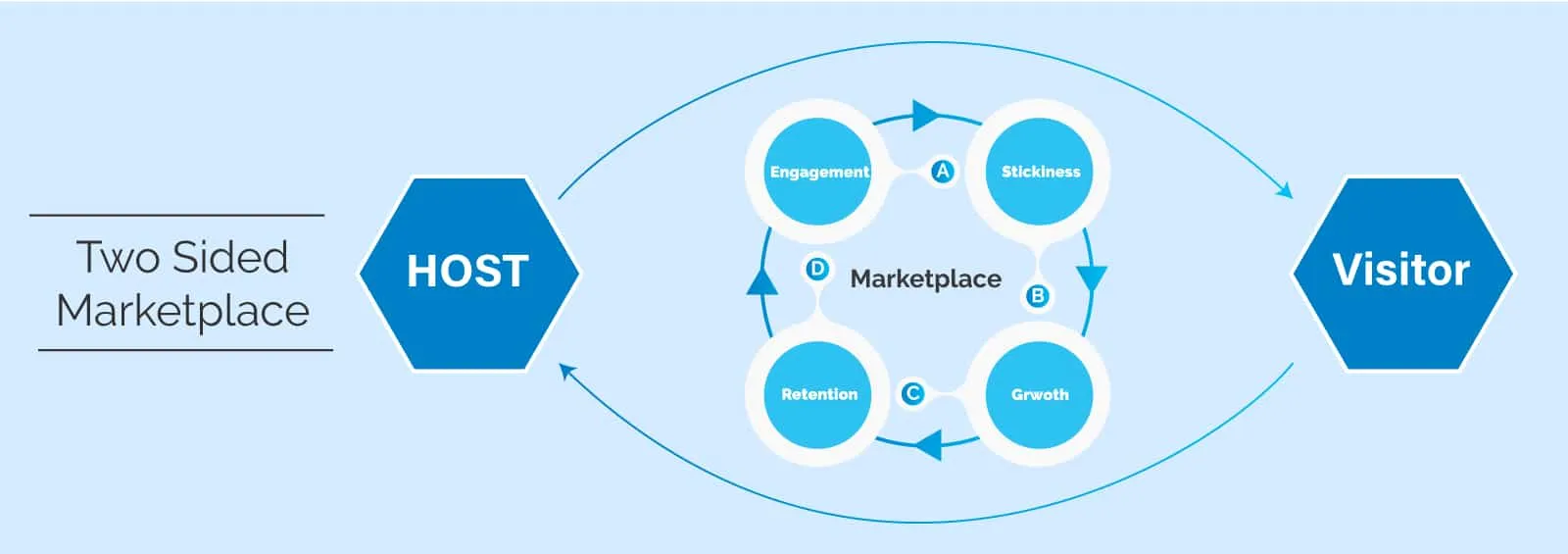
A restaurant with no customers is not much of a business.
A shopping mall with no stores is not much of a destination.
A dating app with only one user is an exercise in solitude.
Some business models derive value from products.
Others derive value from services.
Two-sided marketplaces derive value from something far more delicate.
Participation.
Specifically, participation from two entirely different groups that need each other but often arrive for different reasons.
This dynamic has created some of the most influential businesses in modern commerce.
Yet it has also destroyed countless startups that misunderstood one simple reality.
Attracting one side is difficult.
Attracting two sides simultaneously is exponentially harder.
That challenge sits at the heart of every two-sided marketplace.
And understanding it reveals why these businesses can become extraordinarily valuable once they achieve scale.
A Two-Sided Marketplace Connects Two Distinct Groups
At its simplest, a two-sided marketplace facilitates interaction between two separate participant groups.
Most commonly:
- Buyers and sellers
- Consumers and providers
- Demand and supply
The marketplace itself acts as an intermediary.
It creates the environment where exchange occurs.
The Marketplace Is Not the Product
This distinction matters.
A traditional retailer sells products.
A two-sided marketplace sells access.
It enables participants to find each other efficiently.
The platform becomes infrastructure rather than inventory.
Value Exists Between Participants
The marketplace becomes valuable because participants interact.
Without interaction, value collapses.
This makes marketplace economics fundamentally different from many traditional businesses.
Why They Are Called “Two-Sided”
The name reflects the structure.
Two groups.
Two audiences.
Two sets of incentives.
Buyers Want Different Things Than Sellers
Buyers often seek:
- Selection
- Convenience
- Competitive pricing
- Trust
Sellers often seek:
- Visibility
- Demand
- Revenue opportunities
- Growth
The marketplace must satisfy both simultaneously.
One Side Influences the Other
More sellers attract buyers.
More buyers attract sellers.
This mutual dependence defines the model.
The Marketplace Creates Mutual Value
Successful marketplaces create benefits for both sides.
That sounds obvious.
In practice, it is extraordinarily difficult.
Buyers Benefit From Supply
Greater participation from sellers creates:
- More choices
- Better availability
- Competitive pricing
Buyer value increases.
Sellers Benefit From Demand
Greater buyer participation creates:
- More transactions
- Increased revenue potential
- Improved visibility
Seller value increases.
The strongest marketplaces create a cycle where both sides continuously reinforce each other.
Network Effects Drive Growth
Network effects sit at the center of marketplace economics.
Without them, many marketplaces struggle to scale.
More Sellers Increase Buyer Value
Every additional seller can improve marketplace utility.
Customers gain:
- More options
- More inventory
- More competition
The platform becomes increasingly attractive.
More Buyers Increase Seller Value
Every additional buyer expands potential demand.
That expansion improves marketplace attractiveness for sellers.
Growth becomes self-reinforcing.
At least in theory.
The Cold Start Problem Is the Marketplace’s Greatest Challenge
Every two-sided marketplace begins with a difficult problem.
No participants.
Buyers Need Sellers
Customers rarely join empty marketplaces.
An empty platform provides little value.
Sellers Need Buyers
Sellers rarely join platforms without demand.
Supply follows opportunity.
Demand follows supply.
Each side waits for the other.
This creates what marketplace founders often call the cold start problem.
It is one of the most difficult challenges in business.
Liquidity Matters More Than User Count
Many entrepreneurs focus on growth.
Marketplace operators often focus on liquidity.
Liquidity Measures Activity
A marketplace with thousands of inactive users creates little value.
A marketplace with fewer users but frequent transactions often performs far better.
Matching Efficiency Drives Success
Buyers must find relevant sellers.
Sellers must find relevant buyers.
The speed and quality of those matches matter tremendously.
Liquidity transforms participation into transactions.
Trust Becomes Essential
Two-sided marketplaces often facilitate interactions between strangers.
Trust therefore becomes infrastructure.
Trust Reduces Friction
Without trust:
- Buyers hesitate
- Sellers hesitate
- Transactions decline
With trust:
- Participation increases
- Activity accelerates
- Revenue grows
Trust Systems Create Confidence
Common mechanisms include:
- Reviews
- Ratings
- Verification systems
- Guarantees
These systems create confidence where familiarity does not exist.
Revenue Models in Two-Sided Marketplaces
Once activity develops, monetization becomes possible.
Transaction Fees
The most common model involves commissions.
The marketplace earns revenue when exchanges occur.
Subscriptions
Participants may pay recurring fees for access.
This approach creates predictable revenue.
Advertising
Visibility becomes monetizable.
Sellers pay for exposure.
Premium Features
Enhanced analytics, tools, and services can generate additional income.
The specific model matters less than participation.
Without participation, monetization rarely succeeds.
Comparing Key Components of Two-Sided Marketplaces
| Marketplace Element | Buyer Benefit | Seller Benefit | Business Impact |
|---|---|---|---|
| Search & Discovery | Faster selection | Greater visibility | Higher engagement |
| Reviews & Ratings | Increased trust | Reputation building | Improved liquidity |
| Payments | Convenience | Faster transactions | Revenue generation |
| Verification Systems | Reduced risk | Credibility enhancement | Greater trust |
| Recommendations | Better relevance | Better exposure | Higher conversion |
| Messaging Tools | Better communication | Improved customer interaction | Stronger relationships |
| Analytics | Improved experience | Better decision-making | Ecosystem optimization |
| Customer Support | Reduced friction | Issue resolution | Retention improvement |
The strongest marketplaces optimize multiple components simultaneously.
Marketplace Economics Differ From Traditional Businesses
Traditional companies often scale through assets.
Two-sided marketplaces scale through participation.
Ownership Becomes Less Important
Many marketplaces own little inventory.
Their value emerges from facilitating exchange.
Coordination Creates Competitive Advantage
Efficient coordination can become more valuable than asset ownership.
That reality has reshaped multiple industries.
A Lesson I Learned Watching a Marketplace Struggle
Several years ago, I worked with a startup building a niche marketplace.
The founders were talented.
The technology was impressive.
The user interface looked exceptional.
Growth remained disappointing.
At first, the team focused on improving features.
Then they focused on improving design.
Then they focused on improving marketing.
Nothing produced meaningful results.
Eventually, a different conclusion emerged.
The problem was not technology.
It was imbalance.
The platform had successfully attracted sellers.
Buyers remained scarce.
Without sufficient demand, seller engagement declined.
Without active sellers, buyer experience suffered.
The ecosystem weakened.
The lesson was unforgettable.
Two-sided marketplaces are not technology businesses first.
They are balance businesses.
Success depends on maintaining equilibrium between both sides.
Lose that balance and growth becomes fragile.
Supply and Demand Must Remain Balanced
Marketplace operators constantly manage both sides.
Excess Demand Creates Frustration
Insufficient supply creates:
- Stock shortages
- Limited choices
- Poor experiences
Buyers leave.
Excess Supply Creates Dissatisfaction
Insufficient demand creates:
- Low seller revenue
- Reduced engagement
- Marketplace churn
Sellers leave.
Balance remains essential.
Marketplace Defensibility Comes From Ecosystems
Competitive advantages often emerge over time.
Network Effects Create Resistance
Established marketplaces benefit from participation density.
Replicating participation becomes difficult.
Data Improves Performance
Marketplaces continuously collect insights regarding:
- Behavior
- Preferences
- Demand patterns
These insights improve matching quality.
Improved matching strengthens marketplace value.
Not All Marketplaces Are Product Marketplaces
The concept extends beyond physical goods.
Service Marketplaces
Examples include:
- Freelancers
- Consultants
- Contractors
Asset Marketplaces
Examples include:
- Rental platforms
- Accommodation marketplaces
- Vehicle-sharing platforms
Knowledge Marketplaces
Examples include:
- Educational platforms
- Expert networks
The underlying structure remains consistent.
Two groups.
One platform.
Facilitated exchange.
The Future of Two-Sided Marketplaces
Technology continues evolving.
Artificial intelligence is improving recommendations.
Trust systems are becoming more sophisticated.
Search quality continues advancing.
Yet the core principles remain remarkably stable.
Two-sided marketplaces still depend upon:
- Participation
- Trust
- Liquidity
- Balance
The technology becomes more advanced.
The economics remain surprisingly familiar.
Conclusion: Two-Sided Marketplaces Are Really Businesses of Coordination
Many businesses create value by making something.
Two-sided marketplaces create value by connecting people who need each other.
That distinction seems subtle.
It is not.
It changes everything.
Ownership becomes less important than access.
Inventory becomes less important than liquidity.
Assets become less important than participation.
The marketplace succeeds not because it produces the products being sold.
Nor because it performs every service being offered.
It succeeds because it reduces the distance between supply and demand.
And when that distance becomes sufficiently small, transactions occur naturally.
That is the hidden power of two-sided marketplaces.
They transform disconnected participants into functioning ecosystems.
And once those ecosystems reach meaningful scale, they often become far more valuable than the individual transactions flowing through them.
Because ultimately, the most successful marketplaces do not merely facilitate exchange.
They become the place where exchange begins.
- Arts
- Business
- Computers
- Games
- Health
- Home
- Kids and Teens
- Money
- News
- Personal Development
- Recreation
- Regional
- Reference
- Science
- Shopping
- Society
- Sports
- Бизнес
- Деньги
- Дом
- Досуг
- Здоровье
- Игры
- Искусство
- Источники информации
- Компьютеры
- Личное развитие
- Наука
- Новости и СМИ
- Общество
- Покупки
- Спорт
- Страны и регионы
- World

 Russian
 French
 Spanish
 Portuguese
 Deutsch
 Turkish
 Dutch
Dutch
 Italiano
 Arabic
 Romaian
 Portuguese (Brazil)
 Greek
Greek