
What are decision-making models?
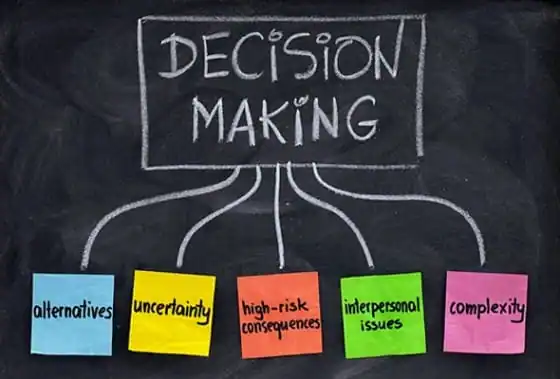
The Architecture of the Map
We walk through the world clutching maps. We are terrified of the uncharted. We believe that if we can just find the perfect framework, the right grid to lay over the chaos of reality, we will be able to navigate the terrain without ever getting lost. We look for decision-making models. We want the algorithm for the human experience.
We seek the matrix, the funnel, the hierarchy. We want the reassurance that if we follow the steps—if we account for the weights, the risks, and the outcomes—we will arrive at the correct destination.
But a map is not the territory. And a model is not a decision.
A model is a filter. It is a way of narrowing your vision so that you can handle the overwhelming nature of infinite choice. But in the act of filtering, you lose the texture. You lose the nuance. You lose the very thing that makes the choice yours. You are trading your sovereignty for the comfort of a pre-fabricated structure.
   [ THE INFINITE FIELD ] (The Chaos of Being)
                 │
                 ▼
   [ THE MODELING ] <─── The attempt to tame the unknown with the intellect.
                 │
                 ▼  (The Sacred Blindness)
   [ THE STRUCTURED LIFE ]
                 │
                 ▼
   [ THE SHADOW ] ──► The truth of your intuition is left behind in the data.
If you live your life through a model, you are living a life of echoes. You are not responding to the world; you are responding to the system you’ve built to manage the world.
The Geography of the Mental Audit
We organize decisions by their frameworks. We have the "Eisenhower Matrix," the "Cost-Benefit Analysis," the "Decision Tree." These are beautiful, logical constructs. They are efficient. They are clean.
And they are almost entirely useless when it comes to the decisions that actually define a life.
The Horizontal Tension (The Search for the Anchor)
Before we adopt a model, we must audit the impulse. What is the source of the desire to use this model?
-
The Audit of the Habitual: We use models to avoid the responsibility of choice. If you follow the model and the outcome is poor, you can blame the model. It is a brilliant way to deflect the weight of your own existence. To audit the model is to realize that you are the one who is choosing, and no amount of logic will ever make that less heavy.
-
The Audit of the Structural: Models thrive in the world of the predictable. They work for building bridges, for managing inventory, for optimizing supply chains. They break in the world of the living. When you try to apply a model to a relationship, to a creative pivot, to a moral dilemma, you are trying to cut the wind with a knife.
The Vertical Extraction (The Deep Descent)
To transcend the model, you must drop down beneath the level of the argument.
-
The silent audit: Take a decision you are currently facing. Apply every model you have. Fill out the matrices. Map the trees. Now, throw the paper away. What is the move that remains? If the answer changes, you were never choosing; you were just calculating.
-
The subtraction of the secondary metric: We categorize decisions by their risk or reward. These are the metrics of the marketplace. They are designed to keep you inside the game. To play outside the game, you must abandon the models and learn to trust the resonance of your own presence.
A Lesson from the Muted Session
In the late nineties, I was working with a CEO who was obsessed with the "Rational Choice Theory." He had built his entire operation on a set of mathematical models. Every hire, every product launch, every marketing pivot was determined by a proprietary algorithm he had spent years perfecting.
He was the most "efficient" person I had ever met. He made decisions with breathtaking speed.
But he was miserable. His company was a success, but the culture was a ghost town. The products were technically perfect, but they had no soul. They were designed to satisfy the model, not to serve the human.
I watched him go through a massive pivot. He had a model that dictated he should liquidate a certain division. The data was undeniable. It was the only logical choice.
"What does it feel like?" I asked him.
"The math is clear," he replied. "The math doesn't have feelings."
"You are the one making the choice," I said. "Not the math. If you do this, you are the one who has to live with the reality of it. Forget the model. If you were the only person affected, would you make the same choice?"
He sat in the silence for a long time. It was the first time I had ever seen him pause. He realized that the model had become a shield, a way to insulate himself from the emotional weight of his own power. He didn't make the move. He chose a different path—one that was harder, one that looked worse on a spreadsheet, but one that allowed him to sleep at night.
[ The Model-Driven Loop ] ──► Feed the Logic / Protect the Ego / The Dead Success
[ The Sovereign Pivot ]    ──► Face the Truth / Own the Result / The Living Work
He learned that the model was a map of a ghost. It told him what he could do, but it had no idea what he should do.
The Landscape of the Sovereign Discernor
Discernment is not about the scale of the model; it is about the presence of the chooser.
| The Arena | The Standardized Technician | The Vertical Auditor | The Sovereign Discernor |
| The Primary Metric | Framework; does this choice align with the logic of the model? | Integration; does this move affect the structural integrity of the life? | Resonance; is this move an alignment with the nature of the reality? |
| The Internal Speed | High-velocity; the race to calculate and dispense with the choice. | Interrupted; the creation of a deliberate vacuum between the stimulus and the choice. | A metronomic stillness that waits for the light to show the path. |
| The Operational Tool | Addition. Bringing more matrices, more logic, and more certainty into the room. | Subtraction. Clearing the table until only the irreducible bone of the truth remains. | An effortless presence that sees the move because it has stopped fighting the terrain. |
| The Human Hazard | Becoming a high-fidelity echo of a narrative that is functionally empty. | Turning into a skeptic who disassembles the process but loses the spirit. | The realization that the decision must serve the spirit, not the ego of the manager. |
The Fortress of the Certified Illusion
There is a clean, sophisticated failure that waits for the person who spends their life curating their own decision-making models. They are the masters of the "strategic framework." They can tell you exactly why they chose the path they did, citing the specific model they employed. They are the experts of the rationalization.
They feel safe because they have built a system. They feel informed because they have categorized the world. But they are never actually living. They are merely curating their own experience from behind the glass of their own system.
   [ THE METRIC CLERK ]      ──► Catalogs the models ──► Asks "Is it proven?"   ──► The Grid of Iron
   [ THE ISOLATED THEORY ]   ──► Debates the method   ──► Asks "Who agrees?"    ──► The Stagnant Water
   [ THE SOVEREIGN WITNESS ] ──► Touches the material ──► Asks "What is true?"  ──► The Clear Ground
If you only use your decision-making to optimize the narrative you were told to carry, you are not living. You are simply becoming a more efficient operator of someone else’s narrow, frightened vision. You are using your intellect to build a more comfortable prison cell for the truth.
The Cleansing of the Room
We do not manufacture the truth. We merely wash the soot off the window so the light can show us where the floorboards are honest.
The institutions will continue to offer you an endless menu of convenient, logical-looking models. They will tell you that the path of the framework is the path of the wise. They will tell you that the sorting of the choices is the measure of the intelligence.
The decision to practice true, sovereign discernment is a radical act of spiritual hygiene.
It is the choice to step into the room and exist without the armor of the model. It is the decision to lay down your need to be "rational" at the threshold, to look at the fork in the road until the noise of your own expectations runs out of fuel, and to wait for the movement that arrives from the marrow of your own bones rather than the manual of the status quo. Trust the silent weight of your own direct presence, drop the obligation to model the world, and let the false structures of the reasoning dissolve in the sun.
- Arts
- Business
- Computers
- Spiele
- Health
- Startseite
- Kids and Teens
- Geld
- News
- Personal Development
- Recreation
- Regional
- Reference
- Science
- Shopping
- Society
- Sports
- Бизнес
- Деньги
- Дом
- Досуг
- Здоровье
- Игры
- Искусство
- Источники информации
- Компьютеры
- Личное развитие
- Наука
- Новости и СМИ
- Общество
- Покупки
- Спорт
- Страны и регионы
- World

 English
 Russian
 French
 Spanish
 Portuguese
 Turkish
 Dutch
Dutch
 Italiano
 Arabic
 Romaian
 Portuguese (Brazil)
 Greek
Greek